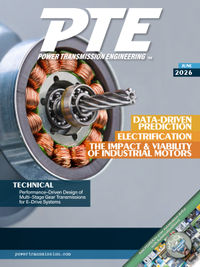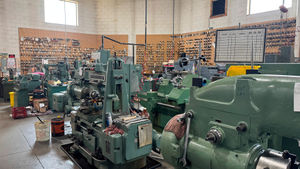
Sadly, we do not currently provide a gigantic, six-volume manufacturing series on the history of gears, bearings, couplings, brakes and motors with descriptions and details that would make the likes of Leo Tolstoy or J.R.R. Tolkien jealous with envy. One day, at the very least, I’d like to put down on paper a travel narrative about the gear and bearing shops I’ve visited since 2008 and the impact each has had on U.S. manufacturing.
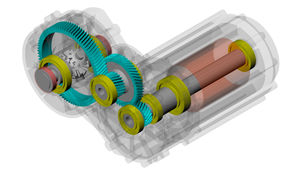
This study investigates the influence of internal damping within drivetrain components.

Helix develops motors, inverters, and e-powertrains for a diverse range of industries including automotive, marine, and aerospace. The company’s expertise, founded in decades of elite engineering experience, provides a diverse range of engineering technologies from a single-source.
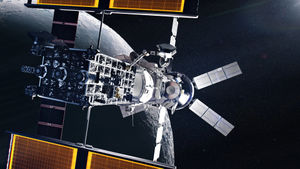
NASA’s successful Artemis II mission represented the first crewed lunar mission since Apollo 17 in 1972 as well as a major leap forward in humanity’s return to deep space exploration. The mission launched on April 1, 2026, and lasted approximately nine days, one hour and 32 minutes.
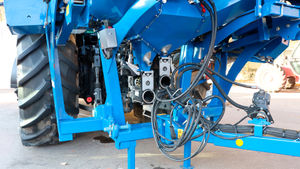
The hydraulics market is very mature, according to Terry Hershberger, mobile hydraulics technology leader, Bosch Rexroth. So mature, in fact, changes occurring from an innovation standpoint come in smaller and smaller increments on the hardware side. Today, it’s all about bundling components in new ways and focusing on advancements in electrohydraulics and sensor technology.
The belt and chain market is heavily driven by intralogistics, automation and infrastructure growth in 2026. Manufacturers are looking at areas like electrification, sustainability and supply chain resilience to meet stricter performance expectations. PTE recently sat down with Kyo Oh, vice president and general manager at AMMEGA Group Power Transmission and Fluid Power Solutions, to discuss the U.S. belt market from a power transmission perspective.
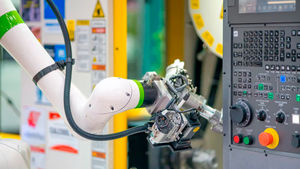
Freudenberg Sealing Technologies (FST) continues to expand its seal and lubrication technology platform by providing a range of solutions addressing critical issues such as friction, performance, power and material compatibility. The following article examines three recent additions to the company’s broad range of system solutions.
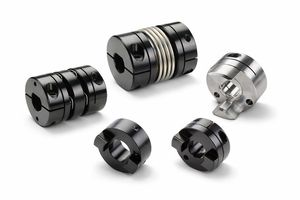
Ruland has introduced D-bore couplings designed to engage directly with D-profile shafting to prevent slippage in critical motion-control applications such as semiconductor equipment, medical devices, and factory or warehouse automation systems. The couplings are available in disc, jaw, bellows, and oldham styles, allowing engineers to select the coupling type best suited to their application requirements.
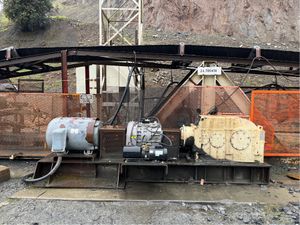
Conveyors are critical equipment at aggregate plants. Downhill conveyors, loaded with tons of material, don’t leave much room for error. When brakes fail and a belt gets away, the result is immediate and dangerous. Material moves where it shouldn’t, and equipment takes the hit. Unfortunately, that’s exactly what happened recently at an Oregon aggregate plant. A brake failure caused a loaded belt to let loose, damaging both the belt and sections of the conveyor framework. Operators responded with front loaders and dump trucks, making repeated trips up and down the incline to clear material. The plant was down. With replacement parts carrying lead times of up to 20 weeks, there was real concern about how long it might stay that way.
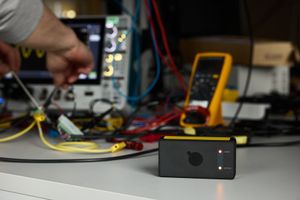
While the AI boom has made robots significantly more capable, the accompanying safety infrastructure has struggled to keep pace. Traditional 2D laser scanners, which are widely used to define safety perimeters for most mobile robotic systems, are unable to detect people and obstacles above or below a single plane.
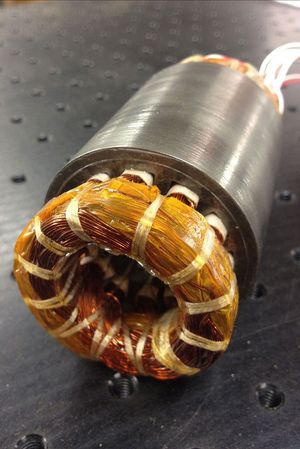
Arnold Magnetic Technologies Corp. introduced the next generation of high-efficiency electric machines with its Arnon non-grain oriented electrical steel (NGOES). Engineered for ultra-thin lamination and precision finish, Arnon helps manufacturers design smaller, lighter and more energy-efficient motors, generators and transformers, reducing core losses and improving performance at high speeds and frequencies.

The Düsseldorf-based cybersecurity company Onekey has developed digital twin technology that enables automated scans to monitor firmware around the clock. Onekey's monitoring system reanalyzes the firmware daily to ensure continuous security throughout its entire lifecycle. When new vulnerabilities arise, the constantly updated database and enhanced detection capabilities alert users to critical developments that could compromise a product’s security.
Eaton has entered into a definitive agreement with Dana Incorporated under which Eaton will separate and combine its Mobility Group with Dana in a Reverse Morris Trust (RMT) transaction creating a combined company valued at over $10 billion.

SKF has announced a strategic investment, together with Stephen Industries and Chalmers Ventures, in startup Anferra AB to tackle one of the industrial sector's most persistent waste challenges – hazardous steel grinding sludge.



Contact | Privacy Policy
©2026 Power Transmission Engineering
 Power Transmission Engineering is THE magazine of mechanical components. PTE is written for engineers and maintenance pros who specify, purchase and use gears, gear drives, bearings, motors, couplings, clutches, lubrication, seals and all other types of mechanical power transmission and motion control components.