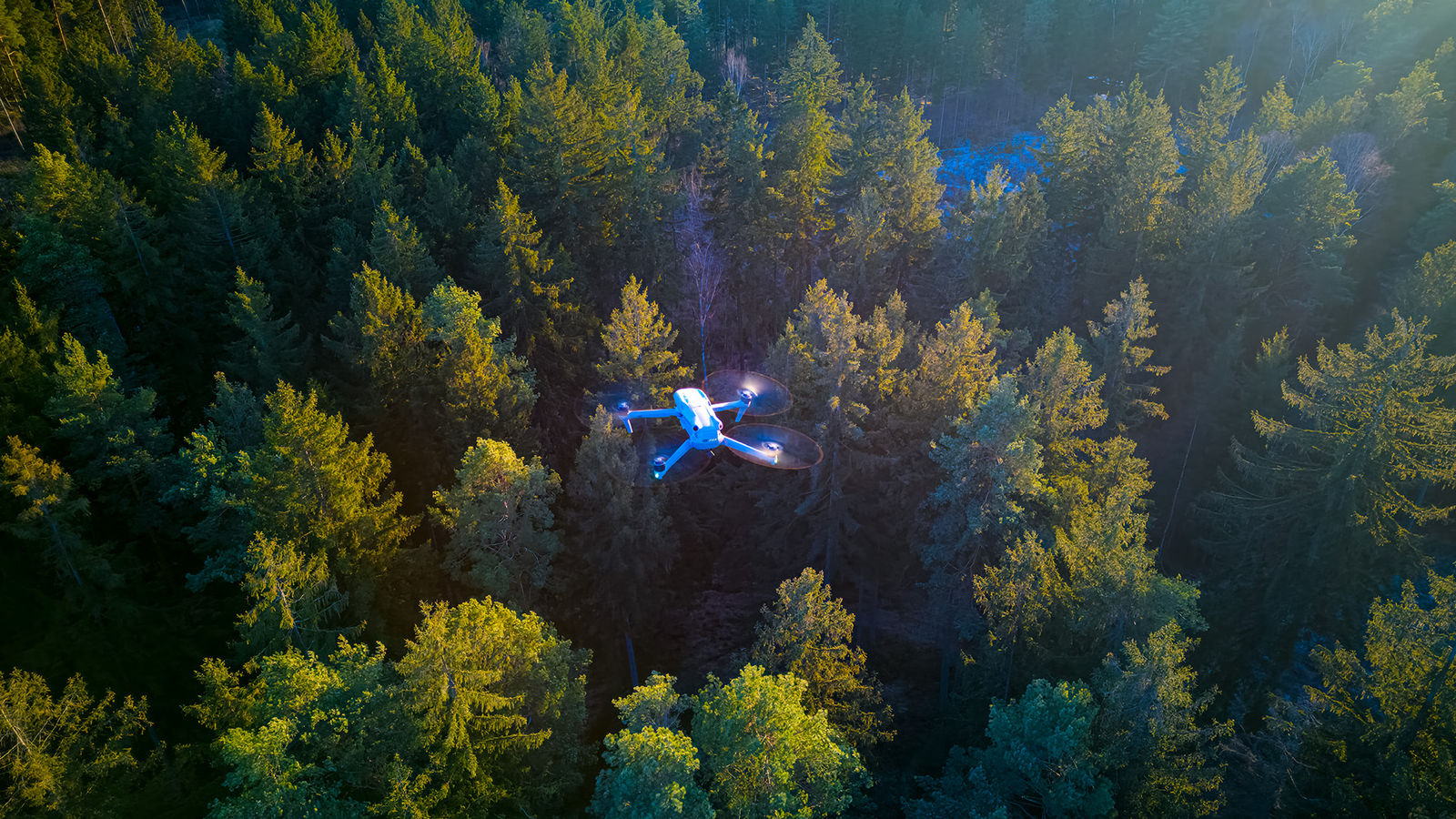
Drones are tasked with providing state-of-the-art autonomous capabilities, unique movements, automated inspection, urban delivery solutions and advanced military operations. They upgrade agricultural farming technology, provide safety and logistic solutions and report key disaster and engineering mapping. PT components such as motors, controllers, and sensors are an integral part of their core structure.
Brushless motors spin the propellers, electronic speed controllers regulate the power based on control signals and the sensors are utilized for flight control, navigation and obstacle avoidance. In short, mechanical power transmission components help pave the way for these devices to transform into intelligent autonomous tools.
Nearthlab’s Drone First Responder (DFR) station, for example, is a leap forward in autonomous emergency response, seamlessly integrating with law enforcement systems to launch drones, obtain flight authorization, and respond in real-time to incidents. The company has also received recognition for its high-speed military interceptor drone.
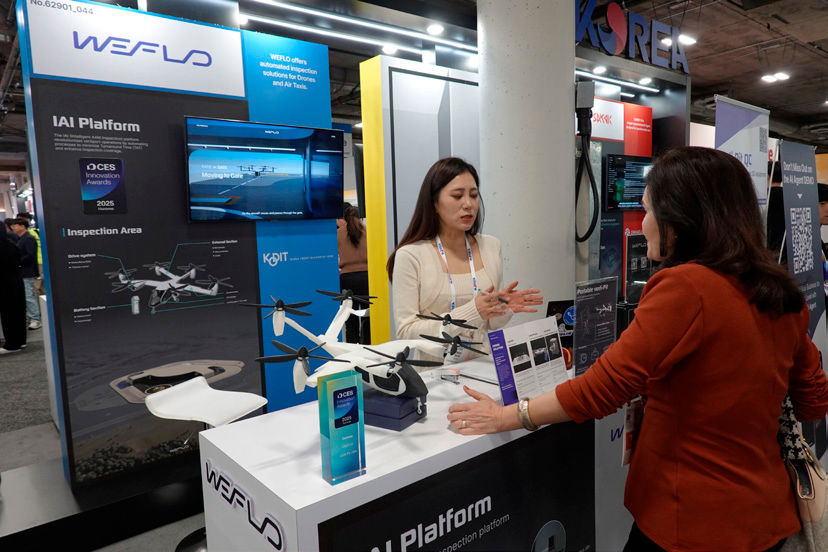
WEFLO’s Verti-Pit Mini offers an AI-powered, non-contact drone inspection system that eliminates manual checks, enabling predictive maintenance and fault detection through advanced diagnostics, streamlining operations and enhancing drone reliability across industries.
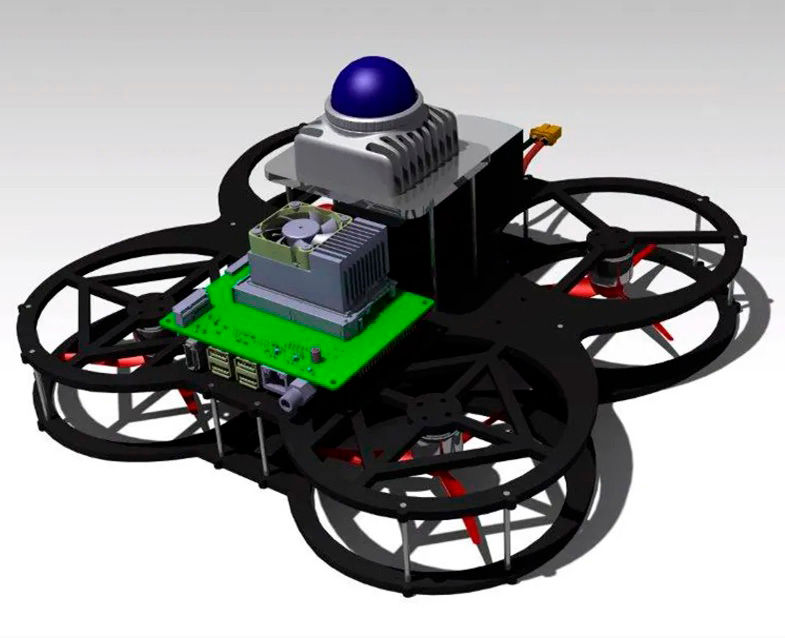
Sky Flight/Hanseo University’s advanced underground drone uses 360-degree LiDAR to navigate GPS-deprived environments, capturing detailed 3D maps and transmitting critical data for infrastructure inspection, mine exploration, and disaster response.
AIRUS/Hanseo University’s bladeless drone provides a quieter, safer, and smarter urban delivery solution with AI-powered systems, real-time monitoring, and the ability to carry up to 10 kg of sensitive cargo, offering a glimpse into the future of sustainable city logistics.
Nearthlab recently won an award in the Robotics and Aerial Integration for Defense (RAID) Challenge in the tactical UAV category. Hosted by the Ministry of National Defense of Korea, the challenge examined the military potential of drone technology and provided a pathway for high-performing drones to be considered for military procurement.
The competition assessed drones in two areas: their ability to track and neutralize a fixed-wing target over a 1 km distance, and the effectiveness of swarm operations, in which a single operator managed at least five drones working together to identify and engage a target.
Nearthlab’s Kaiden, a high-speed kinetic interceptor drone, reached a top speed of 150 mph (250 km/h) as it closed in on a target equipped with obstacle avoidance technology. Guided by advanced autopilot algorithms, Kaiden executed precise maneuvers to track the target even as it engaged in sudden evasive attempts. The demonstration highlighted the drone’s ability to carry out all necessary actions to neutralize the target with speed and precision. Meanwhile, Nearthlab’s autonomous drone, Aiden, excelled in swarm operations, seamlessly coordinating with other drones to locate targets.
“Drones are rapidly becoming a cornerstone of modern warfare,” said Jay Choi, co-founder and CEO of Nearthlab. “This competition was a great opportunity to showcase what our drones can do, and we’re excited about the role technologies like Aiden and Kaiden could play in shaping the future of defense.”
“It’s deeply meaningful to see Korean-built autonomous flight technology recognized at a national level,” said Youngsuk Chung, chief technology officer at Nearthlab. “We’ll keep driving the convergence of AI and robotics to deliver technologies that make industries more resilient.”
Drone Maintenance and Health
In 2025, WEFLO introduced the AI-based smart drone quality management equipment Verti-Pit QC at CES in Las Vegas. The Verti-Pit QC can automatically check mechanical defects within seconds without flying drones directly during the end-of-line (EoL) process in the production stage, dramatically increasing production efficiency compared to conventional flying test methods. It is evaluated as an essential solution for drone manufacturers trying to establish a mass production system.
Since spinning off from Hanwha Systems in 2022, WEFLO has been developing solutions capable of diagnosing the health of electric mobility—starting with drones and expanding to air taxis (UAM) and electric vehicles—using AI non-contact methods. WEFLO’s AI diagnostic solution is being continuously advanced through deployment to mobility manufacturers and operators. The scope of diagnosis is expanding beyond the conventional areas of propulsion and structural components to include batteries, geomagnetic accelerometers and gyro sensors. WEFLO has recently achieved recognition for its technological prowess by being selected for a KITIA (Korea Information and Communications Technology Association) project.
Additionally, the Verti-Pit Mini won the Innovation Award in the drone category at CES 2025. The Verti-Pit Mini is a portable inspection solution that quickly and accurately diagnoses the condition of small drones in a non-contact manner through a multi-modal sensor developed by itself. Recently, demand has been confirmed in the defense field, where drones must be used in the field based on missions, and it is expected to be used in various fields.
WEFLO CEO, Yee Jung Kim, stated, “We will continue to maximize customer operating efficiency through tightly integrated AI and hardware solutions, set the predictive maintenance standards for the future mobility industry, including drones, and actively target the global market.”
The Underground Advantage
[advertisement]
Sky Flight/Hanseo University’s underground drone can perform autonomous flight by utilizing LiDAR in environments where GPS signals are unavailable, creating real-time 3D maps of the surroundings and estimating their position. In irregular underground environments, the drone uses 360-degree LiDAR to comprehensively capture the entire surroundings, detecting obstacles and preventing collisions.
The underground drone is equipped with AI-based imaging capabilities, enabling it to transmit essential exploration data for mining or detect structural defects in underground infrastructure to the ground station in real-time. This technology mitigates risks during dangerous tasks and supports real-time terrain analysis and rescue operations in GPS-unavailable disaster scenarios.
In a technical article, “Signal-Based Self-Organization of a Chain of UAVs for Subterranean Exploration,” written by Laclau P., Tempez V., Ruffier F., Natalizio E. and Mouret J-B in 2021, the authors explored how thousands of subterranean networks permeate the underground: caves, utility tunnels, abandoned mines, underground quarries, sewers, etc. These voids often need to be mapped and inspected, typically to ensure the safety of new buildings or tunnels, but also in case of obstruction or intrusions. Drones are a promising alternative as they can move through these subterranean networks faster and more efficiently than humans or ground robots.
The underground drone is equipped with AI-based imaging capabilities, enabling it to transmit essential exploration data for mining or detect structural defects in underground infrastructure to the ground station in real-time.
New Propulsion Technology
The Bladeless Drone by Airus and Hanseo University is an innovative unmanned aerial vehicle that enhances safety and quietness through its bladeless propulsion technology. Its design eliminates propellers, reducing noise by over 40 percent, making it ideal for urban environments. Capable of carrying up to 10 kg of cargo, it utilizes an AI-based smart flight system and smart air cargo system to safely and accurately deliver sensitive items like food and medicine in complex urban settings. Equipped with real-time monitoring, it tracks delivery routes and status. The Bladeless Drone presents a key solution for future logistics innovation and provides more advanced robotic functionality and AI integration.
In 2025, WEFLO introduced the AI-based smart drone quality management equipment Verti-Pit QC at CES inLas Vegas.
Rewriting the Technology Rules
Per Cornell University Press, The Remote Revolution: Drones and Modern Statecraft by Erik Lin-Greenberg shows that drones are rewriting the rules of international security. Emerging technologies like drones are often believed to increase the likelihood of crises and war. By lowering the potential risks and human costs of military operations, they encourage decision-makers to deploy military force. Yet as Lin-Greenberg contends, operations involving drones are in fact less likely to evolve into broader, more intense conflicts than similar operations involving traditionally crewed assets. Even as drones increase the frequency of conflict, the decreased costs of their operations reduce the likelihood of conflict escalation.
Leveraging diverse types of evidence from original wargames, survey experiments, and cases of US and Israeli drone operations, Lin-Greenberg explores how drone operations lower risks of escalation. First, they enable states to gather more or better intelligence that may avert or reduce the chances of high-stakes conflict. Second, drone attacks are less likely to affront a target state's honor and therefore less likely to provoke aggressive responses. Lastly, leaders are less likely to take escalatory actions when drones are attacked than they are with incidents involving inhabited assets.
It’s a fascinating read if you have an opportunity to check it out. With the use of unmanned technologies growing rapidly, The Remote Revolution looks at modern and future warfare from a different point of view and hints at ways to rethink military strategy in the future.
On the Horizon
Drone technology was again front and center this January at CES in Las Vegas. Military operations and the recent FCC ban of the sale of drones from Chinese firm DJI added some political intrigue to the technology show.
This ban could affect drone maintenance and repair operations and make it difficult to obtain critical drone components. If you’re working on drone technology here in the United States, we’d love to hear your story and discuss the prospects of the commercial drone and air mobility ecosystem.
[advertisement]
×
Like What You see?
Power Transmission Engineering is THE magazine of mechanical components. PTE is written for engineers and maintenance pros who specify, purchase and use gears, gear drives, bearings, motors, couplings, clutches, lubrication, seals and all other types of mechanical power transmission and motion control components.
*Unsubscribe any time. Full details in our privacy policy








 Power Transmission Engineering is THE magazine of mechanical components. PTE is written for engineers and maintenance pros who specify, purchase and use gears, gear drives, bearings, motors, couplings, clutches, lubrication, seals and all other types of mechanical power transmission and motion control components.