
[advertisement]
Feature Articles

March 4, 2026


Matthew Jaster


Feature Articles

On the Fly Rebuild

Atlanta Gear Works takes on tight deadline for vertical mill drive project

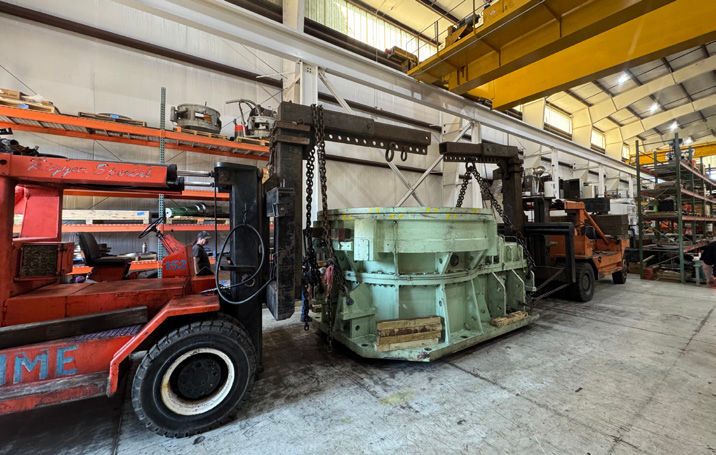
Atlanta Gear Works brought in a rigger with two 100,000-pound capacity forklifts to remove the gearbox from the trailer (all photos courtesy of Atlanta Gear Works).

The call came into Atlanta Gear Works like any other—a vertical mill drive used for a crusher application in cement needed a gearbox upgrade. The difference this time was the sheer size and scope of the gearbox in question. Similarly-sized gearbox rebuilds could take a month or more to complete, but Atlanta Gear Works had 14 days to complete this rebuild—counting weekends—with a tight schedule leaving no room for error.

“Several accommodations were required at the beginning,” said Taylor Sims, senior engineer, at Atlanta Gear Works. “Size, weight, tooling, personnel were all critical factors. We needed to ensure we had the lifting capacity and the proper space to disassemble and reassemble the gearbox in the shop.”


We had seven other gearboxes being assembled and four other gearboxes being torn down. Plus, a machine shop that is making parts daily for everything we need. It took a total team effort.

      Taylor Sims, senior engineer, Atlanta Gear Works


A Logistical Challenge

At the outset, the biggest challenge was the weight of the gearbox. It was the heaviest one Atlanta Gear had ever worked on and required flexibility in the shop.

“We have a 50-ton overhead crane on rails in our main assembly building, but we could only lift individual components for this job,” Sims said. “Getting the gearbox to the shop, off the trailer and into the building was a pretty big undertaking.”

Share and save:


This article appeared in the March 2026 issue.


Read PDF

[advertisement]

Atlanta Gear Works needed special permitting and custom trucks and trailers just to get the gearbox to the shop. Even with the company’s high-capacity cranes and forklifts, they could not lift the entire 145,000-pound gearbox off the trailer.

“We brought in a rigger with two 100,000-pound capacity forklifts to remove it from the trailer and into the building. Once the gearbox was inside the building, our equipment was able to move it piece by piece,” Sims said.

Craig Massa, vice president-sales, Atlanta Gear Works, said manpower was another critical challenge. Did they have enough personnel to work on this new rebuild? Would the size of the gearbox interfere with other projects taking place on the shop floor?

“We had seven other gearboxes being assembled and four other gearboxes being torn down,” Sims added. “Plus, a machine shop that is making parts daily for everything we need. It took a total team effort.”

Flender sent an experienced German gearbox technician from Canada who supplied Atlanta Gear Works with tech support and drawings that saved additional time.

Sims said the key to meeting the tight deadline was being prepared during the planning phase.

“Before the gearbox arrived, we formulated an action plan, purchased some special tooling for disassembly and assembly and knew exactly who would be responsible for what on the shop floor,” Sims said.

Luckily, they had history with both the customer and the vertical mill drive. Atlanta Gear Works had detailed engineering notes from looking at the gearbox the year before. This gave the company a headstart on the project.

Atlanta Gear Works personnel repair the housing lid bore.

Increased Repair

After disassembly, they discovered further equipment damage they had not anticipated, all of which required extra work with no additional time allotted.

Sims said damage from a previous build prevented the hydraulic fit from being utilized to remove the table. Before the rebuild could proceed, they had to add the task of configuring a strongback and a hydraulic ram that were powerful enough to remove the table without the hydraulic fit.

[advertisement]

Additionally, the output shaft extension side bearing bore was damaged from a bearing spinning in the bore. They repaired the bore by machining out the damaged section and inserting a sleeve. The housing section weighed 30,000 pounds, which they were able to accommodate in a CNC horizontal boring mill. The machine shop’s resourcefulness enabled Atlanta to repair the housing to OEM specifications.

One challenge requiring extra hours occurred when the customer supplied an OEM Babbit bearing assembly that was incorrect for the gearbox. Seven of the twelve Babbit pads were missing machining features critical for operation. To remain on schedule, AGW’s machine shop worked through the night to machine the pads for installation the next morning.

One of the greatest challenges was the weight of the gearbox itself and required flexibility in the shop to perform the necessary upgrades.

All Hands on Deck

Sims said the gearbox rebuild required everyone’s assistance across the shop. “Everyone in the company needed to contribute to help reach the finish line.”

He added that people on the project were selected from various departments so as not to deplete any one group. Several employees worked extra hours even on weekends.

“Throughout the project, they were resourceful in solving countless unanticipated problems and stayed committed to a job well done even when it required sacrificing personal time to accomplish it,” said CEO Jack Conway.

Atlanta Gear Works has invested in machine technology in recent years including four Kapp Niles grinding machines, four CNC Mazak lathes and other machine tools for gear cutting, grinding, checking, inspection, testing, dynamic balancing and more.

Safety was an important aspect with so many moving parts to this project.

“Flender’s ideology is like ours. We know how critical it is to keep the environment clean and keep the parts clean during reassembly. We try to follow that kind of thought process,” Sims said.

Disassembling the gearbox.

With years of experience working with Flender equipment, Atlanta Gear Works recently became certified as an official Flender Service Partner. The company underwent a rigorous two-day audit that covered everything from its environmental, health and safety plans to its manufacturing procedures and operations, including data control, training and even the cleanliness of the facility.

“The two companies share similar protocols when it comes to safety, and our experience working with Flender has given us an edge when it comes to updating or refurbishing any of their equipment,” Sims said.

The most satisfying element of this project was knowing Atlanta Gear Works has the capabilities and engineering knowledge at their disposal to work on these heavy-duty applications in the future, fast and efficiently.

“It’s the confidence in completing a project like this under a strict deadline,” Sims said. “This is the biggest one we have done, but I am sure we will be taking on bigger gearbox projects in the future. Knowing we have the right personnel and equipment in place to keep these projects running smoothly certainly helps.”

atlantagear.com

[advertisement]

×

Like What You see?

Power Transmission Engineering magazinePower Transmission Engineering is THE magazine of mechanical components. PTE is written for engineers and maintenance pros who specify, purchase and use gears, gear drives, bearings, motors, couplings, clutches, lubrication, seals and all other types of mechanical power transmission and motion control components.

E-mail

Choose at least one from the options below:

 Power Transmission Engineering magazine, published 8 times per year (print or digital).

 Power Transmission Engineering e-mail newsletter, published weekly.

 Special Offers and promotions via e-mail from Power Transmission Engineering's advertisers and partners.

*Unsubscribe any time.
Full details in our privacy policy
Already a subscriber? Log in