
The Year Ahead in Robotics
A3 examines adoption advancements and education
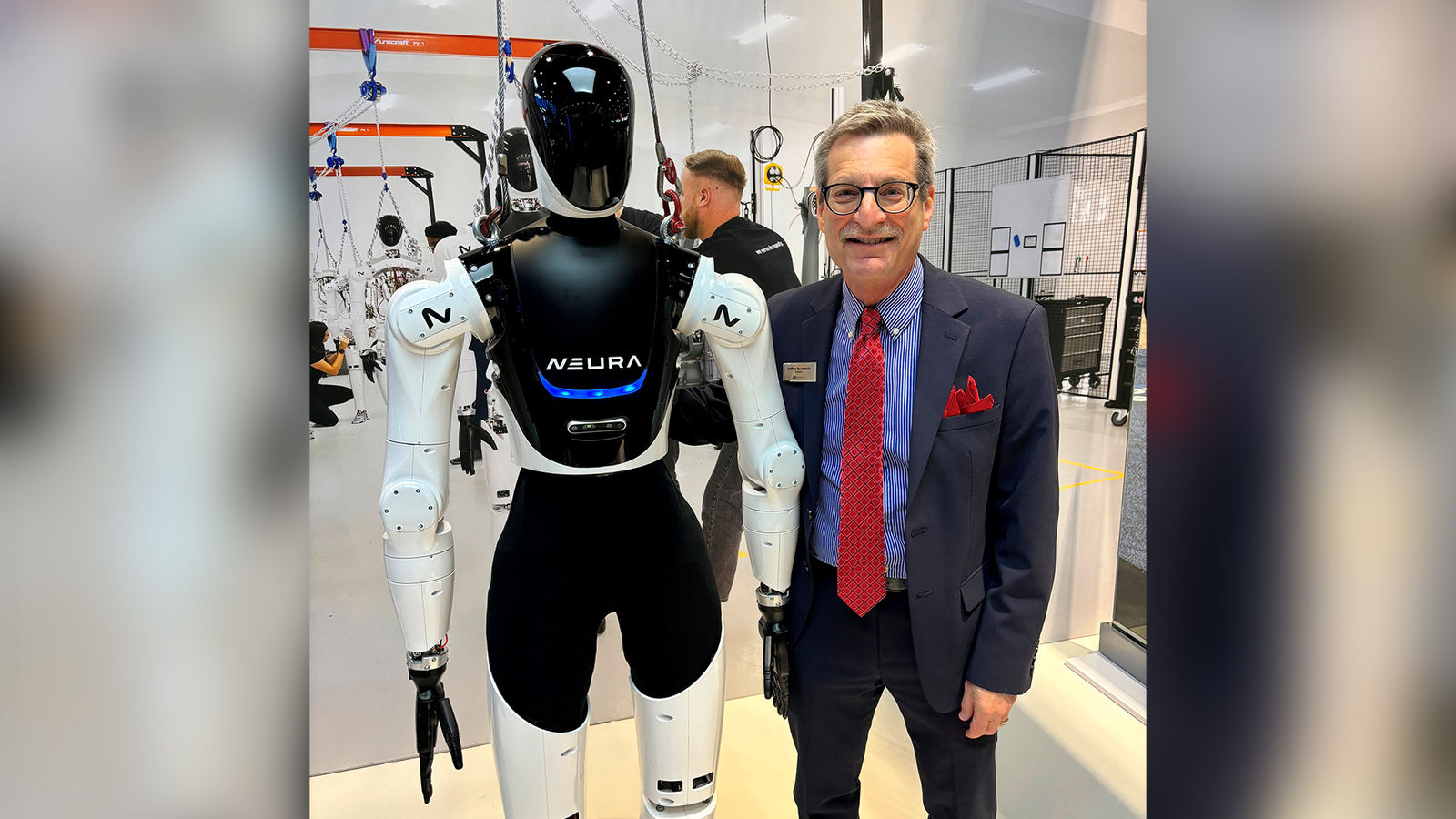
Jeff Burnstein stands with a humanoid robot from NEURA. (All Photos: A3)
As someone who has spent more than four decades involved in the robotics industry, I can say unequivocally that this is the most exciting time ever. From a technology that was originally used predominantly by U.S. automotive companies, robotics has now spread to nearly every industry and every country around the world.
Advances in artificial intelligence and robotics have created enormous interest from the press, public and policy makers. We’re now constantly hearing about “physical AI,” which essentially means giving robots the intelligence to perform far more tasks than ever before, even without being programmed. The real fascination now is around humanoid robots, in part because of the battle for global leadership in this emerging space.
This year A3 is focused on several key projects related to advancing the adoption of robotics and to educating people about what’s real and what’s hype in this brave new world of robotics. Here are three main areas of emphasis for 2026:
1. Advocating for a U.S. National Robotics Strategy
Robotics was invented in the United States. The first industrial robot was installed in a General Motors plant in 1961. Robots were going to be the next “industrial revolution.” But even as the industry grew in the United States, adoption was accelerating faster in Japan, where robotics was more fully embraced by industry and the Japanese government. Japanese robot makers like Kawsaki, Fanuc, and Yaskawa became major players. Our trade association urged U.S. government leaders to provide more incentives for adopting robots or risk losing leadership to Japan. Ultimately, our advocacy efforts fell on deaf ears, and Japan indeed became the world leader, in large part due to government support.
Fast forward 25 years or so and it was China that realized it needed to become a leader in adopting robotics. National strategies were put in place to become not only the world’s leaders in the use of robots but ultimately to become the world’s leading manufacturer of robots. And while that second goal may not have been achieved yet, the first goal was. China now dwarfs the rest of the world in robot use and the number of robots manufactured locally is rising fast. In the new field of humanoid robots, China is moving quickly to establish leadership.
What’s New at Automate 2026
[advertisement]
As artificial intelligence and robotics accelerate across manufacturing, logistics, healthcare, energy and other industrial sectors, Automate 2026 (June 22–25, 2026) will bring together the companies and leaders shaping the next era of automation. The 2026 event returns to McCormick Place in Chicago. This four-day trade show and conference will showcase robotics, AI, machine vision, motion control and advanced automation technologies across multiple industries. Key areas of interest will include industry data and trend briefings, product launches and technology demonstrations, interviews with CEOs, founders and engineering leaders and workforce and AI policy discussions shaping U.S. competitiveness. A new development at the 2026 show is a dedicated Humanoid Robot Pavilion, sponsored by NVIDIA. The pavilion will spotlight a range of humanoid robots and offer live demonstrations. The event also co-locates the third annual Humanoid Robot Forum, offering deep-dive programming on humanoid development, deployment and enabling technologies. Automation investment is increasingly critical to manufacturing competitiveness, supply chain resilience and workforce transformation. Automate provides a concentrated look at:
For business, technology and workforce reporters, Automate offers direct access to timely data, real-world case studies and national economic context. |




A3 is once again advocating for a national robotics strategy in the United States, but this time policy makers are listening. Recently more than one piece of legislation has been introduced, including the National Commission on Robotics Act (H.R. 7334) which we believe, if passed, would be the first step towards on the path to a full U.S. robotics strategy. Here is a link to the full text of our strategy recommendations: https://www.automate.org/a3/advocacy-principles
The U.S. government is also considering Executive Orders on robotics and is conducting a 232 National Security Investigation into Foreign Robots and Components which could lead to additional tariffs on products made outside of the United States. We believe that in the near-term, if the United States is going to successfully reshore manufacturing at scale, we’ll need a tremendous amount of automation, much of which is manufactured in allied nations like Japan, Germany and South Korea. Many of the components aren’t readily available in the United States and we will need time to build a stronger supply chain. Increased adoption of robotics would potentially lead more companies to manufacture here, another reason why the United States should consider incentivizing companies to adopt robotics. Therefore, we have not advocated for additional tariffs on traditional industrial robots and key components such as motors, gears, and bearings.
2. Educating the World on Humanoid Robots
Humanoids are all the rage, as major companies and venture firms are pouring billions of dollars into startups. The Chinese government is going all in as well in the hopes of establishing leadership in this emerging field. Elon Musk, who says Tesla plans to build millions of humanoids soon, believes that eventually everyone on the planet will have one or more humanoid robots, that they will do all the work, leaving us with free time to do anything else we want. Is this the future? Maybe. But there is plenty of skepticism as well. What is the best form factor of a humanoid and what can it do better than an existing robot? Does it need to walk on two legs, or is a humanlike torso on a mobile base a better solution? Are two arms the right number, maybe it should have one, or three, or more? Is a humanoid robot safe enough to work around people (there are no standards yet, but A3 and others are working on this)? What will humanoids cost in comparison to other types of robots? Will humanoids be accurate enough to meet customer needs? Will AI allow humanoids to do every task, and if so, will that be more valuable than a single-purpose robot? Will insurance companies insure humanoid applications? What impact will humanoids have on the jobs of the future? Do people trust humanoids in their homes? What happens if the home humanoid breaks down, or falls on our children or pets?
These are just some of the questions we’ll discuss at our annual Humanoid Robot Forum on June 23 & 24 during the Automate 2026 trade show and conference at McCormick Place in Chicago, running June 22–25. The show floor will feature a Humanoid Robot Pavilion sponsored by NVIDA. Automate 2026 also includes over 1,000 exhibitors showcasing all types of robots, motion control and motor technology, machine vision, artificial intelligence, systems integrators and more. The concurrent Conference covers a wide range of topics to help companies just starting their automation journey as well as experienced users looking to expand their use of automation. More than 50,000 registrants are expected for Automate 2026 (automateshow.com)

3. The Importance of Adopting Robotics
In the early days of robotics in the United States more than 75 percent of the robots were sold to the automotive industry. Today, the numbers are about 50 percent to automotive and 50 percent to general industry, which includes electronics, consumer goods, food & beverage, pharmaceuticals, aerospace and more. In recent years we’re seeing nearly every industry adopt robots including life sciences, agriculture, construction, warehousing & logistics, hospitals and more. This is true globally as well, as robots are no longer confined to manufacturing applications. Robots also aren’t just for big companies anymore; costs and complexity have been reduced, allowing for more applications by small and medium sized companies.



 Power Transmission Engineering is THE magazine of mechanical components. PTE is written for engineers and maintenance pros who specify, purchase and use gears, gear drives, bearings, motors, couplings, clutches, lubrication, seals and all other types of mechanical power transmission and motion control components.