38 results for "fva-workbench" ( Sorted by relevance. Sort by date )

Technical sales personnel use intelligent features to select suitable motor-gearbox combinations and run calculations based on customer-specific operating data. This provides obvious added value for the customer. Service lives, safeties, and expected loads can all be determined in a short time. Maintenance of the underlying database and the use of simulation tools make it possible to quickly and easily perform technical calculations without having to rely on a central calculation department. In less than a minute, the customer is provided with a data sheet which includes reliable statements about the gearbox based on these technical calculations.


With the release of version 9, the FVA-Workbench once again sets new standards in gearbox design, enabling the seamless integration of the latest research results into industrial practice. As a groundbreaking interface between collective research and application, the FVA-Workbench accelerates development and innovation in drive technology. This new release is more powerful than ever, with innovative features for flexible load spectra and improvements in FEM components and shaft-hub connections.

FVA-Workbench 11.0.0 is now available. This manufacturer-neutral simulation platform for modeling, parameterization, and calculation of transmission systems has been enhanced with numerous new features.

The FVA-Workbench is a manufacturer-neutral solution for modeling, parameterization, and simulation of transmission systems. Version 10 was released on February 17, 2025, to make gearbox design even more efficient. For drive technology professionals, the FVA-Workbench is an indispensable tool for reliable modeling, calculation, and optimization of complex drive systems and transmission elements. The software bundles 50 years of research and development from the FVA expert network into a single platform, making its collected knowledge directly applicable for industrial practice.

Oversized drivetrains are inefficient and waste resources. The FVA-Workbench helps you turn real-world load data into actionable insights in just a few steps. Discover how intuitive workflows lead to lighter, safer, and more efficient drivetrains.

Rolling bearing calculations are usually based on the assumption of ideal nominal geometries. However, actual components and assemblies are always subject to statically distributed geometric deviations resulting from the manufacturing and assembly processes. This leads to changes in the internal geometric conditions which have an effect on bearing characteristics such as the service life. The FVA-Workbench makes it possible for users to consider these geometric deviations in bearing calculations for more reliable results.

Stöber Antriebstechnik GmbH + Co. KG rely on the FVA-Workbench for dimensioning and verification of their drives. The calculation and simulation software allows Stöber engineers to develop their innovative gear unit solutions more quickly and efficiently. The result: higher quality products.

FVA GmbH has released mechanicus, an intuitive online calculation tool for machine elements and standard calculations. The new web application is available for free now here and marks a significant milestone in the world of drive technology.


For optimal gear design in accordance with requirements, it is essential to consider load spectra under the most realistic conditions possible as early as the virtual basic design phase. This is the only way to ensure that all components are loaded as evenly as possible to avoid overdimensioning.
Optimized design saves resources and costs and improves the CO2 balance – an aspect that is becoming increasingly important in the current environment and can offer a competitive advantage. Load spectrum calculations are also important for replacing complex time and cost-intensive experiments by simulating test rig damage tests.

The goal of increasing the power density of a gear unit demands that extraneous material reserves can be detected and reduced to the necessary level. In this context, it is important to know the influences acting on the gear unit and the resulting loads. FVA examines the precise knowledge of the longitudinal load distribution in the gear meshes during operation, and specification of suitable microgeometries for its optimization, play a decisive role.

Developing a new gearbox series is costly and time-consuming. This is especially true in marine propulsion, as classification society certifications must be achieved in addition to the required verifications. For this reason, Reintjes offers the same drives for various types of ships. In gearbox development, this means that each application requires different loads and usage profiles, with different service lives and maintenance intervals. Thus, each drive must be designed and calculated with advance consideration of every possible profile.

The latest version offers a wide range of powerful new features, from a new gear design module, to the influence of the wheel body during a complete rollover, to new display options for 3D images and animation of the gearbox kinematics in reports.
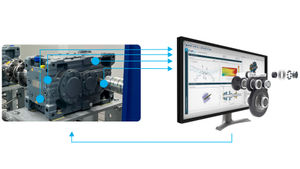
The digital transformation is fundamentally changing the industry, and digital twins play a central role. They enable real-time monitoring of physical systems, simulation of their behavior, and informed decision-making. A dissertation from the TU Darmstadt Institute for Product Development and Machine Elements (pmd) shows how the FVA-Workbench gearbox design software can be implemented as a platform for creating digital twins of industrial gearboxes. The results demonstrate how the combination of detailed modeling, continuous real-time calculations, and engaging dashboard visualization offers an efficient and user-friendly solution for the development of digital twins.




SEW-Eurodrive has expanded its PxG planetary servo gear unit portfolio with the introduction of the PxG economy series, adding three performance classes for machine builders and OEMs seeking cost-effective servo performance for standard industrial automation applications.

Kollmorgen has introduced the Kollmorgen Essentials motion system, a new line of servo motion solutions that makes high-performance motion control easier and more affordable for virtually any axis of motion. These thoughtfully pre-configured systems enable simple sizing and selection, while multiple onboard communication protocols ensure seamless integration into the most common controller environments.

This paper will review the development process, current research status, characteristics, functions, and measurement methods of TE. It will analyze the difficulties and core issues existing in the basic theory of TE, clarify the limitations and deficiencies of TE, and explore ways to overcome the shortcomings of TE.

Study uses a Monte Carlo simulation to investigate the influence of tolerances on the load capacity.

The International Manufacturing Technology Show (IMTS)—September 9–14 at Chicago’s McCormick Place—is the largest manufacturing technology show and marketplace in the Western Hemisphere, and it’s right around the corner! With visitors from more than 110 countries, IMTS is where the creators, builders, sellers and drivers of manufacturing technology come to connect and be inspired. But with more than 1.2 million square feet of exhibit space, where do you begin? Here at Gear Technology, we do our best to help you make the most of your show experience by assembling booth previews that will be worthy of your attention.

Red Lion is pleased to announce the launch of two new programmable Remote Terminal Units (RTUs), VT-MIPM-138-D and VT-MIPM-248-D. Equipped with onboard I/O and designed for uncompromising performance in extreme environments, the industrial controllers are ideal for a wide range of rugged, process-oriented applications in water and wastewater processing, oil and gas production and other advanced automation settings.



Contact | Privacy Policy
©2026 Power Transmission Engineering
 Power Transmission Engineering is THE magazine of mechanical components. PTE is written for engineers and maintenance pros who specify, purchase and use gears, gear drives, bearings, motors, couplings, clutches, lubrication, seals and all other types of mechanical power transmission and motion control components.