
Haddy Scales AI-Enabled Adaptative Microfactories with Siemens Xcelerator
Siemens has announced that Haddy, a U.S.-based additive manufacturing company, has adopted the Siemens Xcelerator open digital business platform, to scale local additive manufacturing using circular materials across industries including furniture, marine and defense.
Founded around the idea that additive manufacturing can support both local production and circular material use, Haddy produces large-format components using robotic additive manufacturing processes and recyclable and biodegradable materials designed to stay in use. Products are made to be taken back at end of life, reprocessed into feedstock and returned to production, helping to reduce waste and keep materials out of landfill. Materials are sourced domestically in the U.S. to help reduce transportation-related emissions while supporting local supply chains.
“Our goal is to keep materials in use and production close to where products are needed,” said Jay Rodgers, chief executive officer, Haddy. “Adopting Siemens Xcelerator helps us connect design, automation and manufacturing in a way that supports circularity, local sourcing and rapid iteration while using data and AI to continuously improve how our microfactories operate.”
Haddy delivers this model through a network of digitally standardized, AI-enabled microfactories. By producing closer to where products are needed and relying on data and software to maintain consistency across sites, the company aims to reduce supply-chain complexity while supporting more resilient, low-waste production.
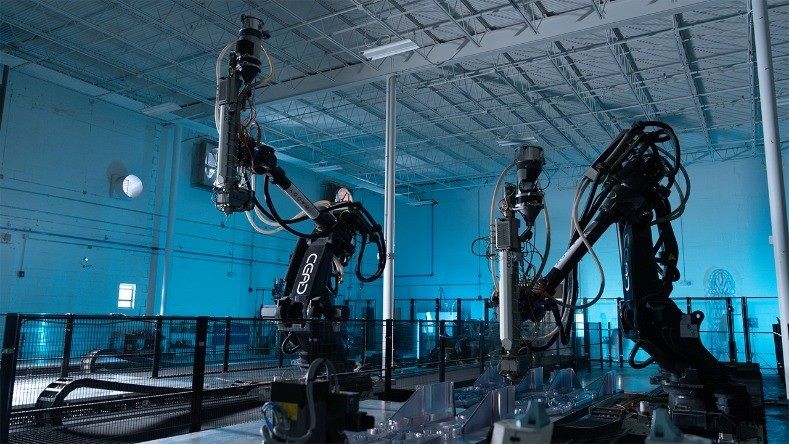
To support this approach, Haddy uses Siemens Xcelerator to connect product design, manufacturing planning and automation through a consistent digital thread. Siemens’ Designcenter software is used to design large-format parts produced through additive manufacturing and prepare those designs for robotic production. Teamcenter software manages product data and configuration across sites, while Sinumerik, Siemens’ CNC control platform primarily for machine tools, is used to provide high-precision motion control and execution on the shop floor, including the integration of industrial robots. In Haddy’s microfactories, Sinumerik orchestrates robotic additive manufacturing systems, combining CNC-based path control with industrial robot kinematics, including CEAD’s large-format robotic extrusion platforms.
As part of this adoption, Haddy is expanding its use of Siemens’ software, as the company scales its distributed production model. It has adopted Simcenter Optistruct software to assist with product optimization and validation of its large-scale products. Alongside this, Haddy is leveraging NX X Manufacturing, a cloud enabled manufacturing solution, to define build strategies, support NC programming, simulation and execution of complex large format robotic additive manufacturing processes. Haddy also uses of subtractive CNC machining as part of its production process using the same toolset providing advanced computer aided machining (CAM) part programming, simulation and verification capabilities.
NX X Manufacturing allows Haddy to produce parts from the size of a shoe box to an entire boat with precision and quality, while inherent cloud accessibility means Haddy can meet the needs of its rapidly expanding business with low IT overhead while using value-based licensing tokens to expand production with additional software capabilities.
“Haddy is showing how manufacturers can rethink production by combining the power of the AI-enabled digital twin and local manufacturing with circular material strategies,” said Tony Hemmelgarn, president and CEO, Siemens Digital Industries Software. “By building a digitally connected, software defined manufacturing model, Haddy is creating a scalable approach that helps maintain consistency across sites while supporting more resilient and sustainable production. This same approach can help other manufacturers adapt faster, reduce waste and bring production closer to where products are needed.”
siemens.com/en-us/company/digital-transformation






 Power Transmission Engineering is THE magazine of mechanical components. PTE is written for engineers and maintenance pros who specify, purchase and use gears, gear drives, bearings, motors, couplings, clutches, lubrication, seals and all other types of mechanical power transmission and motion control components.