


Where Do They Get Those Wonderful Toys?
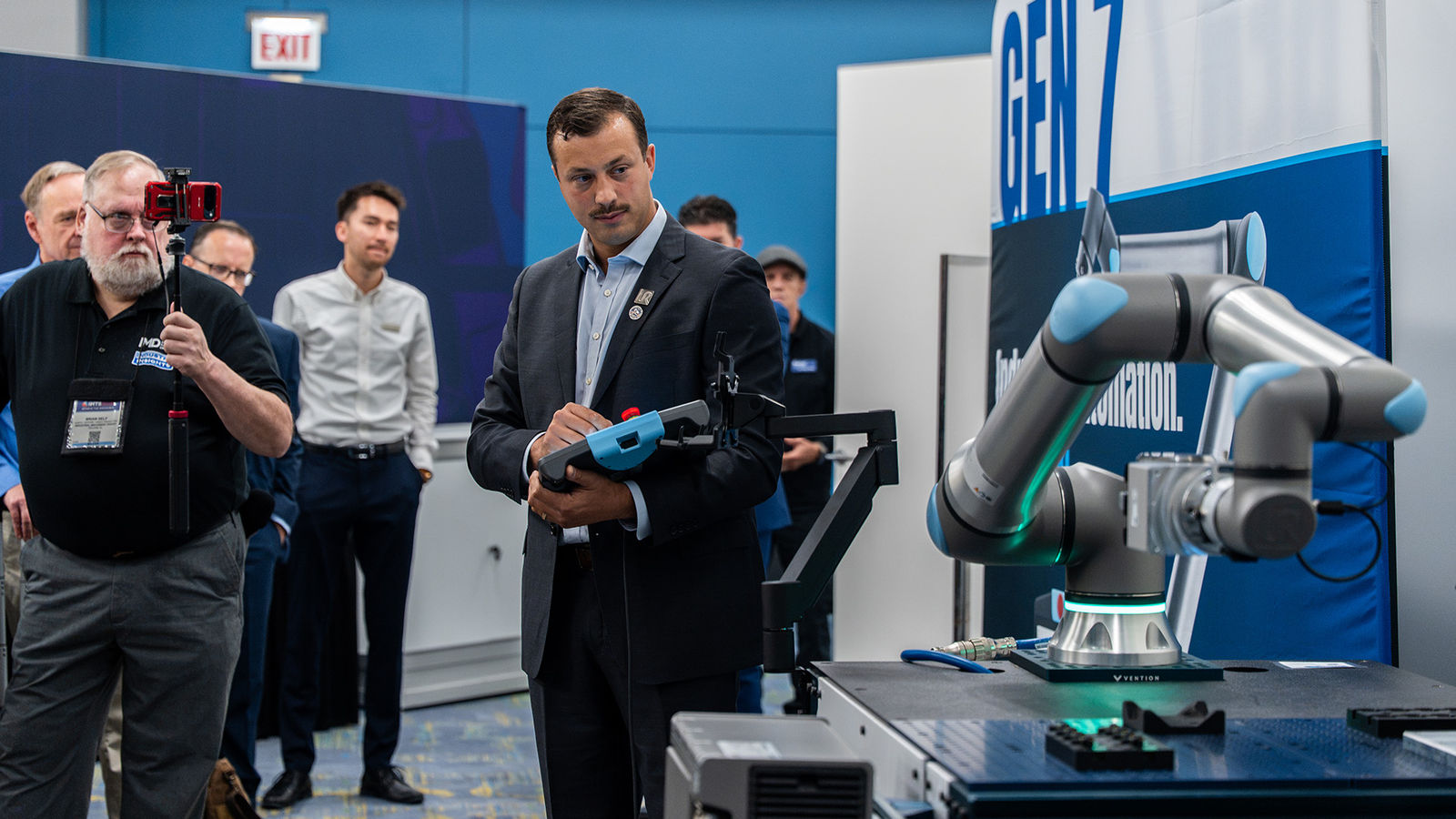
Universal Robots Global Head of UR+ Ecosystem Christopher Savoia presents Gen 7, the company’s seventh generation robotics platform, to media and industry at IMTS in Chicago. (Image: Universal Robots)
The “World’s Fair of Metalworking” was back in town recently showing the world how AI, robotics, automation, manufacturing cells and machine integration is changing manufacturing technology today. IMTS in Chicago is still THAT PLACE, a physical trade show where people discuss the opportunities and challenges customers are encountering across all facets of manufacturing. It remains the one stop on the trade show circuit where you get a firm grasp on where manufacturing is and where it’s going.
One new development from Siemens at IMTS is their “Meet at the Machine” initiative where machine tool builders utilize software and automation technologies to become much more productive long term. Traditionally, many programming, validation and training activities begin only after a machine is installed. This initiative shifts these activities earlier in the process, allowing manufacturers to prepare for production even before the machine is delivered.
“We, as manufacturers, must produce increasingly more complex cyber physical systems,” said Mark Hindsbo, head of operations software at Siemens Digital Industries. “We live in a world where supply chains are changing, regulations are changing. Most of us face skilled work shortages. Yet at the same time, we must be more adaptable, produce more shifting product mixes, and be productive much faster because our time to market is shrinking for our products all the time.”
Built in collaboration with TRAK Machine Tools, the first phase of this initiative is focused on enabling part manufacturers to be productive from day one. It addresses one of the most common challenges manufacturers face when purchasing a new machine: the time required to move from delivery to productivity. The solution combines software, automation and machine expertise into a connected workflow that allows manufacturers to program, simulate and validate production while a machine is still being built.
“Like our customers, we’re on the path of using these powerful tools for increasingly demanding work. As a supplier, we’ve also seen how much time and effort is consumed in machine startup by simply getting applications to work together and connected,” said Steve Pinto, president, TRAK Machine Tools. “When our customers invest in a new machine, their goal is to achieve productivity and business results as quickly as possible.”







 Power Transmission Engineering is THE magazine of mechanical components. PTE is written for engineers and maintenance pros who specify, purchase and use gears, gear drives, bearings, motors, couplings, clutches, lubrication, seals and all other types of mechanical power transmission and motion control components.