

Teradyne Robotics Unveils Wide Range of Production-Ready Physical AI Applications at Automate 2026
Teradyne Robotics, the company behind Universal Robots (UR) and Mobile Industrial Robots (MiR), will demonstrate how physical AI is transforming industrial automation at Automate 2026 in Chicago, June 22-25 at Booth #1250.
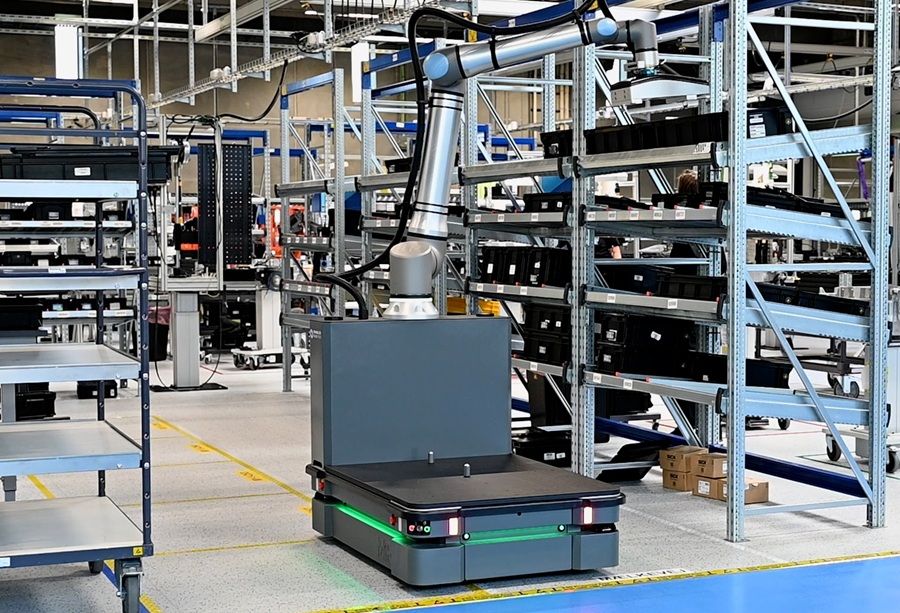
"Physical AI is on full display across our robotic solutions at Automate," said Jean-Pierre Hathout, president of the Teradyne Robotics Group. "The demos we are presenting are real and deployable. Manufacturers can purchase the physical AI-enabled applications we have on display, including our first physical AI-product the MiR1200 Pallet Jack, today - delivered through our global ecosystem of system integrators and partners - to automate tasks that have traditionally been difficult or impractical for robots, including those in dynamic and unstructured environments.”
PolyScope X introduces PLC style logic for multiple work cell control
The foundational layer for physical AI advancements is PolyScope X, UR’s next-generation software platform: PolyScope X still relies on the powerful motion-control foundation that has defined UR for decades, while modernizing the operator experience on a state-of-the-art technology stack. This includes modern web technologies, containerized applications and native ROS 2 support, which allow developers and engineers to program automation applications the way they are most comfortable.
PolyScope X also introduces Logic Programs, continuously running, multi-threaded programs that execute in parallel with the main robot program. This native, PLC-style background logic lets programmers coordinate and control multiple work cell components, exchange data, and, in many deployments, reduce or replace external PLCs, running independently of safeguard stops, program pauses, and robot power state.
Teradyne Robotics’ Automate booth will host a demonstration stage showcasing hourly live demos of how PolyScope X serves as the tech stack for future-proof, cyber-secure, and AI-ready robotics. “Automation today requires more than just a robot - it demands a platform that can adapt, integrate, and evolve with the needs of modern manufacturing,” said Hathout.






 Power Transmission Engineering is THE magazine of mechanical components. PTE is written for engineers and maintenance pros who specify, purchase and use gears, gear drives, bearings, motors, couplings, clutches, lubrication, seals and all other types of mechanical power transmission and motion control components.