
[advertisement]
Feature Articles

October 7, 2026


Matthew Jaster


Feature Articles

Systematic Solutions

Schaeffler Showcases Motion Technology at Automotive Symposium 2026

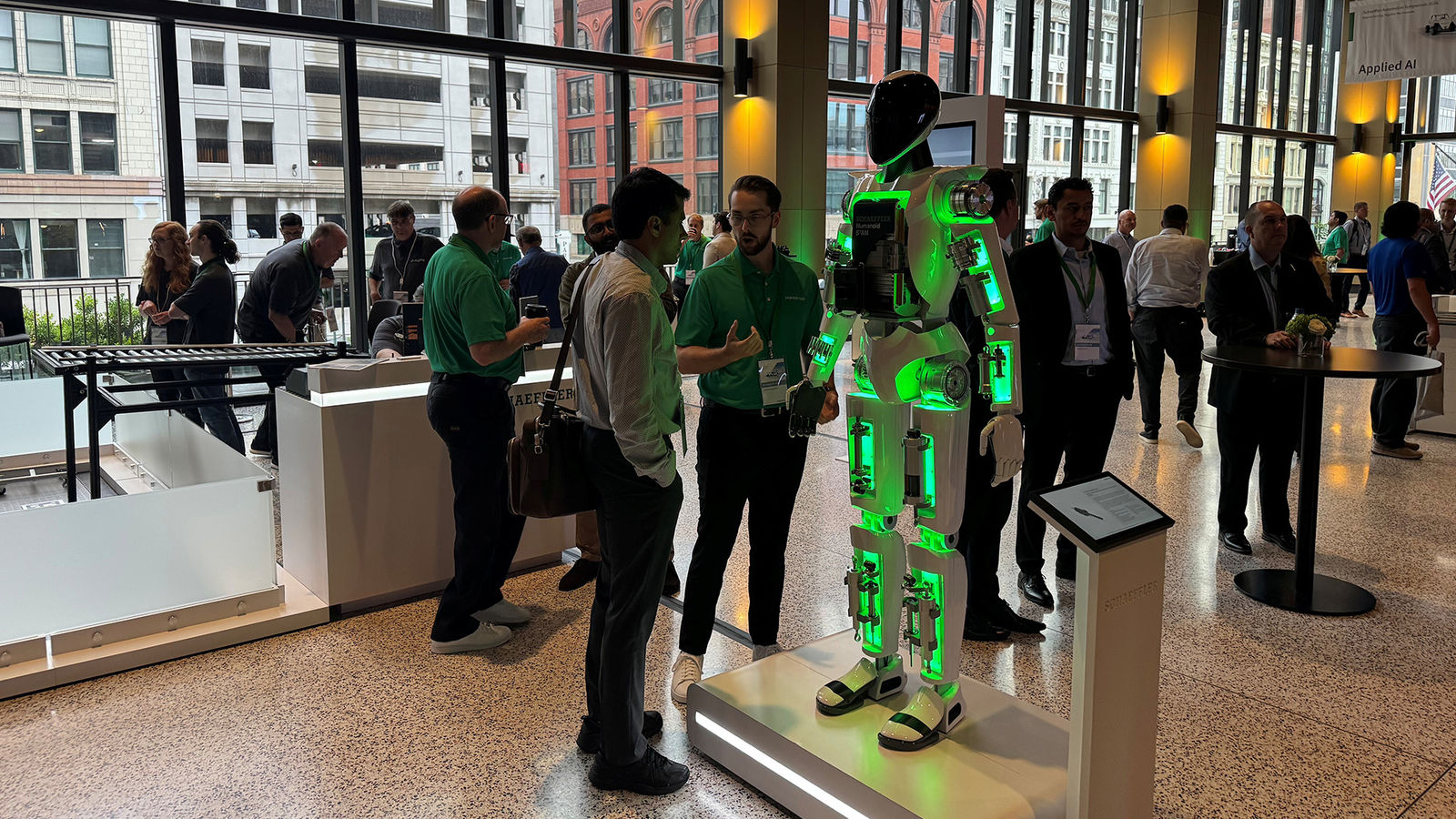
All-solid-state battery (ASSB) technology can also be valuable for humanoid robots where reduced weight, improved safety and extended operating time are vital. (All images: Matthew Jaster)

Supply chain challenges, global tariffs and rising energy prices make it extremely difficult to collaborate with multiple vendors on a mechanical engineering project. The biggest takeaway from Schaeffler’s incredibly informative and insightful Automotive Symposium in Detroit is how lucky the organization is to avoid these challenges thanks to an extremely robust product portfolio.

“Our steer-by-wire technology is a great example of this,” said Jeff Hemphill, CTO, Schaeffler, as he took the media on a tour of the 100-plus technology exhibits displayed at the historic Department at Hudson’s building. “Instead of needing to contact a variety of customers or vendors, we simply gather our internal engineering experts involved in components, hardware, software, electronics, etc. and put them in a meeting together.”

Being able to pull resources from different departments—under various engineering specialties—is an advantage many companies simply do not have. Combining mechanical, software, electronics and mechatronics experience under one roof is how you successfully plan a road map toward automated mobility in the future.

Chassis & Body Technologies

Schaeffler’s approach connects steering, suspension, vehicle access, sensing technologies, and electro-mechanical actuation technologies into intelligent vehicle functions.

“As vehicle architectures become increasingly interconnected, success depends on understanding how every system influences the next,” said Matt Frary, president, Powertrain & Chassis. “Schaeffler’s expertise enables us to develop integrated solutions that create greater value, improve the driving experience and enhance comfort in the next generation of vehicles.”

Share and save:


This article appeared in the October 2026 issue.


Read PDF

[advertisement]

Sensors play a significant role in this process as Schaeffler’s sensor portfolio continuously monitors vehicle motion and environmental conditions, enabling real-time data processing that supports advanced driver assistance systems, automated driving functions and active chassis control.

EV Battery Performance

Schaeffler’s all-solid-state battery (ASSB) technology represents a significant step forward in energy storage. By replacing conventional liquid electrolytes with solid electrolytes, ASSBs offer the potential for improved safety and higher energy density. The use of ultra-thin metallic lithium anodes can increase energy density significantly compared with today’s lithium-ion batteries, supporting lighter and more compact battery systems.

Beyond automotive applications, ASSBs have the potential to benefit from emerging mobility solutions, including humanoids, where reduced weight, improved safety and extended operating time are especially valuable. Schaeffler continues to advance these required technologies to bring next-generation solid-state batteries to market.

Schaeffler’s conventional battery module is a standard building block for EV energy storage that groups individual cells into a structured, scalable unit for assembly into a larger battery pack. It stores electrical energy, supports the electric drivetrain and makes battery systems easier to build, service and integrate.

Comprehensive Vehicle Control

Today’s automakers require integrated systems that intelligently coordinate vehicle functions across a centralized architecture. Schaeffler’s production-ready portfolio of technologies works together to manage energy, process vehicle data and coordinate critical vehicle functions. Through the integration of intelligent power electronics, battery management, zonal control and centralized computing, Schaeffler enables a scalable vehicle architecture capable of supporting over-the-air updates, advanced driver assistance systems, electrified propulsion and future software-enabled features.

“By integrating software, electronics and hardware, Schaeffler is helping accelerate the industry’s transition to centralized vehicle architectures and delivering future-ready solutions across a wide range of vehicle platforms,” said Jerry Dixon, head of Controls and Mechatronics & Modules, Schaeffler.

Integrated Power Electronics Platform

One highlight on the media tour was the SuperBox, combining the inverter, onboard charger, high-voltage DC booster and auxiliary power module (12V & 48V) into a single compact system. This innovative technology reduces the number of components compared to similar architectures.

By consolidating these technologies, the SuperBox reduces system complexity, minimizes weight, optimizes packaging space, enhances vehicle interconnectivity and enables software-defined functionality throughout the vehicle’s lifecycle.

Schaeffler’s next-generation inverter technology converts direct current (DC) from the battery into alternating current (AC) required by the electric motor. The inverter precisely manages motor speed, torque and regenerative braking to maximize energy efficiency, vehicle performance and battery utilization.

Integrated Powertrain Technologies

Schaeffler highlighted a variety of technologies in this area including bearings, actuators, electronic control units, e-axles and transmission components. Engineered to work together as complete systems, these technologies reduce complexity, improve efficiency, optimize installation space and shorten development cycles for passenger cars and commercial vehicles.

[advertisement]

“The future of mobility will require a range of powertrain solutions tailored to different markets, applications and customer needs,” said Patrick Lindemann, president, E-Mobility, Americas. “Schaeffler’s strength is our ability to combine expertise across components, electric drives, hybrid systems, electronics and software to deliver integrated technologies that help automakers develop efficient and flexible vehicles for the road ahead.”

E-Axle Solutions

Schaeffler’s e-axle supports both battery electric vehicles (BEVs) and hybrid electric vehicles (HEVs), integrating key propulsion and power management functions into a compact, highly efficient system. By combining the electric motor, transmission and power electronics, Schaeffler’s e-axle solutions reduce installation space, simplify vehicle integration, and give automakers greater flexibility to meet application-specific performance and packaging requirements. The modular architecture also enables different levels of integration and power output, helping optimize efficiency, performance and overall vehicle design across the evolving mobility mix.

A key technology within the portfolio is Schaeffler’s Externally Excited Synchronous Motor (EESM), which replaces permanent magnets with electrically excited rotor windings. By eliminating the need for rare earth magnets, the EESM provides a more sustainable motor solution while delivering permanent magnet performance across the entire operating range with enhanced power and efficiency at high speeds.

Bearing Solutions Built for Electrification

The electric powertrain portfolio is enhanced by Schaeffler’s advanced bearing technologies, engineered specifically for the demanding operating conditions of electrified powertrains.

VoltShield bearings feature electrically insulated overmolding that block harmful current flow through the bearing, protecting electric motors from premature failures caused by high frequency circulating currents, delivering up to 50 percent cost savings compared with ceramic coatings or ceramic balls. Together with Schaeffler’s precision bearing portfolio, these technologies improve powertrain durability, enhance system reliability, and support higher power densities and rotational speeds required by next-generation electric vehicles.

VoltPath bearings provide a controlled electrical current path through the bearing, safely diverting stray shaft currents away from sensitive components to help prevent electrical damage and extend bearing life.

Jitesh Modi, director of engineering, gave an educational presentation on the current and future state of bearing technology during the symposium—one of 19 technical presentations that took place during the event.

Final Thoughts

Few companies pull off a symposium that equally balances superb technical content with in-depth product displays on the exhibit floor. Schaeffler seems to take a page out of its very own engineering departments and consistently offers great content for customers, partners and media professionals covering all aspects of mechanical design—a truly systematic approach to everything they do.

I look forward to this event every four years and encourage the mechanical power transmission and motion control industries to attend the symposium in the future. Schaeffler will exhibit next at CES 2027, taking place January 6–9 in Las Vegas.

schaeffler.us/us/

[advertisement]

×

Like What You see?

Power Transmission Engineering magazinePower Transmission Engineering is THE magazine of mechanical components. PTE is written for engineers and maintenance pros who specify, purchase and use gears, gear drives, bearings, motors, couplings, clutches, lubrication, seals and all other types of mechanical power transmission and motion control components.

E-mail

Choose at least one from the options below:

 Power Transmission Engineering magazine, published 8 times per year (print or digital).

 Power Transmission Engineering e-mail newsletter, published weekly.

 Special Offers and promotions via e-mail from Power Transmission Engineering's advertisers and partners.

*Unsubscribe any time.
Full details in our privacy policy
Already a subscriber? Log in