

Schaeffler Expands OPTIME Portfolio
The Schaeffler OPTIME ecosystem is a leading solution for condition monitoring and smart lubrication of machinery. Sensor technology and software combined with the expertise of a globally leading bearing manufacturer characterize this offering from the Motion Technology company.
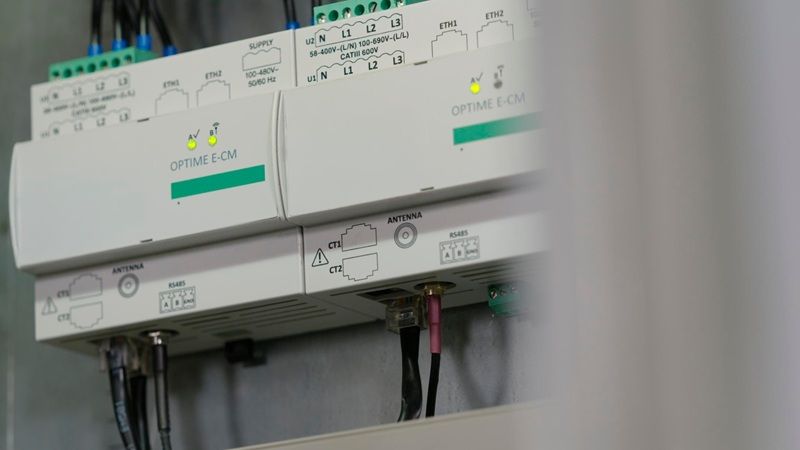
With the FAG OPTIME E-CM (Electrical Condition Monitoring, E-CM), Schaeffler is now expanding its portfolio to include electrical condition monitoring of three-phase motors – such as those commonly used in compressors, rotary pumps, fans, blowers, grinding machines, and in large quantities in all industrial sectors. Schaeffler is thus taking the next step towards trouble-free production processes.
"Electrical condition monitoring adds an essential perspective to the existing OPTIME ecosystem and enables maintenance teams to detect both mechanical and electrical malfunctions at an early stage," says Dr. Philipp Jussen, head of Schaeffler Industrial Lifetime Solutions Europe.
The existing OPTIME sensors are specialized in detecting vibrations that indicate premature wear and possible mechanical malfunctions. FAG OPTIME E-CM rounds off the product family by monitoring and evaluating electrical currents and voltage of the electrical drive. "As a result, our customers can now prevent unplanned downtimes in production environments even better", explains Dr. Philipp Jussen.
For example, FAG OPTIME E-CM enables early detection of insulation faults and damage, cable defects, static and dynamic eccentricity, broken rotor bars, voltage fluctuations, and overcurrents. Customers benefit from improved system transparency, resulting in higher plant availability, proactive maintenance planning, and thus lower costs and personnel expenditure. This is especially true for systems that work in hard-to-reach environments, as the sensors are attached to the cables in the control cabinet.
The technical installation is straightforward for electrical personnel. The system consists of a measuring unit and the sensors for current detection, which are attached to the live cables of the generators in question. Both are in the control cabinets that are easily accessible for maintenance staff.






 Power Transmission Engineering is THE magazine of mechanical components. PTE is written for engineers and maintenance pros who specify, purchase and use gears, gear drives, bearings, motors, couplings, clutches, lubrication, seals and all other types of mechanical power transmission and motion control components.