
Physical AI: Driving Innovation in Industry at Hannover Messe 2026
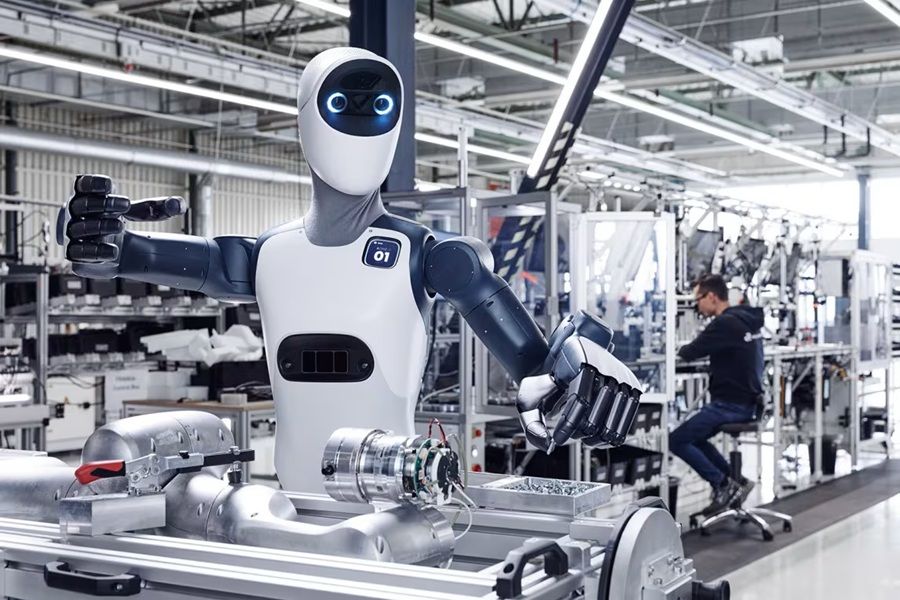
AI is transforming industrial processes - making them more autonomous, efficient, and adaptable. Agile Robots brings this intelligence into the physical world by combining powerful algorithms with state-of-the-art robotics to create solutions that extend beyond the digital realm and deliver tangible value on the production floor. How this translates into real-world performance will be showcased by Agile Robots and Franka Robotics at their joint booth at Hannover Messe, Hall 27, Booth J72.
With advanced sensor technology, machines can imitate human senses: cameras provide vision, microphones enable hearing, and tactile sensors simulate the sense of touch. The captured data is transmitted in real time to interconnected AI systems. Using signal processing, neural networks, and sensor data fusion, a precise digital representation of the environment is created, which the AI analyzes and translates into targeted actions.
Interpretation is handled by transformer models - such as large language models (LLMs) or specialized in-house robotics foundation models. They process multiple data sources simultaneously and convert them into precise movements. Techniques like reinforcement learning and imitation learning ensure that the systems continuously learn and steadily optimize their performance.
Physical AI in Industry
Agile Robots uses Physical AI as a powerful industrial tool by seamlessly integrating hardware, software, and artificial intelligence within a holistic framework. Technology is never viewed in isolation, but as part of an interconnected system in which all components interact optimally and unlock their full potential.
With this approach, Agile Robots automates entire factories worldwide - from individual, flexible robotic cells to fully integrated production lines. The result is scalable solutions that dynamically adapt to new products, variants, or batch sizes, enabling companies to remain competitive and future-ready.
Powered by Physical AI, robots on the production floor act intelligently and learn continuously: they detect deviations, autonomously adjust processes, and steadily enhance their performance.






 Power Transmission Engineering is THE magazine of mechanical components. PTE is written for engineers and maintenance pros who specify, purchase and use gears, gear drives, bearings, motors, couplings, clutches, lubrication, seals and all other types of mechanical power transmission and motion control components.