
PBC Linear Highlights Linear Motion Technology at Automate 2026
PBC Linear will be presenting the latest linear motion technologies at Automate 2026 in Booth #1269 including two new belt-driven actuator series for the industrial market, a step into programmable mechatronics on the precision side, and an early look at PBC Linear’s first family of electric cylinders.
New MTE and MTS Series Expand the Industrial Belt-Driven Family
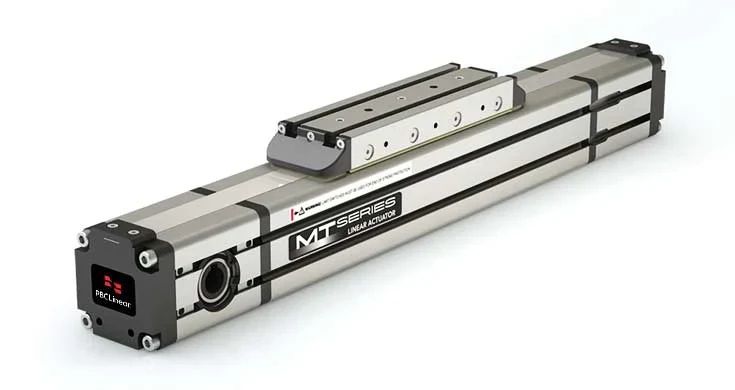
For the large-format industrial market, PBC Linear is extending its MT Series (pictured above) of belt-driven linear actuators with two new variants — the MTE and MTS — built on the same architecture as the established MTB Series but engineered for applications that demand greater rigidity, higher payloads, and longer strokes. The MTE Series introduces a dual-profile rail guidance system to enhance rigidity and load capacity over the single-rail MTB while remaining more compact than the MTS. This makes it well suited for industrial automation, material handling, robotics, and gantry applications where space is at a premium. The MTS Series steps up further, using a full dual-profile rail configuration to support multi-axis Cartesian gantry systems in material handling, automotive, packaging, and large-scale assembly applications with higher demands for stroke length and load capacity.
Integrated Control Electronics for Precision Ball Screw Actuators
For the small/precision market, PBC Linear is taking a significant step into programmable mechatronics by integrating control electronics directly into its precision ball screw and stepping motor assemblies. Building on the company’s BE Series of integrated hybrid stepper motor and ball screw actuators — which already combine motor, screw, and nut into a single compact unit with over 90% transmission efficiency — the next generation adds onboard programmable electronics, transforming what has historically been a mechanical building block into a self-contained mechatronic subsystem. This represents PBC Linear’s first move into programmable electronics at the actuator level, opening the door to simpler integration, fewer external components, and faster deployment in lab automation, medical devices, semiconductor handling, and other precision applications.
Sneak Peek: Electric Cylinders
Automate 2026 will also offer attendees an early look at PBC Linear’s forthcoming family of electric cylinders — the company’s first foray into the cylinder form factor and a direct alternative to hydraulic and pneumatic cylinders in industrial automation. Unlike PBC’s established actuator portfolio, which moves loads via an external carriage, the new electric cylinders extend a rod from the end of the unit, mirroring the physical interface that engineers expect from a hydraulic or pneumatic cylinder while delivering the cleanliness, controllability, and energy efficiency of electric actuation. Internally, the cylinders use either lead screw or ball screw drivetrains, leveraging the same precision drivetrain technology PBC has developed for its existing actuator lines.
pbclinear.com






 Power Transmission Engineering is THE magazine of mechanical components. PTE is written for engineers and maintenance pros who specify, purchase and use gears, gear drives, bearings, motors, couplings, clutches, lubrication, seals and all other types of mechanical power transmission and motion control components.