

Optimize Cobots for Worksite Efficiency
Precision and productivity strengthen automation and motion control opportunities
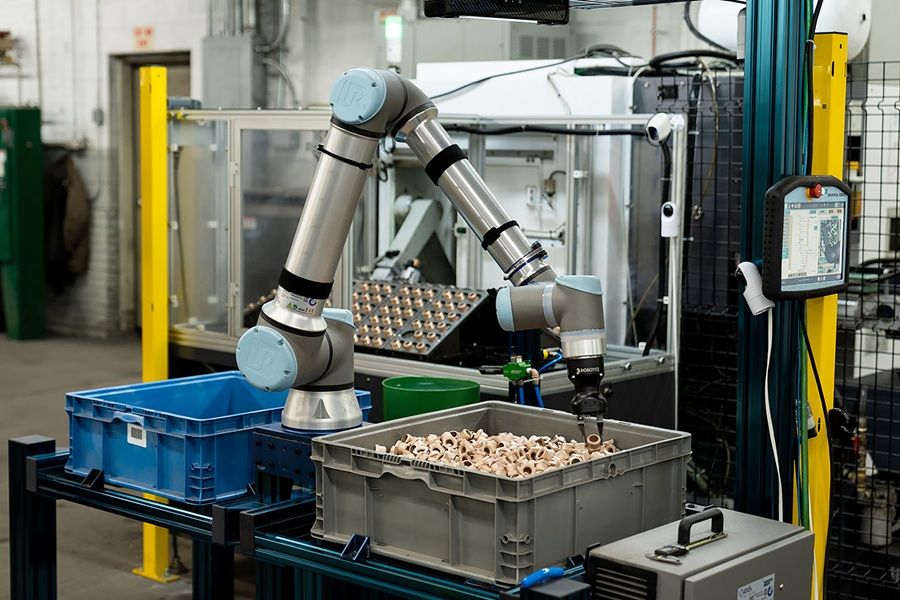
Pictured above: Figure 1—Cobots are ideal for machine tending applications like the one shown here. They can often tend multiple machines at once to free up workers for more important tasks. Image courtesy of Motion Automation Intelligence.
Collaborative robots have been hugely beneficial for manufacturers of all sizes over the past 15 years, and their share of the total robot market continues to grow every year. As of 2025, hundreds of different cobot models are available from dozens of manufacturers. Today, we will discuss the differences between industrial and collaborative robots, advantages of cobots, typical cobot applications, case studies, and some specific robotic solutions.
Let’s begin by looking at problems facing manufacturers today.
- The cost of goods has increased dramatically.
- Engineers are in high demand, and labor rates have skyrocketed.
- Many companies are seeing a lack of skilled workers, and supply chain disruptions are unprecedented.
- Inflation remains high.
So, how can you address these issues within your company? One way would be to automate some of your production processes.
Let’s look at industrial robots, which have some significant pros and cons:
- They have been used across manufacturing verticals for quite some time.
- Industrial robots can run at very high speeds with high repeatability and carry very high payloads.
- A big downside is that they can be dangerous to your workforce. Industrial robots are very heavy and must be framed or caged to protect your team.
- As industrial robots are difficult to program, your business would need a dedicated programmer on staff, or you could outsource that work. Thus, industrial robots have a significant financial cost to deploy and support them effectively.
An alternative to industrial robots would be collaborative robots (cobots). According to the Robotic Industries Association, a cobot is a robot specifically designed for direct interaction with humans within a defined shared workspace.







 Power Transmission Engineering is THE magazine of mechanical components. PTE is written for engineers and maintenance pros who specify, purchase and use gears, gear drives, bearings, motors, couplings, clutches, lubrication, seals and all other types of mechanical power transmission and motion control components.