How servo drives and motion systems are powering the next wave of industrial automation
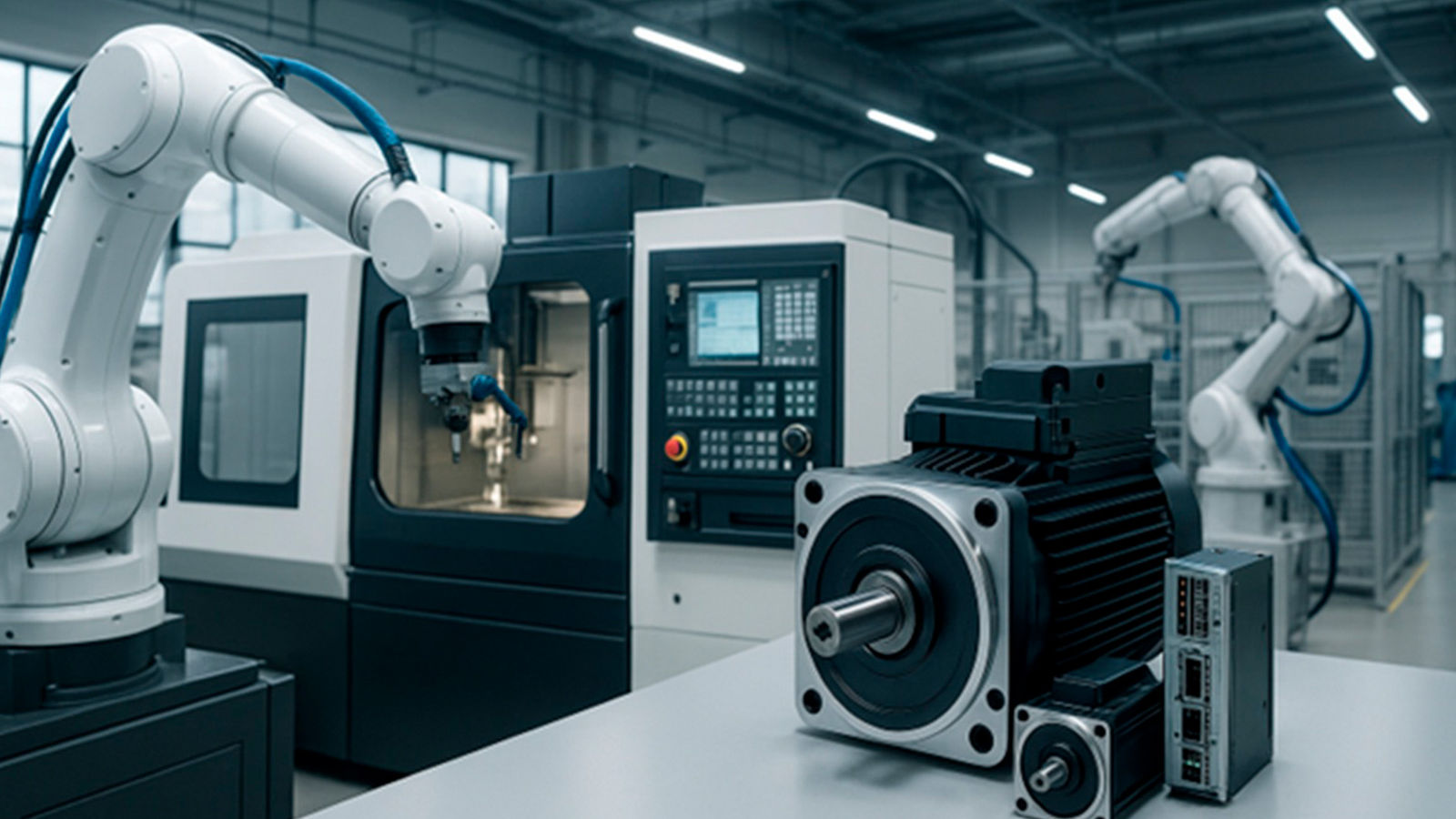
Today’s factories require advanced motion control to provide speed, repeatability and accuracy for continuous manufacturing production. (All Photos: Advanced Motion Controls)
Servo drives are electronic devices that control the precise motion of motors in automated systems, and they have become one of the most influential technologies behind today’s industrial transformation. Their rise reflects a broader shift toward flexible, intelligent, energy-efficient production. Demand for advanced motion control is accelerating fast, with global industrial automation projected to surpass 400 billion dollars within a few years. That growth is fueled by factories seeking accuracy, repeatability, speed, and the kind of reliability required for round-the-clock manufacturing.
These systems matter because they enable machines to move precisely as required, whether executing micron-level adjustments or coordinating multiple axes simultaneously.
This article will explore what servo drives are, how they enhance accuracy and efficiency, why industries depend on them, how they integrate into CNC and robotics, and how they compare to alternative motion technologies in modern production.
Modern Servo Drives and Motion Systems
Modern servo drives are control devices that manage the movement, torque, and position of servomotors, and motion systems are coordinated assemblies that combine motors, sensors, controllers, and drives into an integrated framework. They fit within the context of industrial automation because they serve as mechanisms that convert digital commands into precise physical motion.
A servo system interprets a command signal, determines the necessary movement, and continuously adjusts its output using real-time feedback.
This closed-loop structure provides the responsiveness required for robotics, advanced CNC machinery, packaging equipment, and semiconductor tools.
Motion systems rely on encoders, controllers, and drives to orchestrate smooth trajectories and repeatable movements, and they maintain accuracy even under fluctuating loads or challenging production conditions.
Servo drive types refer to categories of devices that manage the motion of servomotors, and these types fit the article’s context because each design supports different performance requirements in modern automation.
Analog servo drives, for example, regulate current and velocity using continuous control signals whiledigital servo drives use microprocessors for more refined control, tuning, and communication.
AC servo drives dominate industrial environments due to their efficiency and precision, while DC servo drives are used in lower-voltage systems or on mobile platforms.
Integrated servo systems combine the motor, encoder and drive into a single compact unit for rapid deployment.
Multi-axis controllers coordinate multiple servo drives to execute synchronized tasks and control complex machine behavior.
A servo drive operates by comparing a command position to the motor’s actual position and adjusting its output to eliminate the difference.
This immediate comparison shows how motion control loops deliver precise, stable movements.
The drive uses encoder or resolver feedback to detect position and velocity, then adjusts the voltage or current to correct deviations.
[advertisement]
PID algorithms balance rapid response and smooth transitions, enabling equipment to accelerate, decelerate, and hold positions with remarkable accuracy.
Servo drives improve accuracy, speed, and efficiency by constantly correcting deviations between commanded and actual motion.
This ability ensures that machines maintain tight tolerances and perform fast, consistent movements across repeated cycles.
In addition, precise torque management delivers smoother operations and reduces mechanical strain.
Energy savings and recovery is an important step in reducing wear and tear on motion control components.
Advantages of Using Servo Drives in Automation
Servo drives offer precision, efficiency, and energy savings from the first moment they are integrated into a machine.
They deliver six main advantages that shape modern automation:
Improve precision by minimizing motion error
Enhance efficiency with optimized power delivery
Reduce energy waste by adjusting power dynamically
Increase throughput with high acceleration capability
Support advanced automation and robotics through refined control
Enable safer operations in collaborative environments by using sensitive torque feedback mechanisms
What Industries Rely Most on Servo Drives and Motion Systems?
Many industries rely on servo drives and motion systems because they enable accurate, repeatable, and highly responsive machine movements.
These technologies support complex tasks across assembly, precision machining, packaging, and semiconductor manufacturing.
Seven industries use them extensively including:
Robotics manufacturing for articulated and SCARA robots
CNC machining for milling, routing, and multi-axis cutting
Packaging and material handling for fast pick-and-place cycles
Automotive production for assembly and welding accuracy
Semiconductor fabrication for wafer handling
Medical device manufacturing for micro-scale motion
Energy and renewable systems for positioning and control
Motion engineers often evaluate servomotor drives when designing new automation platforms.
How Servo Drives Support the Rise of Cobots
Servo drives support collaborative robotics by enabling compliant, smooth, and low-latency motion, allowing people and robots to work side by side safely. This combination of sensitivity and accuracy ensures that robots respond instantly to unexpected changes or human interaction. Torque sensing improves collision detection, while high-resolution feedback produces organic movement patterns that feel natural in shared workspaces.
Their advanced algorithms help robots maintain stable trajectories without generating hazardous forces. Cobots depend on real-time force control, precise positioning, and coordinated multi-axis motion to perform tasks safely. These requirements include maintaining smooth acceleration, modulating torque based on human proximity, and dynamically adjusting speed during collaborative tasks.Compliance ensures the robot adapts to external forces, while synchronized axes enable complex, flowing movements needed for shared assembly or inspection work.
The Role Servo Drives Play in Next–Generation CNC Automation
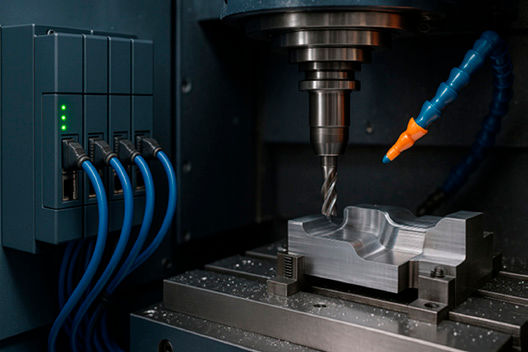
Servo drives support high-speed machining and play a critical role in CNC automation.
Servo drives support high-speed machining and play a critical role in CNC automation.
Servo drives play a central role in next-generation CNC automation by enabling precise contour control, rapid acceleration, and the ability to follow complex toolpaths without deviation. They synchronize axes during coordinated cutting or forming, ensuring surfaces remain smooth and dimensionally accurate. This technology supports high-speed machining by maintaining rigidity and eliminating positioning errors, even under variable material loads or abrupt directional changes.
Which CNC Machines Benefit the Most from Advanced Servo Drives?
CNC machines such as laser cutters, press brakes, waterjet cutters, milling centers, and robotic machining cells benefit from advanced servo drives. These machines rely on accurate axis positioning and repeatable motion to shape materials with high precision. Laser cutters require exact toolpath tracking, waterjet systems depend on stable velocity control, and press brakes need controlled bending sequences.
A highly relevant example of servo-enabled CNC technology is the use of a servo-electric press brake, which shows how precise motion improves forming accuracy.
Servo Drives vs. Variable Frequency Drives
Servo drives differ from variable-frequency drives because servo drives control torque, speed, and position with feedback, while VFDs regulate speed only and do not provide precise positioning. Servo systems outperform VFDs in accuracy, dynamic response, and closed-loop feedback.VFDs, however, are simpler and more cost-effective for constant-speed applications.
Limitations of Servo Drives
Servo drives have several limitations despite their advantages.
They can increase project costs, require tuning expertise, and may be sensitive to electrical interference.
Suffer from electrical noise in harsh environments
Demand specialized training for long-term maintenance
Most Important Factors When Selecting a Servo Drive
Selecting a servo drive depends on matching torque, speed, inertia, and communication requirements to the machine’s intended use.
Engineers evaluate feedback type, environmental conditions, and integration demands before choosing hardware.
The most important considerations include compatibility with controllers, load characteristics, communication protocol, and system scalability.
How Communication Protocol Choice Affects Motion Performance
Communication protocols affect motion performance by determining data speed, synchronization quality, and system responsiveness. High-speed fieldbuses such as EtherCAT enable rapid updates for multi-axis control.CANopen supports distributed motion with moderate bandwidth, while Modbus suits slower or simpler systems.Some proprietary systems may offer enhanced tuning or specialized diagnostics.
Integrating Servo Drives into a Modern Automation Line
Integrating servo drives into an automation line involves defining motion needs, selecting hardware, configuring parameters, establishing communication, and validating performance.
There are five steps in the integration workflow:
Define motion requirements by assessing torque, speed, and precision
Select compatible servo hardware that matches the load and environment
Configure drive parameters and encoder settings for correct operation
Integrate controls and communication using the chosen fieldbus
Test, tune, and validate performance to ensure long-term reliability
Servo Drive System Costs
A servo drive system typically costs between $300 and $2,000 per axis, depending on power, encoder type, and performance.
Five factors influence final price considerations:
Power rating defines overall hardware cost
Feedback encoder type affects accuracy level
Communication protocol determines controller compatibility
Environmental rating influences durability
Application complexity shapes engineering time
Examples of Modern Automation Using Servo Drives Today
Servo drives are used in many advanced automation applications, such as high-speed robotics and micro-positioning systems.
Their ability to deliver stable and responsive motion makes them essential in precision industries.
Six standout applications include the following:
High-speed pick-and-place robotics using multi-axis coordination
Autonomous material transport with controlled acceleration
Alternative Motion Technologies Competing with Servo Systems
Alternative motion technologies include stepper motors, hydraulic actuators, pneumatic systems, linear motors, and induction motors controlled by VFDs.
Each option offers distinct strengths depending on the application context:
Stepper motors provide cost-effective positioning
Hydraulic actuators deliver high force for heavy loads
Pneumatic systems support simple repetitive actions
Linear motors achieve rapid acceleration without mechanical transmission
Modern servo drives and motion systems define the future of industrial automation by combining precision, speed, and dynamic control across a wide range of applications. They empower robotics, CNC systems, packaging lines, and high-tech manufacturing to achieve consistent performance even under demanding conditions. As factories shift toward flexible, energy-aware, and fully synchronized workflows, servo technology will continue to shape competitive advantage across every industry.