
[advertisement]
Product News

May 7, 2026


Manufacturing Automation Motion Control Motor Controls Motors Servo Drives Servomotors Servos Product News Motor Design Motor Efficiency Optimization Reliability

Kollmorgen Examines Hazardous Locations in Modern Factory Automation

It wasn’t too long ago that hazardous zones and production zones were reasonably well separated. The areas where explosive gases, vapors, or combustible dusts were present tended to stay in their own very specific environments, and the equipment operating in those areas was specified accordingly. Today, however, that distinction is less clear. 

As automation spreads deeper into processing, handling and transport operations, motors are increasingly required to operate in spaces that sit on the edge of hazardous zones. In these environments, explosive gases or combustible dusts are not continuously present, but they may occur during abnormal conditions or for brief periods of time. The engineering challenge is no longer simply “hazardous or not,” but rather “how hazardous, and how often?"

Answering that question correctly can make the difference between a well-optimized design and an unnecessarily expensive, inefficient, and bulky one.

Understanding the zone

In the ATEX and IECEx frameworks, hazardous areas are divided into zones. Zone 0 and Zone 20 represent the highest level of risk, where explosive gas or dust is present continuously or for long periods, while Zone 1 and Zone 21 apply where it is likely to occur during normal operation. In contrast, Zone 2 (gas) and Zone 22 (dust) apply where explosive atmospheres are not likely during normal operation and, if they do occur, will only exist for a short time.

The significance of this extends far beyond paperwork and has many practical ramifications.

Share and save:


[advertisement]

For example, the explosion-proof motors designed for Zone 0 or Zone 1 are typically engineered to withstand and contain an internal explosion. Their housings are thick and heavy. Flame paths are carefully designed to prevent ignition from propagating. Cable entry is typically via rigid conduit rather than standard connectors. These motors are robust, proven, and an essential part of making industrial operations possible in severe environments, but they are also large, heavy and highly expensive.

As such, if a machine only needs to comply with Zone 2 or Zone 22, specifying a fully Zone 1-complient motor is excessive. It adds weight to moving axes, increases inertia, may complicate mechanical integration and drives up cost unnecessarily.

Automation expands into the gray areas

One reason for historical over-specification is simple availability. Both supply and demand for purpose-designed servo motors for Zone 2 and Zone 22 applications have historically been limited, so when faced with regulatory scrutiny and liability concerns OEMs have defaulted to the highest-rated solution available.

The need for motors tailored to these environments is growing as the nature of automation changes. Consider a robotic transport system moving unfinished assemblies from a welding cell to a paint spray booth. The booth environment may only occasionally present an explosive gas mixture, but any motor operating inside that space must comply with the appropriate hazardous location standard.

Similarly, in pharmaceutical manufacturing, servo-controlled gate valves meter fine powders with high precision. Under normal conditions the environment is controlled, but combustible dust may be present in abnormal situations. Grain handling systems, food processing lines, textile operations, and powder coating systems present similar challenges.

These are not traditional heavy industries typically associated with hazardous zones, such as mining or petrochemicals. They are high-precision, high-value production environments that increasingly depend on servo technology.

As a result, more machines now operate in the transitional space between conventional automation and classified hazardous areas. The specification approach must evolve accordingly.

Designing for Zone 2 and Zone 22

For Zone 2 and Zone 22 environments, the objective is not to contain an explosion in the way that is required in more high-risk areas, but to reduce the likelihood of ignition under abnormal conditions. That distinction allows for a very different design philosophy.

[advertisement]


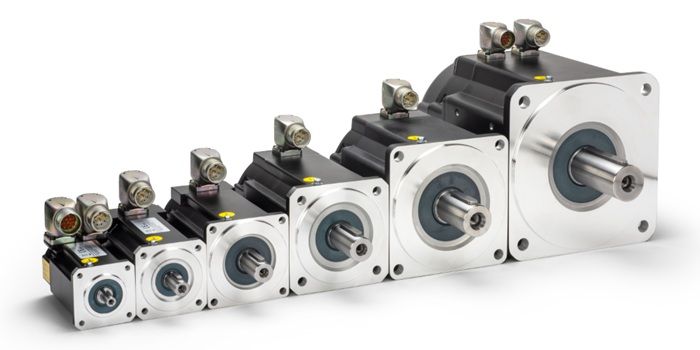
Kollmorgen’s AKME series of servomotors was developed specifically for these applications (pictured above). Rather than redesigning the motor as a flameproof enclosure, the approach builds on the established AKM servo platform and applies targeted enhancements to meet the requirements for Zone 2 and Zone 22.

The design makes use of several key protection concepts. For gas environments in Zone 2, the motor employs increased safety and encapsulation. The windings are vacuum impregnated to isolate conductive components and reduce the risk of ignition sources, while the design meets the T4 temperature class requirement. In practice, gases may enter the motor, but the rotor surface temperature remains well below the ignition threshold.

For dust environments in Zone 22, protection is achieved through a sealed enclosure. The motors incorporate IP67-rated shaft sealing and connector sealing, exceeding the IP64 level required by the certification standard. This ensures that dust cannot accumulate inside the motor and allows it to meet the T130 temperature classification for dust that may settle on the motor surface.

Because the motor is not required to withstand an internal explosion, it does not need thick-walled housings or flame paths. The result is a compact, lightweight solution that preserves the torque density, dynamic performance and mounting flexibility expected of a modern servomotor.

A measured approach to safety

It is important to note that adopting a more measured response to motor specification does not diminish the importance of safety. On the contrary, increasing awareness of combustible dust and gas hazards have improved industry standards significantly. The goal is not to reduce protection, but to apply it intelligently.

Hazardous location classification exists precisely to enable proportionate design. When engineers understand the nature, frequency and duration of the hazard, they can select equipment that provides the required level of protection without introducing unnecessary compromise.

As automation continues to expand into food production, pharmaceutical processing, advanced coatings and other dust- and gas-sensitive environments, this middle ground between standard industrial servomotors and fully explosion-proof designs will become more important.

The challenge for designers is to resist the instinct to default to the highest rating and instead align specifications with real-world risk. By doing so, they can achieve compliant, efficient, and mechanically optimized systems that reflect both engineering rigor and practical judgment.

In modern factory automation, safety and performance are not opposing goals. Indeed, with the right approach to hazardous location specification, they instead reinforce each other. 

kollmorgen.com


[advertisement]

×

Like What You see?

Power Transmission Engineering magazinePower Transmission Engineering is THE magazine of mechanical components. PTE is written for engineers and maintenance pros who specify, purchase and use gears, gear drives, bearings, motors, couplings, clutches, lubrication, seals and all other types of mechanical power transmission and motion control components.

E-mail

Choose at least one from the options below:

 Power Transmission Engineering magazine, published 8 times per year (print or digital).

 Power Transmission Engineering e-mail newsletter, published weekly.

 Special Offers and promotions via e-mail from Power Transmission Engineering's advertisers and partners.

*Unsubscribe any time.
Full details in our privacy policy
Already a subscriber? Log in