
[advertisement]
Revolutions

March 2, 2026

Blake Griffin


Automation Motion Control Components AC Motors DC Motors Electric Motors Motor Controls Motors Inspection Motor Maintenance Safety Revolutions

Interact Analysis Examines 2026 Motor Market

EC motors, axial flux and the fight for differentiation in high-efficiency motors

The market for high-efficiency motors (>IE4 or equivalent) continues to grow at a faster pace than the broader low voltage AC motor market. Through 2030 we are expecting the market to nearly double from its 2025 value of $1.7 billion.

This market has seen a flurry of activity as established motor manufacturers look to future-proof their offering, while differentiating against their competitors. In 2025, nearly every major motor manufacturer announced new high-efficiency products. Although most are still in early phases of product rollout, these announcements offer a glimpse into the increasingly varied product landscape that is emerging amid high-efficiency applications. This insight looks at two significant product announcements in the context of the trends upon which they intend to capitalize.

We classify an electronically commutated (EC) motor as a brushless motor with an integrated drive on board. Among traditional motor and drive suppliers, EC motors have increasingly become a substitution threat to stand-alone motor and drive products. Use of these motors is growing in air handling applications, where OEMs benefit from a smaller form factor and higher efficiency, and are increasingly displacing induction motors.

There are several factors increasing the relevance of EC motors within the motor market conversation. Notably, data center construction and the need for energy efficiency within the cooling systems has driven many suppliers to launch new products to serve this growing market. The data center sector remained a bright spot for growth in 2025 and is expected to continue expanding above other sectors. Through 2030, we are expecting the market for high-efficiency motors within data centers to grow at an average annual rate of 16%, driven largely by the increasing prevalence of AI technology.

Announced during the AHR 2025 HVACR expo, ABB’s ERH motor is a direct competitor to Ziehl Abegg’s EC Blue product. Ziehl Abegg popularized this product within Europe over the last decade and has been a big driver of the adoption of EC Motors in fan applications. ABB’s ERH is, similarly, an external rotor motor that includes an integrated drive and is targeting many of the same fan applications to which the EC Blue product is suited.

It is interesting that ABB decided to go in this direction. ABB is the largest motor manufacturer in the world and so does not need to be the first mover on a trend. When it comes to unproven technology, ABB is in a fortunate position to be able to wait and see how a trend plays out for a few years before taking the risk of investing heavily in it.

Share and save:


[advertisement]

The decision for ABB to enter the EC motor market speaks to the strength of the substitution threat to traditional motor and drive systems that these products represent. With an EC motor now part of ABB’s portfolio, the company has better future-proofed its offering against potential disruption if the EC Motor trend continues as strongly as expected. Additionally, its portfolio is better suited to serve high growth data center applications.

Axial flux motors have received a lot of attention in recent years. Infinitum, a Texas-based motor manufacturer, built an impressive product around axial flux technology with its Aircore EC. The product was considered state-of-the-art, with its use of printed circuit board stator technology and a high-efficiency integrated drive. It gained the attention of US automation giant Rockwell Automation, which became an early investor in Infinitum. The company has since scaled to become one of the largest suppliers of axial flux motors in the commercial space. While Infinitum found success targeting high growth air handling applications, its exposure to industrial applications remains limited.

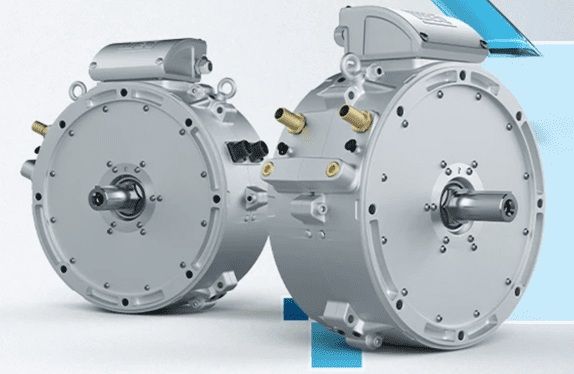
In early 2025, WEG announced plans to release its AXGEN W80 motor, an axial flux motor explicitly targeting industrial applications. While other axial flux motors struggle with heat mitigation at higher powers, WEG designed its motor to be liquid cooled, making it suitable for a much broader range of applications. This product fills a gap in the market within the industrial landscape where axial flux motors haven’t historically been found.

The footprint of WEG’s AXGEN W80 (pictured above) is significantly smaller than a motor of comparable power output. This allows WEG to position the product as providing benefits beyond efficiency, such as a reduction in overall machine size; a powerful value proposition for industrial OEMs.

Our research found these types of value propositions can be more effective unique selling points than efficiency alone. Oftentimes, if the motor meets the required minimum efficiency specification, OEMs are unwilling to pay more for higher-efficiency motors. However, when a motor design can improve overall machine design by shrinking the footprint, or reducing the size of other components, there is a greater desire to adopt.

WEG’s AXGEN W80 is an impressive product. One of the most interesting aspects of the product is its ability to stack with other motors to increase the power output. Shown in this promotional video, the motor is able to connect to a second motor to effectively double its power output. This is something unique to this motor and is likely to drive significant interest from heavy industry applications like mining and oil & gas where WEG is already strong.

These types of motors offer motor manufacturers an avenue to differentiate them from their competitors in an increasingly commoditized market. Within the high-efficiency landscape, there is a lot of ground to be won and getting a product like this to market early provides WEG with additional tools to expand its share in many of its core markets.

Final thoughts

Within the motor market, high-efficiency products remain the area manufacturers have the most room for differentiation. It is still early days for high-efficiency products but the movements occurring today are likely to have significant ramifications for the market landscape in ten years’ time, as efficiency levels become more tightly regulated.

interactanalysis.com

[advertisement]


×

Like What You see?

Power Transmission Engineering magazinePower Transmission Engineering is THE magazine of mechanical components. PTE is written for engineers and maintenance pros who specify, purchase and use gears, gear drives, bearings, motors, couplings, clutches, lubrication, seals and all other types of mechanical power transmission and motion control components.

E-mail

Choose at least one from the options below:

 Power Transmission Engineering magazine, published 8 times per year (print or digital).

 Power Transmission Engineering e-mail newsletter, published weekly.

 Special Offers and promotions via e-mail from Power Transmission Engineering's advertisers and partners.

*Unsubscribe any time.
Full details in our privacy policy
Already a subscriber? Log in