How SKF testing and investigation helps solve bearing failures
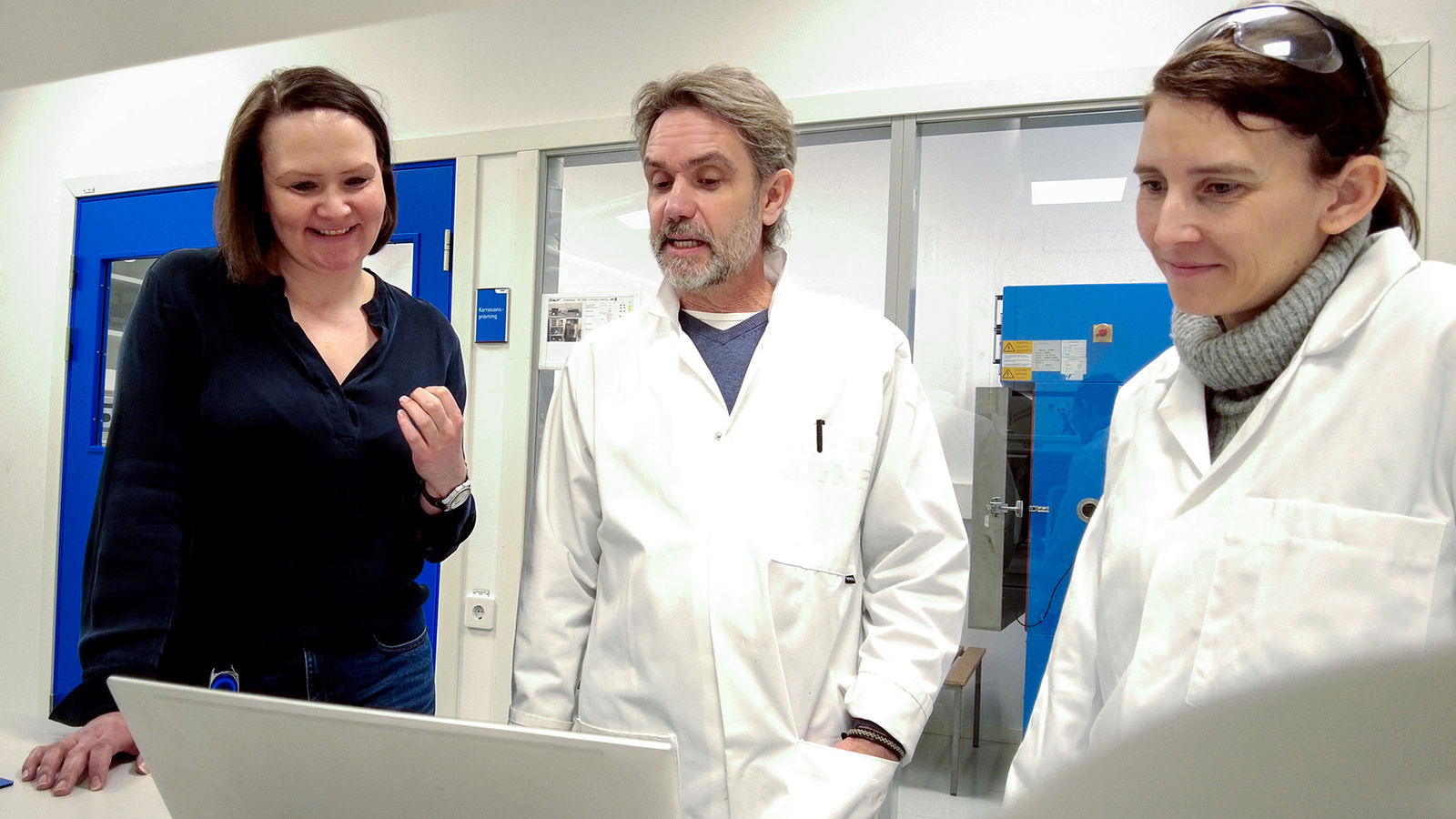
Decoding lubricant performance: Elin Liden, Fredrik Reinholdsson and Maria Odqvist review chemical analysis results for lubricants in hybrid bearings at SKF Global Labs Sweden. (All images: SKF)
Testing is a powerful tool for improving equipment reliability and reducing the risk of costly, unplanned downtime. When a bearing fails, it’s important to figure out why. Without an investigation or testing to determine the cause, there is a greater likelihood that the same problem will happen again. That’s why SKF Global Labs and Testing plays such a critical role in helping customers maximize the performance and service life of their rotating equipment.
Using advanced testing methods and decades of engineering expertise, SKF specialists examine wear patterns, material condition, lubrication performance and operating history to determine exactly what happened and why. They use advanced technologies to validate materials, verify designs and test performance in real-world conditions. Every bearing investigation gives the team valuable insights, helping them understand root causes, prevent future issues and continuously improve their products.
As SKF continues to strengthen its technology leadership, Global Labs and Testing plays a central role in ensuring their products deliver performance, reliability and long-term value for customers, according to Elin Liden, director for Global Product Development and Engineering and for Global Laboratories and Testing.
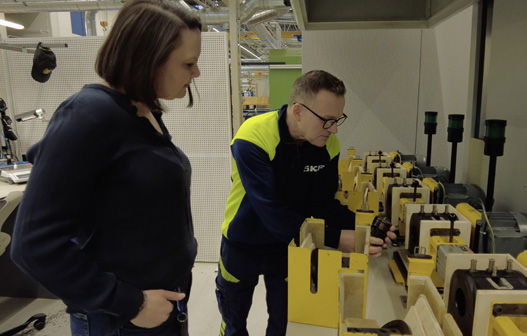
Putting grease to the test: Joakim Hallberg walks Elin Liden through this specific grease life testing setup at SKF Global Testing Sweden.
“Global Labs and Testing strengthens SKF’s innovation by delivering the technical expertise and operational excellence needed to turn complex customer challenges into validated solutions,” she said. “Through robust early-stage testing, advanced verification and reliable material investigations, we ensure that new ideas are proven.”
Global Labs and Testing supports everything from concept to field performance. They validate materials and suppliers to ensure new steels, lubricants and components meet the right standards. During development, they test new designs to confirm they meet customer requirements. They run life tests to validate long-term performance and support bearing life models. And once products are in the field, they investigate failures and feed insights back into design rules and future product development.
Liden is responsible for operational management of labs in Europe, Middle East and Africa (EMEA). Additionally, she is responsible for the Global PD&E team. In her role, she leads the global team to drive customer-centric innovation across the entire product lifecycle. Along with her team, she also focuses on emerging technological areas such as virtual testing, simulation driven development and digital twins to continue reshaping the future of testing at SKF. The focus is on integrating the physical and virtual worlds to increase speed, reduce cost and deliver more faster, competitive innovation.
In the lab, Liden and her team see a slew of bearing challenges from fatigue and premature failure, wear and surface damage, corrosion, contamination, and lubrication breakdown, plus the effects of demanding conditions like high speed, heavy loads, vibration and temperature extremes.
“A big part of the work is understanding why a bearing underperforms — for example, corrosion appearing inside bearings in harsh washdown environments such as food processing,” Liden said.
The goal is to turn these challenges into solutions. So, how do they do that?
The team starts with a detailed bearing analysis and works closely with an application engineer to understand the reasons for the issues, then address that cause directly.
“In some cases, this means that application engineers will suggest a different bearing arrangement, different kinds of seals or sometimes add condition monitoring and in other cases it provides input to the redesign of the bearing,” she said.
They combine three complementary capabilities in their testing and validation.
Intelligent and Clean Bearings
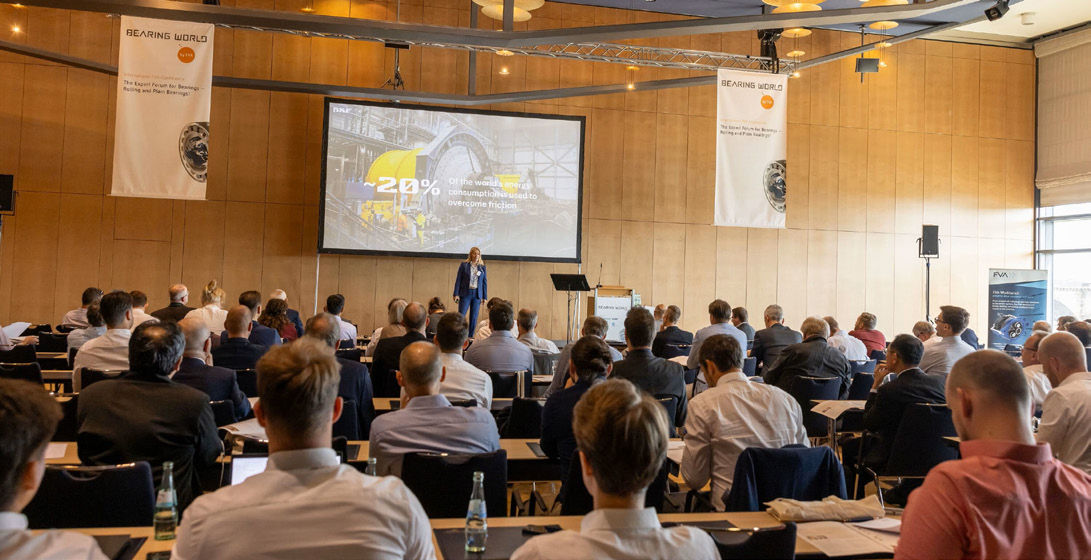
Bearing World took place in Dresden, Germany from June 17-18, 2026. Annika Ölme, CTO and senior vice president technology development at SKF opened this year’s conference with a keynote address on intelligent and clean bearings. Ölme said that customers are under increasing pressure to reduce energy use, improve uptime, and make faster, better decisions. That means the value of a bearing can no longer be defined only by geometry or load ratings. It must be measured by how it helps customers improve efficiency, enable insight, operate predictably, and reduce environmental impact. As industries become more digital, more electrified, and more sustainability-driven, expectations are changing. Bearings remain fundamental, but their role is evolving. One of the strongest takeaways is that progress in the bearing industry will be shaped through collaboration. For SKF, this reinforces the importance of co-creating with customers, working closely with academic partners, and engaging with a broader ecosystem of like-minded innovators to move faster from insight to application. This is true not only in bearing research, but also in AI. SKF’s recent partnership with Sferical AI reflects this mindset — combining industrial expertise with high-performance AI infrastructure to accelerate work in predictive maintenance, quality control, R&D, and next-generation digital products. At Bearing World, AI-powered condition monitoring and modeling were part of the broader technical discussion, reflecting a shift in how this industry approaches performance, reliability, and decision-making. The focus is moving from experimentation to AI as a practical way to improve diagnostics, make sense of complex data and support better maintenance decisions. SKF’s condition monitoring solutions combine sensors, analytics, and AI-based tools to detect issues earlier and help customers act before failures occur. The organization’s collaborations show how AI can support real operating environments where data volumes are high, and conditions are demanding and actionable insight matters more than raw information. For me, that is the real promise of AI in our industry, where technology makes industrial knowledge more scalable, more accessible and more useful to customers. The third and most important takeaway is that intelligent and clean solutions must be anchored in customer needs. Across industries, customers are under pressure to reduce energy consumption, increase reliability, and deliver on decarbonization targets without compromising performance. This is why topics such as friction reduction, lubrication, and life extension were so prominent throughout the Bearing World event. For SKF, this is where customer-centric innovation becomes critical. “Intelligent” means helping customers move from reactive to predictive by turning bearing and machine data into earlier insight and better decisions. “Clean” means designing for efficiency, reducing friction, extending life and enabling circularity from the start. Together, these capabilities help customers reduce energy losses, simplify maintenance, extend asset life, and advance decarbonization in measurable ways.
Annika Ölme, CTO and senior vice president technology development at SKF opened Bearing World 2026 with a keynote address on intelligent and clean bearings.
In the labs, the focus is investigation and analysis—bearing investigation, metallurgical and material analysis, and examining failure modes and materials.
In testing, they verify performance on dedicated test rigs, including purpose-built rigs that replicate field conditions. Alongside both, they use simulation models to model and predict bearing performance, so a design can be studied digitally before and in parallel with physical testing.
[advertisement]
“Together, simulation, lab analysis and rig testing let us validate new designs and qualify new suppliers efficiently before they reach the market,” she said.
They work closely with other department to help deliver these solutions.
This includes with application engineers and sales to turn a lab finding into a practical customer recommendation, and with product development and metallurgy when an insight calls for a design or material change.
“A lab analysis usually explains the problem; the solution comes from solving it together, in many cases also together with the customer, for instance, pairing an analysis with application engineering to recommend a better-suited solution,” she said.
These solutions transfer to their clients and the real world by using their findings as concrete recommendations. Some of these could be a different seal, optimized bearing arrangement or a better application solution. This translates to longer service life, less unplanned downtime and easier maintenance.
“Often the insight also flows back into how the product is designed from the start, so future customers benefit from the new design directly,” she added.
One example is related to their SKF Food Line ball bearing units. A customer in the food and beverage industry was having issues with corrosion inside the bearing due to the severe environment caused by the cleaning of the facilities. This became evident after investigations of the bearing.
“SKF worked together with the customer and our distributor to create a new sealing design, which resulted in a large improvement in the service life of the bearing,” she said.
At SKF, delivering reliable, high‑performing solutions starts long before a product reaches the customer. These capabilities are accelerating innovation, reducing time to market, and ensuring that every SKF solution is backed by solid data and proven reliability.