
[advertisement]
Feature Articles

September 4, 2026


Matthew Jaster


Feature Articles

Industrial Strength Reliability

SEW-Eurodrive gear units help power 42-mile conveyor system

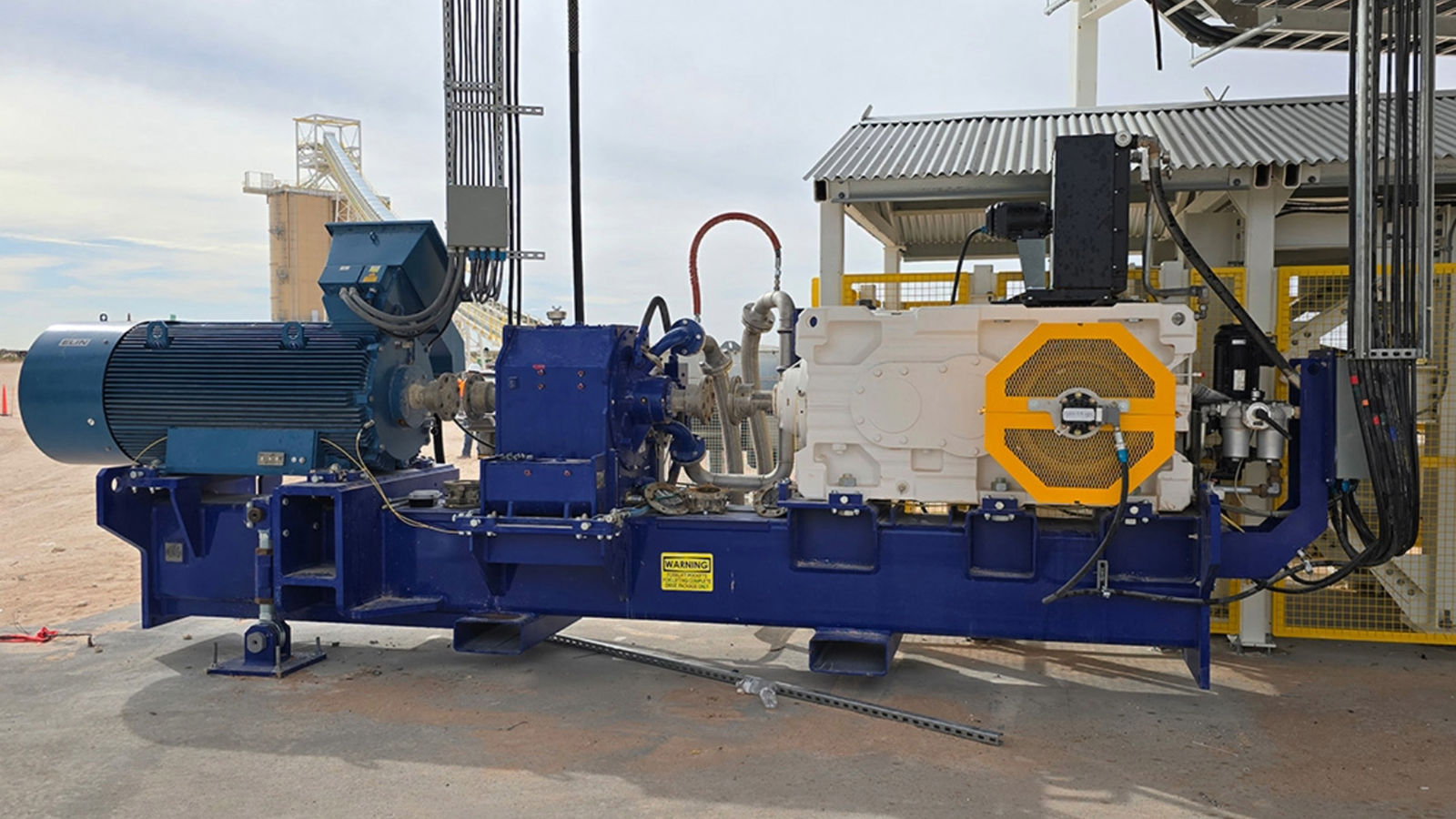
SEW-Eurodrive supplied 36 custom helical-bevel heavy industrial gear units engineered specifically for continuous-duty performance in rugged desert conditions. (Image: SEW-Eurodrive)

SEW-Eurodrive is helping power one of the most ambitious bulk material handling projects in North America through its contribution to the Dune Express conveyor system, a record-setting 42-mile single-flight conveyor designed to transport frac sand across the Permian Basin. Developed by Atlas Energy Solutions in collaboration with system integrator Voith Turbo, the Dune Express system is designed to move up to 13 million tons of frac sand annually from Kermit, Texas, to the New Mexico border.

The infrastructure-scale conveyor is expected to significantly reduce truck traffic, roadway congestion, fuel consumption, and associated emissions while improving logistics efficiency for wellsite operations.

“The Dune Express is a step change in oilfield logistics and will help redefine the efficiency and reliability for the Permian oil and gas community. In addition, the Dune Express will help make the communities of West Texas safer places to work and live by reducing truck traffic on public roads,” said John Turner, president and CEO of Atlas Energy Solutions.

Atlas Energy Expands Autonomous Truck Operations

Atlas Energy Solutions Inc. recently announced an expansion of its autonomous truck operations in the Permian Basin, advancing its commitment to unlocking energy by digitally transforming oilfield logistics. 
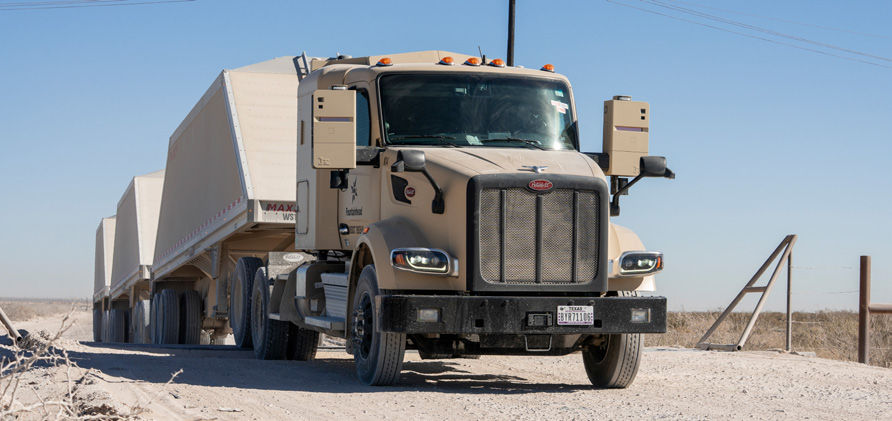
Working with Kodiak AI, Inc. (“Kodiak”) (Nasdaq: KDK), a leading provider of Physical AI-powered autonomous driving technology, Atlas is expanding its driverless proppant delivery program to a second simultaneous load-out point along its 42-mile Dune Express sand conveyor system. This additional load-out point expands the reach of autonomous deliveries and increases Atlas’s responsiveness to growing customer demand. 
In addition, Atlas and Kodiak have agreed to a delivery timetable that will expand Atlas’s Kodiak-enabled fleet from 28 driverless trucks operating as of March 31, 2026, to 100 autonomous delivery trucks by mid-2027. The companies also expect to have the fleet operating on public roads by early 2027, subject to regulatory and operational milestones, dramatically expanding the reach of the Atlas autonomous fleet. 
“This partnership with Kodiak is a critical part of the Atlas strategy to transform oilfield sand logistics through innovation,” said Turner of Atlas Energy Solutions. “Our mission is to seek critical energy infrastructure with inefficiencies, then engineer solutions that improve efficiency, reduce risk and enhance our customers’ operational success.” 
Atlas helps oil and gas producers overcome complex operational and technical challenges by providing high-quality proppant critical to well completions. By integrating mining and transportation automation with advanced last-mile logistics management, Atlas accelerates and simplifies access to critical oil and natural gas resources while reducing operational complexity, risk and cost. 
Atlas is now concurrently operating driverless trucks at load-out sites located in Texas and New Mexico. Trucks equipped with the AI-enabled Kodiak Driver, Kodiak’s autonomous driving system, now have expanded reach and service area to haul sand to well sites across the Permian, one of the world’s most prolific oil and gas basins. Previously, Atlas’s driverless trucks operated from one load-out point at a time. With autonomous operations now running from two distinct locations, approximately 90 minutes apart, Atlas can serve customers across a larger geographic area simultaneously. 
Atlas’s autonomous program has scaled steadily since its initial driverless deployments in 2024. As of March 31, 2026, Atlas operated 28 driverless trucks across 15 distinct routes, which together have carried approximately 7,000 loads and hauled more than 450,000 tons of sand. The fleet also completed over 23,500 driverless hours of operation in the first quarter of 2026. On July 20, Kodiak-powered trucks delivered 176 loads of sand in a single day, an all-time daily high across 18 months of driverless deployments with Atlas in the Permian Basin. 
“Together, Atlas and Kodiak have deployed the world's largest fleet of driverless big-rig trucks,” said Don Burnette, founder and CEO, Kodiak. “We've demonstrated that autonomous trucking is delivering meaningful results today. Our expanding partnership, which now covers two unique locations, is creating a blueprint for how autonomy can transform logistics by improving efficiency, increasing productivity, and delivering lasting value for customers at commercial scale.” 
Earlier this year, Kodiak and Atlas collaborated to introduce advanced capabilities making it possible for one autonomous truck to haul three connected trailers simultaneously. This milestone marks the first ever autonomous triple-trailer trucking operation, with a combined loaded weight of more than 135 tons. Kodiak and Atlas expect to operate Atlas trucks on public roads by 2027, dramatically expanding the reach of Atlas’s autonomous fleet. 
atlas.energy

Atlas is now concurrently operating driverless trucks at load-out sites located in Texas and New Mexico. (Image: Atlas Energy Solutions)

Environmental Demands

To support the extreme demands of the application, SEW-Eurodrive supplied 36 custom X.e Series helical-bevel heavy industrial gear units engineered specifically for continuous-duty performance in rugged desert conditions. The project required advanced thermal validation, high torque capacity, precision mechanical integration, and long-term reliability.

Share and save:


This article appeared in the September 2026 issue.


Read PDF

[advertisement]

Digital data models and the latest calculation methods lay the foundations for a further improvement in the performance of Generation X.e helical-bevel gear units.

SEW-Eurodrive continuously factors the findings of field/test stand trials and simulations into its own calculations, thereby improving their accuracy and reliability. The mechanical and thermal design was precisely evaluated on this basis. In conjunction with the component optimizations already implemented in the past, this results in even higher thermal limit ratings, a much longer bearing service life, and higher nominal torques.  Larger application angles are now permissible with the maximum overhung load. 

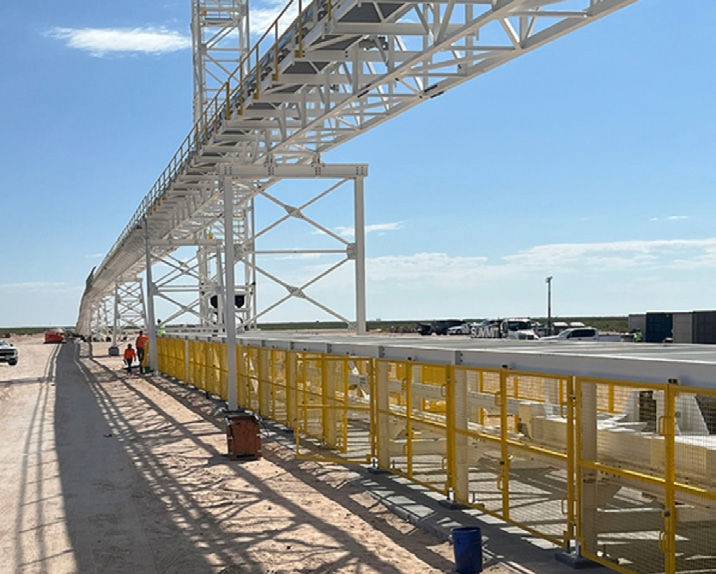
The Dune Express conveyor belt is one-of-a-kind and is expected to significantly reduce traffic accidents and enhance the safety of public roads. (Image: SEW-Eurodrive)

One potential result of these optimizations for users is a smaller gear unit size. Besides reducing the oil volume, energy consumption and total cost of ownership (TCO), this also means users' own designs are lighter and take up less space.

For drives subjected to high loads and mechanical safety concerns, the potential for damage prevention is improved. Additionally, a lower oil-bath temperature and a higher bearing service life mean less frequent maintenance during operation. These are vital when transporting material across one of the most demanding conveyor applications ever constructed.

“Engineering for a 42-mile conveyor takes more than horsepower. It takes understanding application dynamics, thermal performance, and logistics at scale,” said Austin Burdette, project manager, heavy industrial gearing at SEW-Eurodrive. “Our X.e gear units and engineering teams delivered the reliability and performance required for a project of this magnitude.”

SEW-Eurodrive engineers collaborated closely with Voith Turbo throughout the project to deliver the following:

  • Gearbox sizing matched to application dynamics

  • Thermal performance modeling and bearing life analysis

  • Mechanical interface verification and fabrication support

  • Integrated condition monitoring and safety specifications

[advertisement]

On-site commissioning and logistics support

Technical Advantage

The magnitude and complexity of the Dune Express project required significant technical work. As reported earlier in PTE, the multimillion-dollar project required different drive package designs for the install. Most significantly, the drives needed to be designed to provide a specified acceleration time of 10 minutes for the conveyors. This extended start-up time was required to maintain belt tensions, especially along the lengthy horizontal curves for two of the system’s four belts. This start-up time is significantly longer than most large conveyors, which typically require 60 to 120 seconds.

During the planning phase, all companies involved had to be mindful of the 42-mile length of the system which included a world record single conveyor belt flight length of 16.4 miles without a mid-booster drive. The Dune Express conveyor belt is one-of-a-kind and is expected to significantly reduce traffic accidents and enhance the safety of public roads. The conveyor belt will also significantly reduce fuel emissions caused by transportation.

The conveyor system incorporates multiple SEW-Eurodrive X.e Series gear units ranging up to 900 horsepower and more than 1.46 million lbs.-in. of nominal output torque, highlighting the scale and technical sophistication of the installation.

Beyond the engineering achievement, the Dune Express represents a major evolution in bulk material transport infrastructure for the oil and gas industry. By replacing significant volumes of truck-based sand transportation with a continuous conveyor system, the project is expected to improve operational efficiency while reducing environmental and roadway impacts throughout the region.

seweurodrive.com


×

Like What You see?

Power Transmission Engineering magazinePower Transmission Engineering is THE magazine of mechanical components. PTE is written for engineers and maintenance pros who specify, purchase and use gears, gear drives, bearings, motors, couplings, clutches, lubrication, seals and all other types of mechanical power transmission and motion control components.

E-mail

Choose at least one from the options below:

 Power Transmission Engineering magazine, published 8 times per year (print or digital).

 Power Transmission Engineering e-mail newsletter, published weekly.

 Special Offers and promotions via e-mail from Power Transmission Engineering's advertisers and partners.

*Unsubscribe any time.
Full details in our privacy policy
Already a subscriber? Log in