

Festo Bionic Learning System Shows Off Three New Technologies
Festo recently introduced featured developments for 2015 in the company’s Bionic Learning Network – the basic research effort designed to use biomimicry and emerging technologies, like superconductors, to make automated processes even more efficient and productive.
This year’s projects were designed to illustrate how individual systems can use communication to merge into an intelligent overall system, and how the intelligence of decentralized systems contributes to this process.
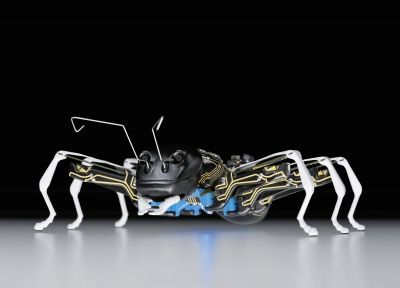
The technology carrier BionicANTS uses the cooperative behavior of ants as a model. Engineers from Festo used regulation algorithms to transfer the behavior of these insects to the world of technology: just like their models from nature, the BionicANTS cooperate in accordance with clearly defined rules. This enables the BionicANTS to react autonomously to different situations as individual units, to coordinate their behavior with each other, and to perform actions as a networked overall system. By pushing and pulling in a coordinated manner, BionicANTS shift loads that one ant could not move alone. All actions are based on a distributed catalog of rules that was devised in advance by means of mathematical model building and simulations and then programmed into each ant. The individual insects are thus able to make decisions autonomously, while nevertheless subordinating themselves to the common aim; each ant thus contributes its share to solving the task at hand.
The required exchange of information between the ants is conducted via radio modules in each torso. The regulation strategy comprises a multi-agent system, in which the participants have equal rights. With the 3D stereo camera in their heads, the ants recognize an object to be grasped and can determine their own locations.
To manufacture BionicANTS, laser-sintered components are fitted with visible circuit structures in a Molded Interconnect Device (3D MID) process. The electrical circuitry is attached to the outer surface of the components, which assumes both a structural and an electrical function.
BionicANTS are fitted with piezo-ceramic bending transducers in their mouthparts for gripping objects, and also for their leg movements. When the upper bending transducer is deformed, the ant raises its leg. With a lower pair of piezo elements, each leg can be precisely moved forward or backwards.






 Power Transmission Engineering is THE magazine of mechanical components. PTE is written for engineers and maintenance pros who specify, purchase and use gears, gear drives, bearings, motors, couplings, clutches, lubrication, seals and all other types of mechanical power transmission and motion control components.