
[advertisement]
Revolutions

May 27, 2026


Manufacturing Automotive Electric Vehicle Electrification E-Mobility Off-Highway Vehicles Drive Systems Electric Motors Motors Feature Articles Software Transportation Revolutions

Digital Process Chains for Hairpin Stators

How Gehring Technologies Accelerates Prototyping and Secures Industrialization

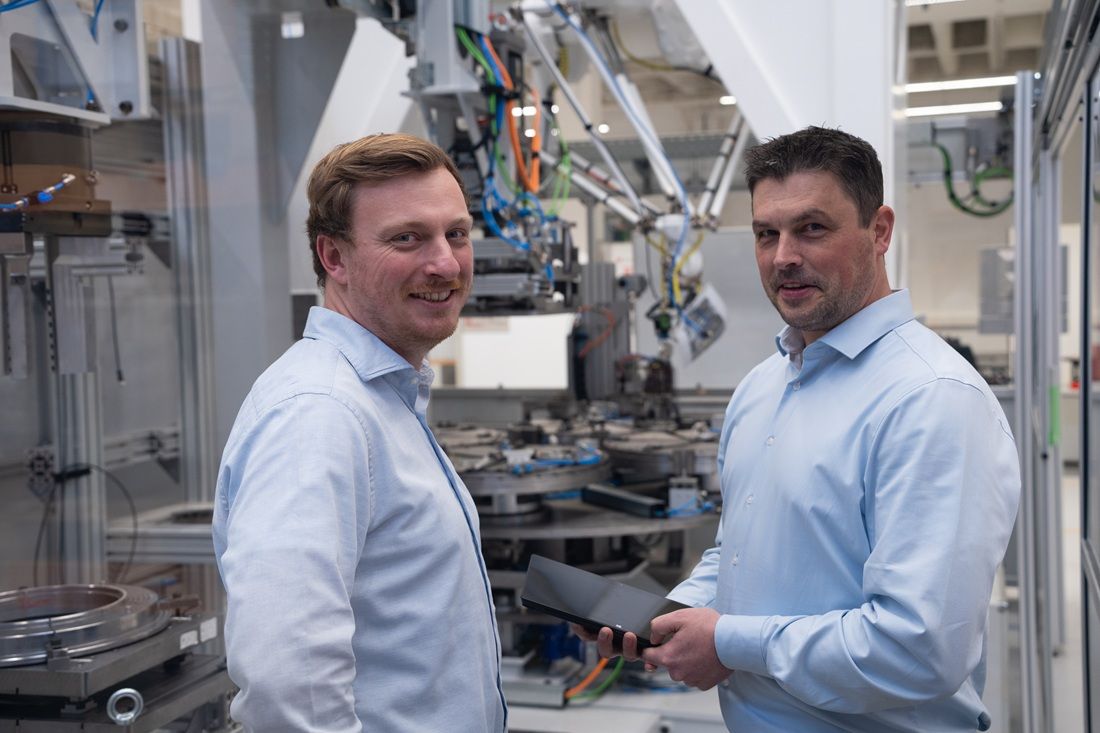
From left to right: Laurens Schmid (team lead development assembly and joining) and Dr. Andreas Wiens (head of technological development at Gehring Technologies).
Images: Gehring Technologies

The increasing electrification of drive systems is leading to a growing variety of hairpin stator designs, while development cycles continue to shrink. Traditional prototyping processes—relying on series-oriented special tooling and sequential development workflows—are increasingly reaching economic and time-related limits. Long procurement lead times, high one-off tooling costs, and limited integration between development and production complicate the efficient realization of early prototype stages.

Against this backdrop, Gehring Technologies GmbH + Co. KG has developed an integrated digital process chain that systematically links geometric development, simulation-based process validation, and series-oriented prototype manufacturing.

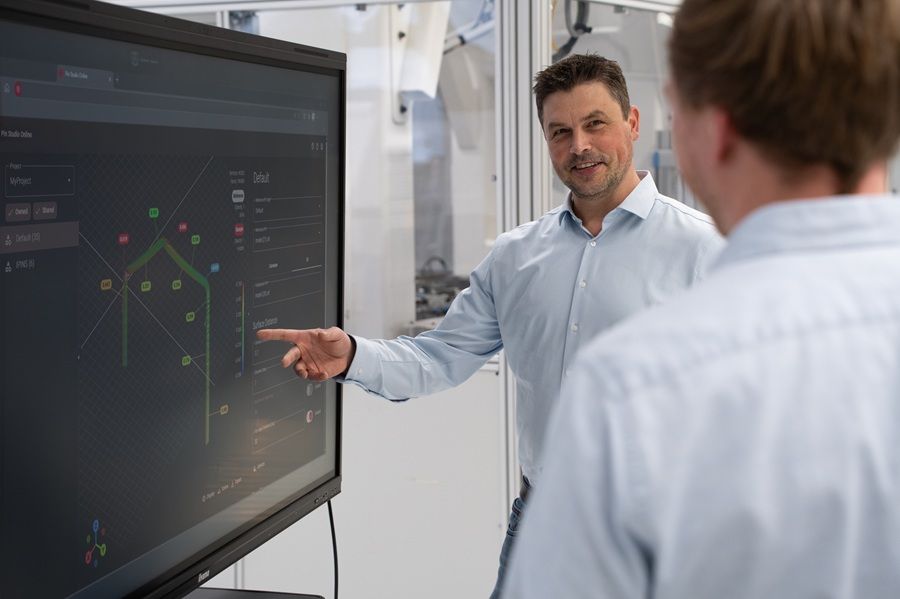
The objective of this approach is to validate development decisions at an early stage, significantly reduce iteration loops, and ensure industrial feasibility already during the prototyping phase. The foundation is a modular software toolkit consisting of parametric geometry modeling (Winding Designer), process-specific forming simulation (Twist Simulator), and automated geometric quality analysis (PinStudio). These modules can be used independently or combined into a continuous digital development and manufacturing chain—suitable for both prototyping and series production.

Parametric Development as a Driver of Product Creation
At the core of the development phase is the Winding Designer, a parametric modeling tool for hairpin stators. Instead of conventional CAD design, the system generates the complete stator geometry directly from electromagnetic target parameters. Spatial constraints, manufacturing conditions, and geometric dependencies are embedded in the model, allowing the design to be algorithmically derived from relevant input parameters.

This approach enables development speeds unattainable with conventional CAD processes. Changes to conductor routing, end-winding geometry, or interconnections can be implemented almost in real time. The model updates automatically, including all derived process geometries. Development engineers can therefore generate, compare, and evaluate variants interactively.

Share and save:


[advertisement]

As Dr. Ludwig Hausmann, Head of Analytics and Modeling at Gehring Technologies, explains: “Using the Winding Designer, we can perform geometric adjustments in real time. This speed is not achievable with traditional design methods - it fundamentally changes the dynamics of the development phase.”

A key advantage lies in shifting the developer’s focus toward functional design. Instead of detailed geometric construction, the emphasis is placed on electromagnetic target definition. The system handles geometric implementation while accounting for manufacturing constraints. At the same time, key metrics such as conductor length, copper mass, and electrical resistance are automatically calculated and made available for further design optimization. Dr. Andreas Wiens, responsible for technological development at Gehring Technologies, emphasizes: “Component
geometry is now derived directly from electrical targets. Manufacturing aspects are considered from the outset, significantly reducing later correction loops.”

Virtual Process Validation and Automated Quality Assessment
To further ensure manufacturability, Gehring Technologies integrates simulation-based tools into its digital process chain. The Twist Simulator virtually models plastic deformation processes during hairpin twisting. Material properties, geometric parameters, and process-specific boundary conditions are incorporated, enabling a realistic simulation of the entire process.

This simulation provides a reliable basis for decision-making in both development and production. Deviations between target geometry and expected process outcomes become visible at an early stage, allowing design adjustments before physical prototypes are produced. Hausmann explains: “We simulate the process virtually and obtain reliable insights into manufacturability. The data can be directly transferred to the real process, ensuring high reliability and reducing the risk of costly iterations.” For users, this results in increased confidence. Development decisions are no
longer based solely on experience but on simulation-driven predictions. Reference applications demonstrate a high correlation between simulated and actual process results, further strengthening trust in digital validation. In addition, PinStudio enables specialized geometric quality assessment of hairpins. The analysis module processes 3D measurement data from various systems and performs automated target-versus-actual comparisons. Deviations are not only detected but also localized within the process, allowing error-causing bending steps to be identified and corrected.

The system’s value lies in its transparency and ease of use. The interface is intuitive, and evaluations are automated and reproducible. PinStudio supports both existing customers seeking statistical process monitoring and users developing their own hairpin designs. Hausmann summarizes: “PinStudio makes process deviations visible. The evaluation is automated, reproducible, and independent of the operator—creating a level of comparability that is difficult to achieve with conventional measurement methods.”

Series-Oriented Prototyping as a Bridge to Industrialization
Based on digitally validated development data, the process transitions into physical prototype manufacturing. Gehring Technologies employs a modular tooling concept that combines series-oriented base modules with component-specific rapid prototyping elements. Standardized fixtures are reused, while product-specific adaptations are primarily produced via additive manufacturing or fast sheet-metal processing.

This approach significantly reduces tooling costs and lead times. While traditional prototyping projects often take several months, A-samples can now be realized within six to twelve weeks. Project costs typically decrease by more than 40 percent. A key factor is the consistent alignment with series production. Prototypes are manufactured on machine platforms closely aligned with future production systems. Dr. Wiens highlights: “Our prototypes are not produced on isolated test rigs. They are manufactured on series-oriented machines - ensuring transferability to production from the very beginning.”


Seamless Integration of Digital Development and Physical Validation
Overall, digital development approaches and physical prototyping are deliberately interlinked. While digital tools accelerate and secure product development, physical manufacturing serves as a reference for validating virtual designs. Prototyping thus increasingly becomes a validation step within an integrated development strategy.

[advertisement]

At the core lies a consistent data model functioning as a digital twin across all process stages. The parametric development model serves as a reference for CAD geometries, simulation models, measurement data, and tooling and process derivations. Design changes are automatically transferred to downstream manufacturing and quality assurance processes, significantly reducing discontinuities between development, production, and quality control. This creates a new dynamic for development teams. Variant studies can be accelerated, design changes evaluated immediately, and manufacturability ensured at early stages. Production teams benefit from series-oriented prototypes, reproducible quality data, and more stable ramp-up processes—
especially in projects with low initial volumes or new drive concepts.

Beyond Automotive: Expanding Application Potential 
The combination of digital development platforms and series-oriented prototyping also opens new opportunities beyond traditional automotive applications. Commercial vehicle drives, industrial electric motors, and customer-specific special applications can be realized using similar development strategies. Companies without in house hairpin development expertise gain access to an end-to-end development and industrialization approach. Gehring continues to expand this strategy, further developing its digital toolchain and integrating additional process modules. The goal
is tighter system integration and greater involvement of external users in early development phases.

As a result, prototyping is evolving from a classical development stage into a strategic component of digital product creation. Physical manufacturing becomes proof of the virtual design, while a scalable platform emerges - reducing development times, minimizing industrialization risks, and significantly shortening time-to-market for new electric drive systems.
By consistently integrating simulation, development, and production, Gehring Technologies positions itself not only as a machine manufacturer but as a system partner for industrial electric motor production. The digital twin serves as the central anchor of a development methodology that significantly accelerates the transition from concept to series-ready product.

gehring.com


×

Like What You see?

Power Transmission Engineering magazinePower Transmission Engineering is THE magazine of mechanical components. PTE is written for engineers and maintenance pros who specify, purchase and use gears, gear drives, bearings, motors, couplings, clutches, lubrication, seals and all other types of mechanical power transmission and motion control components.

E-mail

Choose at least one from the options below:

 Power Transmission Engineering magazine, published 8 times per year (print or digital).

 Power Transmission Engineering e-mail newsletter, published weekly.

 Special Offers and promotions via e-mail from Power Transmission Engineering's advertisers and partners.

*Unsubscribe any time.
Full details in our privacy policy
Already a subscriber? Log in