How Model-Based Design and Digital Twins Transform Diagnostic Accuracy
Drive System Design bridges the gap between engineering reality and data-driven prediction. (All images: Drive System Design)
Across sectors, the same operational truth is becoming harder to ignore: downtime has a direct impact on revenue. It ripples into supply chains, disrupts mission readiness, compromises service levels and, in some environments, creates genuine safety risk.
Yet many maintenance strategies are still built around scheduled servicing and reactive repair. One strategy replaces parts “just in case”, the other replaces them after the damage is done. Both carry cost, disruption and waste. Neither have caught up to a world where products are more complex, more connected, and customers expect more functionality with faster turnaround—with less tolerance for failure.
This is why health management systems and predictive maintenance have become an operational necessity. The goal is to reach a careful balance of detecting when degradation will occur, diagnosing it correctly, and determining when the most cost and time-effective moment is to act without sacrificing safety. Not too late, and not too early.
The Value of Turning Data into Decisions
Sensors are everywhere now. Land based vehicles, aircraft, manufacturing lines and industrial equipment generate streams of vibration, temperature, current, pressure and performance data. The temptation is to assume that more data automatically leads to better predictions.
A classic example is a rotating component, such as a wheel-end bearing, a gearbox stage or motor assembly which operates across changing speeds, loads and environments. The system moves between low and high rotational speeds; it sees transient conditions, temperature changes, variable torque demands, road or runway inputs and unexpected events.
Without engineering insight, it’s easy to trigger false positives which send vehicles in for inspections that they don’t need, ground aircrafts unnecessarily, or stop a production line because of suspicions about one cog. False positives are not a minor inconvenience; they are a cost center. They erode trust in the system and push teams back toward traditional preventative schedules.
Equally, a false negative diagnosis can be worse than no diagnosis. In defense applications, a breakdown can impact live military operations. In aerospace, uncertainty drives conservative replacement schedules that inflate cost. In manufacturing, a small, undetected degradation can quietly reduce product quality before the line stops altogether.
So predictive maintenance isn’t a “data problem.” It’s a decision problem: when do you intervene, why and what action is justified?
Increased Ingenuity & Flexibility in Farmington Hills
Matthew Jaster, Director, Editorial Content
Drive System Design’s (DSD’s) original U.S. facility housed a loaded transmission efficiency test rig and additional driveline test equipment for transmissions, supercharger gearboxes, hydraulics and lubrication analysis. The new Farmington Hills, MI. facility, a few miles from the original location, is much larger and allows DSD to tackle larger design and testing applications outside of automotive.
“One of the major drivers to moving to a larger facility was gaining projects and customers outside of automotive,” said Jason Schneider, director of electrified powertrain at DSD. “We’re handling jobs for commercial vehicles, defense and off-highway applications that require more torque, larger diameters, etc., much larger projects than what you traditionally see in automotive design.”
A move paying off as DSD is gaining a larger, more versatile customer base here in the United States. I visited the facility last fall and can only describe it from a journalist's perspective as a cross between a laboratory and a LEGO project where test cells are transformed, rearranged and extremely versatile, supporting customers with a variety of different engineering scenarios.
There are test cells affectionately known as “Beauty and the Beast” where one area is streamlined, compact and efficient and the other is a gigantic, monstrosity of components built for power. It’s entertaining to imagine how these workspaces change every few months and how much fun the engineers have in creating new systems with new testing parameters.
“The goal was to have everything under one roof,” Schneider said. “Our expanded footprint allows us to handle the engineering, design, analysis, development, testing all right here and deliver validated hardware from a single location.”
The expansion also came from customer requests wondering if DSD was planning to expand to meet the changing energy requirements found in today’s engineering systems. “We wanted the extra space to set up test environments and solve real world problems and create custom solutions for their unique applications. The facility is about three and a half times the size of our original location,” Schneider added.
[advertisement]
DSD recently achieved Cybersecurity Maturity Model Certification (CMMC) Level 2, reinforcing its commitment to the highest standards of cybersecurity for customers operating in defense and aerospace.
This certification confirms full compliance with all NIST SP 800-171 requirements and authorizes the business to manage and protect federal contract information and controlled unclassified information across the Defense Industrial Base. Following an independent third-party assessment with a C3PAO, DSD received certification for CMMC—the US Department of Defense’s cybersecurity framework for organizations handling sensitive defense information.
This milestone reinforces DSD’s expert ability to combine specialist propulsion engineering with the secure handling of sensitive program information.
“The move also opened up additional testing opportunities,” Schneider said. “If a customer has the hardware ready to go and they just need the test cells we can create the environments they need here in Farmington Hills. The flexibility and versatility of the equipment allow us to cover electrification across several key industrial segments.”
DSD accelerates the development of next-generation powertrains through simulation-led design, advanced testing and a unique global delivery model.
How Model Based Design Predicts the Future
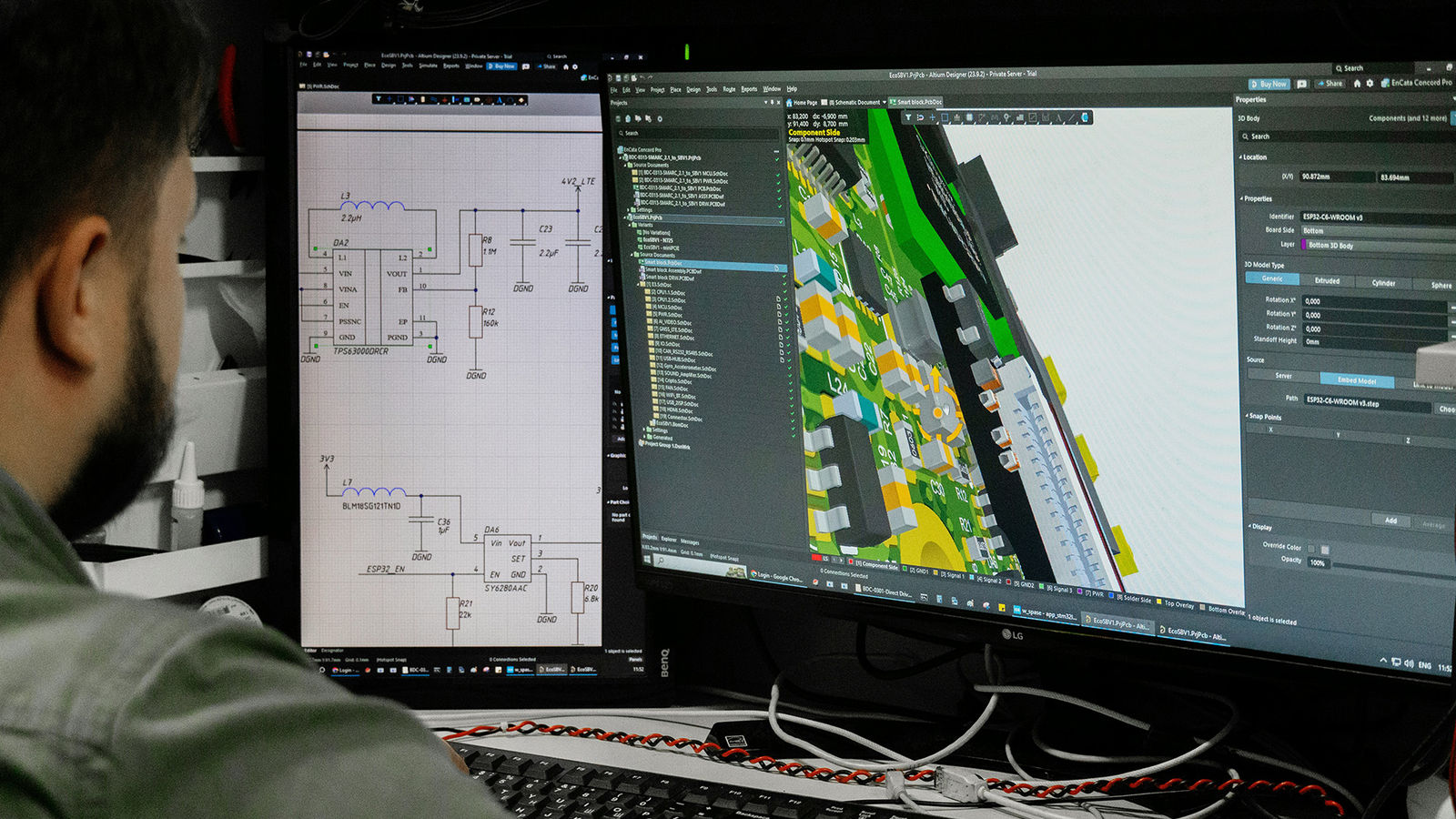
This is where model based design can be applied as the practical bridge between engineering reality and data-driven prediction.
A model-based approach starts by treating the system, rather than a dataset. It uses physics-based modelling to represent how components should behave, how failures can emerge, and what ‘healthy’ looks like across operating conditions. Done well, it provides a reference against which real-world data can be interpreted.
Take the rotating component example. With the right physical model, it becomes possible to simulate operational loading, vibration response and degradation pathways, and then understand how these evolve over time. That might include building a model that can estimate when wear reaches a threshold that should trigger inspection, or when a bearing is likely to need replacement after a given duty cycle. The point is not to predict definite replacement after a certain number of hours or miles; it is to create a defensible engineering basis for predicting remaining useful life and planning intervention.
This is the core advantage of model-based design in health management: it makes prediction interpretable at pace. Rather than waiting for long-term field data to accumulate, engineering teams can explore failure behavior virtually, test assumptions early, and refine diagnostics before a system reaches the end of its life.
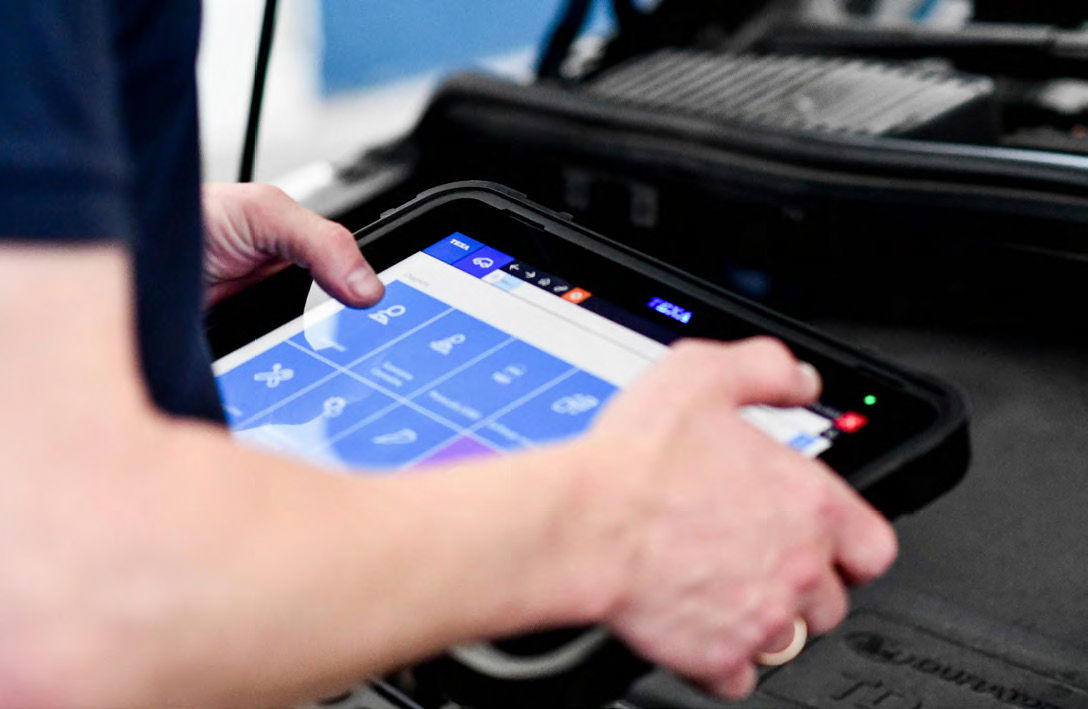
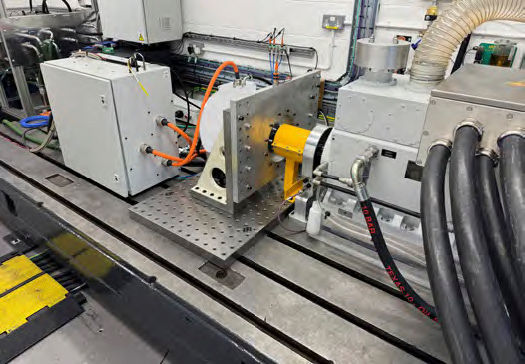
Machine learning and data analytics add the most value when they’re grounded in physics-based engineering like this test conducted at DSD's facility in Michigan.
Why Computing is Changing What’s Economically Viable
Cloud computing, high-performance processing, and accessible AI tools now make it more realistic to run complex models alongside streaming data. As predictions can be updated in near real time when conditions change, models can be richer, diagnostics can be more granular, and lifecycle decisions can be made dynamically rather than on fixed schedules.
Machine learning and data analytics add the most value when they’re grounded in physics-based engineering. They help cut through noisy real-world data to improve diagnostic accuracy, handle variability across real duty cycles, and speed up decisions from detection to action. This reduces unnecessary maintenance and avoids costly downtime.
The core advantage of model-based design in health management is that it makes prediction interpretable at pace.
Crucially, this shift makes health management viable in sectors where cost previously made it hard to justify. When the computation and analytics become scalable, the conversation moves from “Can we afford to do this?” to “Can we afford not to?”
Predictive Maintenance as a Lifecycle Strategy
The organizations that gain the most won’t treat predictive maintenance as an add-on module. They’ll build it into the lifecycle strategy in how systems are designed, validated, operated and improved.
That means designing for observability (what you measure and why), designing models that reflect realistic failure modes, and building analytics that prioritize reliability over novelty. It also means focusing on the operational consequences: avoided downtime, reduced unnecessary part replacement, improved asset availability, and better-informed overhaul planning.
As systems become more electrified, more software-defined and more operationally connected, the center of gravity shifts from designing components to managing performance over time. Reliability becomes a design outcome as opposed to just a maintenance objective.
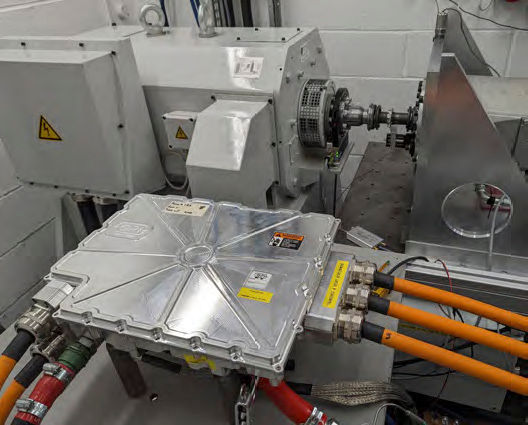
Test cells measure realistic failure modes that focus on operational consequences of the drive systems.
Health management and predictive maintenance are the goals. Model based design is the enabler. Data analytics and machine learning accelerate this, but only when rooted in the realities of physics, operating context and failure behavior.
The organizations that bring these tools together will reduce downtime. But they’ll also make smarter lifecycle decisions, protect revenue, reduce waste and build systems that can be trusted, not only when they’re new, but when they’re years into service.
Power Transmission Engineering is THE magazine of mechanical components. PTE is written for engineers and maintenance pros who specify, purchase and use gears, gear drives, bearings, motors, couplings, clutches, lubrication, seals and all other types of mechanical power transmission and motion control components.
*Unsubscribe any time. Full details in our privacy policy










 Power Transmission Engineering is THE magazine of mechanical components. PTE is written for engineers and maintenance pros who specify, purchase and use gears, gear drives, bearings, motors, couplings, clutches, lubrication, seals and all other types of mechanical power transmission and motion control components.