Smart Factory solutions hint at machine design potential in 2018
Matthew Jaster, Senior Editor
The future of motion control is connectivity. Conversations continue to revolve around the
concept of the smart factory—a plant where
manufacturing blends data and production seamlessly and integration is the
be-all, end-all to long-term success. While we’re not there yet, the concepts,
technologies and potential of the smart factory is certainly taking shape in manufacturing
today.
For every challenge facing machine builders, the answer
will most likely come in the complete optimization and digitalization of
products and services. Actuators, servo drives, encoders, servomotors and
software provide solutions for a wide range of industrial applications today.
These components will be pivotal in driving the technology needed to run the
smart factory of the future. Here’s how the motion control industry is
capitalizing on the latest products and technologies:
1. Creating More Flexible, Modular Machines
Daniel Repp, industry manager, automation at
Lenze, believes it’s no longer only about connecting drives and transmitting
data to subordinate systems, but rather providing software to support the OEM
in the development of flexible, modular machines.
This can be as simple as making frequently-used machine
functions available as standardized technology modules or adding pre-configured
and tested software modules via the application template and adjusting the
parameter settings.
“Automation specialists should work the way they are used
to—with a basic
architecture. The functions are enclosed in the individual modules. The modules
are autonomous and can easily be exchanged and tested completely independently.
The software toolbox provides standard software modules for positioning, cam
profiling, multi-conveyor coordination, and other synchronized motion control
tasks, including modules for feeding, unwinding, sealing, cross-sealing and
pick and place robotics,” Repp said.
Up to 80 percent of machine software engineering
requirements are covered by the modules available from Lenze’s FAST platform.
“This leaves more time for the machine builder to focus on
the development of a machine’s special performance features. It also allows for
a savings on engineering costs while, at the same time, speeding up the machine
design process,” Repp added.
2. More Servo Module Options
Because the cost of power electronics and motor
components are decreasing each year (relative to economic forces), AMK is
making an effort to replace more motion on a machine with servo modules. Things
that once had to be pneumatic due to costs are now in the range of servo
control which gives the OEM the ability to create machines without timers—now they know
absolutely where the mechanics of the machine are at all times.
“Because of the power of the digital signal processor
(DSP) we are using, we are able now to create motion systems that do not need a
centralized controller,” said Tom Jensen, general manager at AMK Automation. “This
makes the machines we are on actual “machine modules” and makes things like
robotic cells, conveyor integration possible in a small cabinet—or likely cabinet
free,” Jensen said.
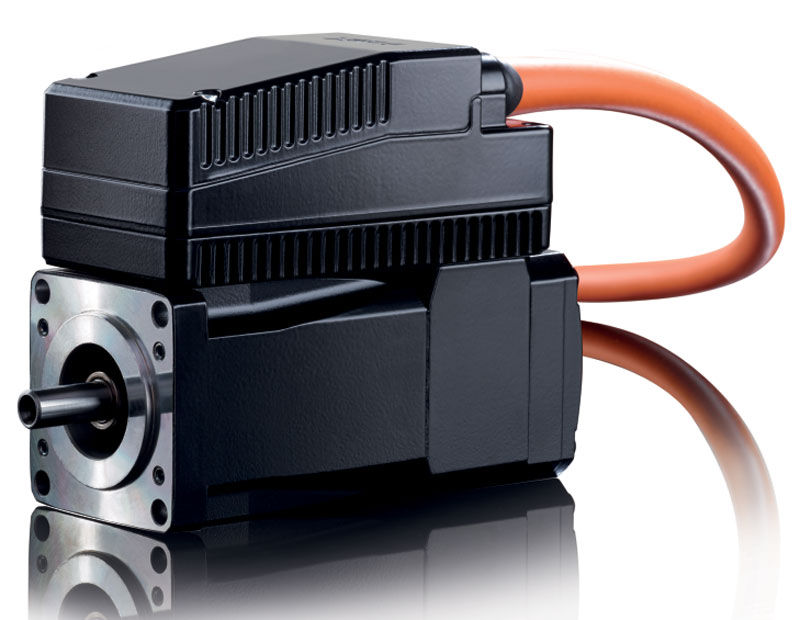
With its new ihXT series, AMK is expanding its AMKASMART
decentralized product family to include a full-value servo drive
with a power range of 150 to 450 watts. (Courtesy of AMK)
3. Ease of Installation
On the installation front, Craig Nelson, senior
product manager at Siemens Industry, Inc., said it is now very common to only
use a single cable between servomotor and drive on servo systems which reduces
the installation time and cable trays—the result is a
simple install that increases productivity and efficiency.
“This is made possible by the fact that encoder signals
are now sent via serial communication, which, once shielded properly, can be
run in the same hybrid cable as the motor power leads and brake leads,” Nelson
said.
4. Innovations in Remote
Diagnostics
Jensen said that remote diagnostics are a focus of
every automation company because of the times we live in, but they need to
provide an action path for the machine owner to be effective. Therefore, AMK is
working on a combined Remote/HMI diagnostic to harmonize the pathway to keeping
machines running.
“As an example, automobiles today have enough dashboard
(HMI) information that the driver knows what is going on (tire pressure, fuel,
oil, etc). What this connectivity provides is the next step in the
process–where to find service, gas, oil. What this combination can do for plant
machinery is to effect a course of action when an alarm arises (call the right
maintenance personnel, but also plants can reduce speeds and cycle machinery
based on plant environmental conditions, power input conditions and other
external variables keeping the operator and machine efficient even when
conditions aren’t,” Jensen said.
Repp said that Lenze is moving far beyond simple remote
maintenance by enabling its customers to be IIoT-ready—a
key element for future machine development.
[advertisement]
“We find that when IIoT systems communicate with each
other, their value is multiplied. This makes interoperability essential and
increases the benefits exponentially. As technology segments get closer and
grow together through digitalization, these cross-functional innovations become
more likely to occur,” Repp said.
5. Trusting Engineering Experience
One thing AMK is focused on in the United States
is the elimination of templates, according to Jensen. For years the automation
industry has focused on templates to hide the complexity of machine
programming, with the goal of making training and adoption simpler.
“This strategy only works if the team developing the
template can make a template that every engineer understands. The
strategy therefore has worked well in niche markets (robotics), but has made
general automation much more complex (that is why you don’t (but could) use a
robotic controller on a conveyor cell,” Jensen said.
AMK has instead created training and tools based on the
fact that the U.S. automation engineers are the best and can handle IEC 1131
programming environments as they are.
“Our bet is that a little more up front training will
allow engineers to create great machines well beyond the initial training with
support only needed for new forward-looking machine concepts,” Jensen said.
6. Staying Connected to the Cloud
Nelson at Siemens Industry, Inc. said that the
increased connectivity of servo systems to Ethernet-based communications for
control and integration into cloud-based analytics represents a future-proof
trend with instant payback as little or no additional costs are typically
occurred.
“Built-in Industrial Ethernet interfaces are common for
most all servo drives today with some offering connectivity to multiple
Industrial Ethernet protocols such as Profinet or EtherNet/IP.” Nelson said.
7. Single Software Solutions
Jensen said the question of software is not as
simple as pointing at the PC based editor most engineers see, because software
exists at every level (in every processor) of the motion system—from the firmware
in the motor module through the PC environment.
“AMK has a single software solution based on IEC61131, and
our tools in the environment are incredibly effective because of the harmony
from the single motion control block at the IEC level to the firmware in the
drive. With a handful of function blocks and our integrated tools, we can truly
make any machine—quickly and in the
OEMs methodology,” Jensen added.
Repp said that Lenze has integrated all the safety
functionality into their existing programming software tools.
“We offer one programing tool, the Lenze PLC Designer,
for all programming demands. Whether it’s motion or logic programming, or
safety implementation—it’s all covered by
one product,” Repp said. “Safety functions are also implemented in our FAST
automation software modules. This allows the machine builder to follow the
modular programming standard not only for the machine application program, but
also for the safety part.”
8. Factoring in Safety
Machine safety is pivotal in the building process,
according to Jensen. Without risk analysis completed for each machine design,
the machine will have a hard time being insured making the final sale
difficult.
“Technology providers then have to be able to show how to
use their systems to eliminate risk conditions in the best way,” Jensen said.
As humans are required to interact more frequently with
machines—and robots, in
particular—machine safety
becomes an even higher priority.
“We have taken this into consideration and integrated the
safety functions directly into the different parts of our portfolio—servo inverter,
servo motors, controls and engineering tools,” Repp said. “Because we
understand that these trends are continuously evolving, we offer a safety
solution—controller-based
and drive-based that provides optimal support to the customer and makes his
machine ready for future safety requirements.”
9. Adapting to Changes on the Plant Floor
Safety functions for servo systems and the
machinery they control are undergoing a radical change on the plant floor.
Here, technology is rapidly changing as robots, automated systems and
autonomous guided vehicles (AGVs) become the norm.
Nelson believes the time has come to adapt to these
changes faster and more efficiently.
“Gone are the cabinets of safety relays and contactors
with the proven and flexible adaption to safety integrated drive functions with
safety signals now coming from a failsafe protocol over Industrial Ethernet.
New safety functions for motion control such as Safe Limited Position, Safe CAM
and Safe Torque are game changers for increased safety and productivity today,”
Nelson said.
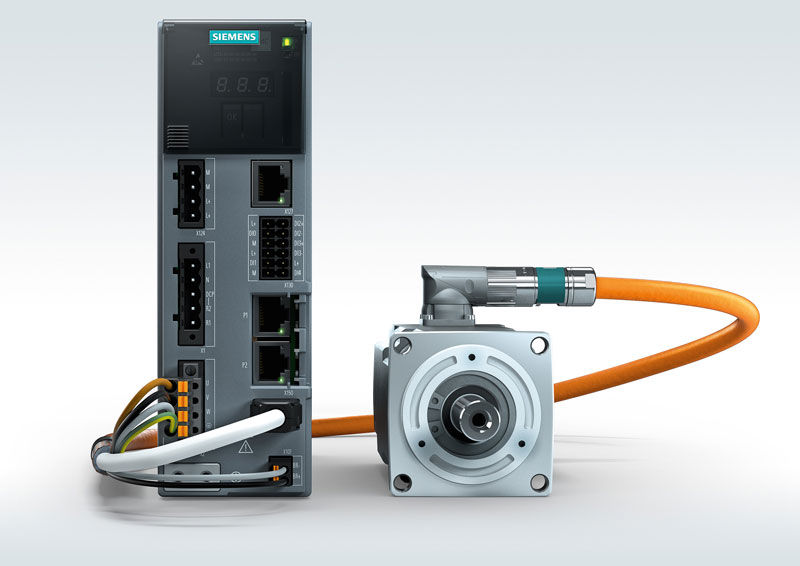
Siemens provides a single cable between a
servomotor and drive to reduce installation
time. Courtesy of Siemens Industry, Inc.
10. Consumer Integration
It’s no secret that when it comes to automation
and motion control, the industrial community lags behind the consumer market by
a wide margin.
“In the near future, the automation industry can expect
the continued influx of technologies from the consumer market into their
portfolios,” said Jensen. “Concepts found in mobile devices and automobiles—Wi-Fi, multiple
cameras, etc.—will become
inexpensive and developed enough that automation engineers will begin to use
them. “
Repp said that consumers love individualized products.
Technologies such as web-based car configurators, individualized beverage
containers or sport shoes have already proven to be successful in the
marketplace.
“The flexibility of a production system for the
manufacture of individually customized products is therefore comparable to the
Holy Grail of production technology,” Repp said. “The advancement of digital
technology—like cheap and
high-CPU performance, or small and cheap memory—means the
long-lasting technological dreams of flexible, autonomous and cost-efficient
production systems, are now very close to becoming reality. This is not only
true for consumer goods, but also for industrial production.”
In short, consumer automation may hold the key for future
products and technologies coming to the industrial market with one awfully
large caveat—technical solutions
take time. An Iphone, Fitbit or pair of running shoes won’t come with the security
concerns, safety requirements, environmental challenges or power needs found in
a pump manufacturing plant or a wind turbine. This is where research and
development will be key to reimagining motion control technologies.
“We need to take advantage of apprentice and mentoring
programs to integrate and test consumer products with our portfolio to see what
is possible,” Jensen added. “Ideas like controllerless automation are
innovations that have come from this process.”
11. A Digital First Approach
Repp is confident that the trend in motion control
for the next five years is the digitalization of industrial processes. “To
improve the quality of new developments, and reduce development time and costs,
many activities will be outsourced into digital processes—a trend that is
already occurring. With continued developments of the IIoT and Industry 4.0,
machines are becoming more connected. Machine builders will benefit from the
optimization of each singular machine, since they can easily be adapted for the
whole machine system. Digital twins of machines will help to reduce development
time and associated cost. Virtual reality environments will improve the tests
and completion of new machines.”
12. Learn, Adapt and
Innovate
Each new concept on motion control starts with
conversations with current customers. How these products and technologies are
put to use—and their
effectiveness—will determine the
course of action for future developments. The feedback received from a servo
drive today will influence how these components will be adapted to new
industrial applications down the road.
Motion control systems—including
controllers, servo drives, rotary and linear servo motors, linear actuators and
software—will continue to
evolve as long as machine builders, engineers and product specialists continue
to strive to make these systems faster and more efficient.
The concept of the
smart factory may still lie behind the curtain, but it’s slowly and
methodically being pulled back to reveal a promising future for manufacturing
production.
Both concepts overlap in several areas, but there
are significant differences between motion control and robotics. This sidebar
aims to clear up some of the confusion with some assistance from National
Instruments, New York University and Omron Adept Technologies.
National Instruments defines motion control software and
hardware as the development of products and technologies that solve a diverse
set of application challenges, faster and at a lower cost. These components can
be applied to robotics, but fall under the motion control umbrella:
Motion Control
Application software—You
can use application software to command target positions and motion control
profiles.
Motion controller—The motion
controller acts as the brain of the system by taking the desired target
positions and motion profiles and creating the trajectories for the motors to
follow by outputting a ±10V
signal for servo motors, or step and direction pulses for stepper motors.
Amplifier or drive—Amplifiers (also
called drives) take the commands from the controller and generate the current
required to drive or turn the motor.
Motor—Motors turn
electrical energy into mechanical energy and produce the torque required to
move to the desired target position.
Mechanical elements—Motors
are designed to provide torque to some mechanics. These include linear slides,
robotic arms, and special actuators.
Feedback device or position sensor—A position feedback
device is not required for some motion control applications (such as
controlling stepper motors) but is vital for servo motors. The feedback device,
usually a quadrature encoder, senses the motor position and reports the result
to the controller, thereby closing the loop to the motion controller.
Looking at Motors in Motion Control Applications
The most common motors in the industrial and
embedded space are stepper, brushed, and brushless DC motors, but there are
other motor options. Each motor requires individual input signals to spin the
motor and transform electrical energy into mechanical energy.
In the broadest sense, motion control helps you use the
motor that best meets your application requirements without dealing with all
the low-level signaling needed to spin a motor. In addition, motion control
provides high-level functions so you can efficiently implement custom
applications based on building blocks to create solutions for common tasks like
precise positioning, synchronization of multiple axes, and movement with
defined velocity, acceleration, and deceleration.
Robotics
According to NYU, the first programmable robot was
designed by George Devol, who coined the term Universal Automation. He later
shortened this to Unimation, which became the name of the first robot company
back in 1962.
Industrial robots gained recognition and rapid growth
during the 1980s. During this time period many institutions began introducing
programs and courses in robotics. Robotics courses are spread across mechanical
engineering, electrical engineering, and computer science departments and they
continue to grow today as the focus turns toward mechatronics and big data.
The design and operation of robotic systems includes
dynamic system modeling and analysis, feedback control, sensors and signal
conditioning, actuators (muscles) and power electronics, hardware/computer
interfacing and more.
What Solution Fits Your Application?
A company like Omron Adept Technologies offers
both motion control systems as well as existing robotic technologies. Most motion
control components can be used in addition to an existing robot or it can be
designed as a stand-alone system. Omron has installed more than 30,000 robotic
and motion control systems in a variety of industrial applications.
While a customer may be wondering if a motion control or
robotic solution would be more appropriate for their automation needs, the
truth is that motion control is really a sub-system of robotics. For example,
many components in motion control—actuators, motors,
etc.—makeup the nucleus
of a Selective Compliance Assembly Arm (SCARA) robot. However, you can create
an automation system without using robotics with the right engineering
experience.
This typically comes down to the engineering support and
technical background within an organization. Productivity and efficiency can
improve if you have the expertise to combine motion control hardware and
software for an automation cell. But, an easier, hassle-free approach may be to
incorporate a few robotic units on your plant floor. They are already assembled,
easy to setup and offer an immediate turnkey solution.
The answer to motion control or robotics lies in how much
time and money you’re willing to invest for the requirements of your
application.
[advertisement]
×
Like What You see?
Power Transmission Engineering is THE magazine of mechanical components. PTE is written for engineers and maintenance pros who specify, purchase and use gears, gear drives, bearings, motors, couplings, clutches, lubrication, seals and all other types of mechanical power transmission and motion control components.
*Unsubscribe any time. Full details in our privacy policy







 Power Transmission Engineering is THE magazine of mechanical components. PTE is written for engineers and maintenance pros who specify, purchase and use gears, gear drives, bearings, motors, couplings, clutches, lubrication, seals and all other types of mechanical power transmission and motion control components.