

[advertisement]
Revolutions

November 10, 2026


Manufacturing Automation Packaging Couplings Revolutions

The Importance of Precision in Automation Systems

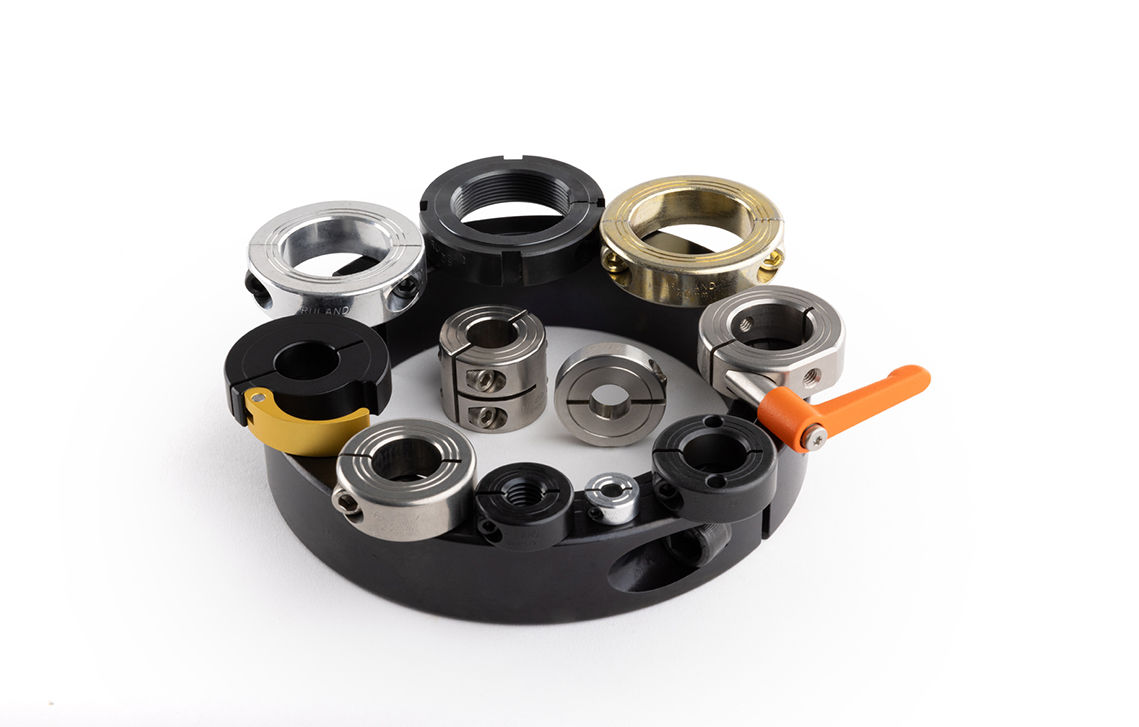
In high-performance automation systems, even the smallest components can carry significant weight. That’s a lesson one U.S.-based OEM learned the hard way when shaft collars – believed to be Ruland parts – began causing failures on packaging machines using linear actuators deployed at customer sites across Asia.

The parts matched the engineering drawing, which still listed Ruland as the source. But when the machines began malfunctioning in the field – drifting out of alignment, requiring emergency servicing, and prompting panic from end users – the OEM turned to Ruland for answers. What they uncovered was a small substitution with major consequences.

A misidentified shaft collar, a real-world failure

The problem surfaced when shaft collars began “walking” down the shaft during use, causing the actuator’s stroke to overshoot its intended limit. These collars weren’t used as hard stops, but rather as precise axial reference points. The moment the actuator reached the collar, it would reverse – meaning even small shifts in the collar position could throw the system out of spec.

When the OEM reached out to Ruland, the support team immediately noticed something was off: the collars had no bore size or manufacturer stamp. Ruland includes both on every shaft collar it ships, precisely for situations like this – ensuring traceability in the event of a failure. These parts may have looked like Ruland collars, but they weren’t.

Without part markings to confirm their origin, the Ruland team turned to the application details. It was there that the issue became clear.

Diagnosing the problem: the face of the matter

Ruland engineers asked how the collars were being used – and the customer explained their role in referencing the actuator stroke. In that type of setup, the face of the collar must be precisely perpendicular to the bore. Without that, the actuator meets the collar at an angle, creating uneven pressure on the shaft. That slight imbalance can cause the collar to move or “walk” with each cycle of the actuator.

Share and save:


[advertisement]

That’s exactly what was happening.

The off-brand collars lacked precision facing – a standard operation on all Ruland collars used in axial applications. Ruland machines the face to within 0.002 inch (0.05 mm) of perpendicularity to the bore and marks the working face with a groove to clearly indicate the correct orientation.

“We precision face our shaft collars to TIR ≤ 0.05 mm (0.002 inch) for this reason,” says Chris Gumas, director of customer experience at Ruland. “While shaft collars are viewed as commodity-type components, this is a clear example of why they are not.”

Without that level of precision, the substituted part simply couldn’t perform in a motion-critical role. Over time, as the actuator continued to contact the collar at an angle, it pushed the part out of position, eventually leading to failure.

A 30,000 dollar mistake

Armed with this insight, the customer conducted lab testing and quickly confirmed Ruland’s analysis. When they reproduced the application using the substituted collars, the failures occurred. When they used genuine Ruland collars, the system performed flawlessly.

Unfortunately, the real damage had already been done.

To identify and address the issue, the OEM had to fly engineers to multiple Asian customer sites on short notice – a scramble that racked up tens of thousands of dollars in travel, labor, and component replacement costs. In total, the event cost the company over $30,000 in direct expenses – all stemming from a decision to substitute a low-cost part.

The source of the problem was traced back to a distributor who had approached the OEM’s purchasing team with a lower cost “equivalent” to the Ruland collar. Without engineering review, the buyer approved the substitution. It wasn’t until field failures occurred that the true cost of the decision became apparent.

The buyer was let go. The distributor was blacklisted. And the company updated its internal processes to ensure that engineering must approve any part substitution going forward.

The value of engineering-grade components

The customer responded quickly and decisively – not just fixing the issue but reevaluating how they manage component specifications. Ruland is now the exclusive specified supplier for shaft collars at the company, and the engineering team gained a deeper appreciation for the role that high-precision components play in motion-critical systems.

[advertisement]

“This story highlights what we believe at Ruland,” says Gumas. “Ruland parts are not cheap, and we know this. The value of a Ruland part is not in our ability to provide the lowest overall cost; it is our ability to provide the most value. In this story, there are three things we do that no one else does: stamp our name and bore size on the part, precisely control face-to-bore perpendicularity, and the groove identifying the work surface of the collar. These are not our only differentiators, but in a critical application like this, the Ruland collar does not fail. The cost savings on a shaft collar are trivial compared to the tens of thousands of dollars this customer had to spend to fix the error.”

The case serves as a reminder that component performance isn’t always obvious on the surface. Shaft collars may seem like low-priority hardware, but when used in linear motion systems, precision matters – and cutting corners can be far more expensive than investing in quality up front.

Conclusion

In mechanical design, every detail matters – even the ones that look simple. Precision facing may sound like a small feature, but in real-world applications, it can mean the difference between system stability and costly failure.

For this OEM, a well-intentioned substitution resulted in a $30,000 mistake. For others, it’s a reminder: when your application depends on precision, make sure your components are built to deliver it. 

ruland.com