
[advertisement]
Feature Articles

September 4, 2026


Matthew Jaster


Feature Articles

The Data-Driven Road Ahead

The role of AI in automotive applications

AI has become an asset for the automotive industry today, offering transformative benefits that enhance efficiency, safety, and customer experience. With advancements in machine learning and data analytics, manufacturers can analyze vast amounts of data from various sources, including vehicle sensors, production lines, and consumer interactions. This enables real-time decision-making, optimizing everything from supply chain management to production processes, ultimately leading to reduced costs and improved operational efficiency.

I recently spoke with Farzaneh Tatari, senior control engineer, Drive System Design (DSD), to discuss the role of AI in powertrain technology. During our conversation, she highlighted several key areas where AI is currently being utilized in vehicles, including enhancements in manufacturing processes, improved sensor integration and innovations in engineering practices.

Greatest Impact

The areas where AI is having the greatest impact in automotive applications include autonomous driving, virtual sensor modeling and predictive maintenance. Tatari said DSD is using supervised machine learning for object detection. Essentially, the supervised machine learning algorithm receives camera frames from the vehicle camera and can detect what is in front of the vehicle or around the vehicle, whether it's another car, pedestrian, cyclist, dog, or cat, for example.

Reinforcement learning is being used in the control systems of autonomous vehicles, where the control software can tell a vehicle the best trajectory to do a maneuver and how to track that trajectory. So basically, reinforcement learning is nowadays being used for trajectory planning and trajectory tracking in autonomous vehicles.

“Another popular area is virtual sensor modeling. In virtual sensor modeling, basically, we have a piece of software that's going to replace our physical sensor, and so we will be relying on estimating a quantity of interest based on the other measurements that are available in our system,” Tatari said. “Data-driven virtual sensor modeling, or machine learning and deep learning-based virtual sensor modeling, are a big category for virtual sensors that rely on supervised machine learning methods to estimate those measurements instead of physically measuring them.”

And then there’s predictive maintenance where DSD can use fleet data from test vehicles to identify the wearing pattern of key components in the vehicle.

Share and save:


This article appeared in the September 2026 issue.


Read PDF

[advertisement]

“We can estimate the remaining useful life of those key components. And if we know that in this many hours, or in this many miles that key component is going to fail, we can light up a service lamp for our driver and let him or her know that this component may be failing so they can take appropriate measures before these failures occur,” she added.

Additional AI applications in automotive include intrusion detection and cybersecurity enhancement using machine learning. “We can identify the attacks over the Controller Area Network (CAN bus), over vehicle-to-vehicle connected systems, or vehicle-to-grid connections. If there is any failure or any attack over these networks that can be identified with supervised machine learning methods,” Tatari said.

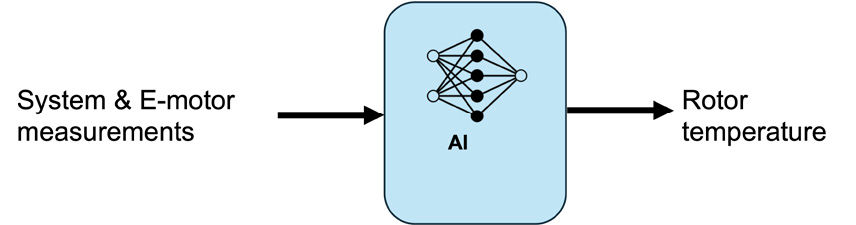
Tatari said virtual sensors are so important in leveraging this data because of the limitations physical sensors are imposing on the system. Sometimes it is impossible to install a physical sensor in a specific system, like installing a temperature sensor in the rotary part of the motor, for example.

Data-driven thermal models provide real time temperature estimations. (Image: DSD)

“These physical sensors degrade over time, and that can really degrade the performance of the entire system. Also, they can get noisy, they can get slow, and all in all, that can lead to inefficiencies across the entire system,” Tatari said. “Some physical sensors are unmanufacturable because they're too complex and expensive. Data-driven virtual sensors are a type of virtual sensors that can bridge the gap. We can utilize the existing data, the test data, as well as the development data to reduce some of these physical sensors in production. This reduces the cost and maintains the accuracy while increasing the reliability and efficiency of the system.”

Thermal Modeling

There are several methods for electric motor thermal modeling today including indirect methods, long-thermometer thermal networks, Kalman-based or observer-based methods, computational fluid dynamics, Finite Element Analysis (FEA) models, and data-driven or machine learning-based thermal models.

“The advantage of data-driven models is that they are very accurate because they can model the non-linearities or the higher-order terms, which cannot be captured with other methods. Data-driven thermal modeling can be executed fast for real-time temperature estimation while other methods like computational fluid dynamics or FEA cannot,” Tatari said.

The biggest advantage of data-driven thermal models is generalization. Tatari said if DSD develops a data-driven or machine learning-based thermal model for a specific motor variant, that can be generalized to another motor variant. This is something which is not always applicable for the rest of the thermal modeling methods.

There are so many advantages with machine learning-based or data-driven thermal models, but of course the trade-off is having good data—enough data—to develop these models. Sometimes it is difficult to really understand what's going on inside the model due to the way the system interprets the data.

DSD is developing a thermal model for the motor with the basic intention to guarantee the safety of the motor. Tatari said that if they have a precise estimation of the motor temperature, they can guarantee motor safety and prevent high temperatures.

“At the same time, we can be less conservative with our thermal margins, so that by knowing an accurate estimation of the motor temperature, we can have more precise thermal limits and really know exactly when to derate and when not to derate. This can lead to increasing efficiency and the performance of the motor and the system that is working with that motor,” she added.

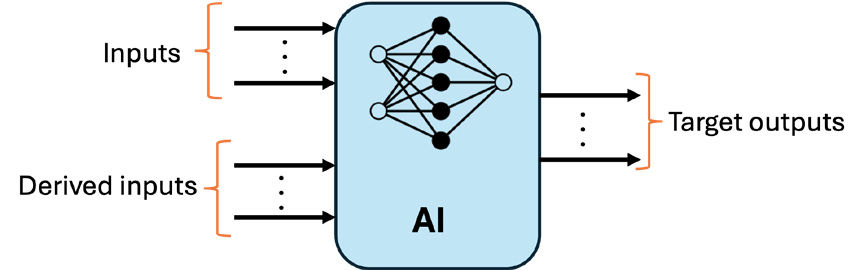
In artificial intelligence, inputs are the raw data or user prompts fed into a system, while derived inputs are secondary features, intermediate representations, or synthetic content generated by transforming those original materials. (Image: DSD)


An Evolving AI Market

[advertisement]

AI applications are evolving at a very fast rate. DSD has several methods and tools being developed with AI, according to Tatari.

“We will be moving toward physics-informed data-driven models, or physics-informed neural networks, because we want to incorporate our physical/engineering knowledge to the information we can get from the data. Through integration we can have a better interpretability of our physics-informed data-driven models,” she said.

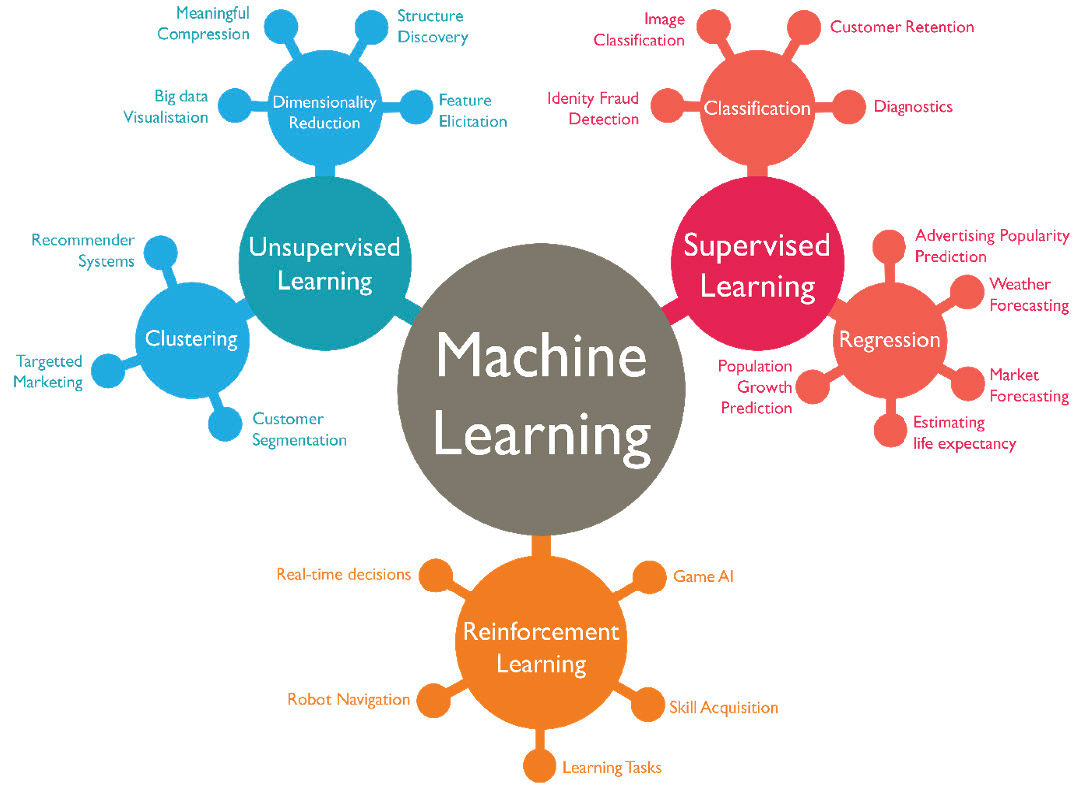
Areas like machine learning, diagnostics and reinforcement learning are driving AI growth. (Image: DSD)

For deploying these algorithms into production, Tatari sees a path where they’ll be moving from machine learning algorithms and AI-based algorithms and deploying them in the cloud. DSD is already moving toward deploying them in edge devices—in local ECUs— reducing the inference latency time for executing an algorithm in the cloud.

For production timelines, AI can really help to decrease the time for making a production or product ready for production. By having all these AI-based digital twins that are high-fidelity models, DSD can speed up development especially in hardware-in-the-loop testing, relying on these models to be fast for prototyping and developing the software of the vehicle faster.

“AI used to change processes every six months, now it feels like monumental changes are taking place every week, every day,” Tatari said. Although DSD’s AI journey started years ago, the organization is focused on increasing the quality of its engineering services.

“We don't want to use AI just to automate away engineering. We want to leverage AI to increase the quality of our engineering services. And you know that here at DSD, we are focusing on the areas of control system software development, electric machine design, and power electronic design, advanced mechanical systems design, and these are the areas that having deep technical knowledge and wide engineering domain knowledge is essential,” Tatari said. “But we would like to leverage AI in these areas to increase the quality of our engineering services and at the same time increase the speed of our deliverables for our clients.”

Safety, innovation, and predictive and prescriptive maintenance will drive AI’s growth in the automotive industry in the coming years. Advanced driver-assistance systems (ADAS) powered by AI can process data from cameras, radar, and lidar to provide features like automatic braking, lane-keeping assistance, and collision avoidance. As these systems become more sophisticated, they contribute to a marked decrease in accidents and fatalities on the road, fostering greater consumer trust in autonomous and semi-autonomous vehicles. Moreover, AI can predict maintenance needs by analyzing vehicle performance data, thereby reducing the likelihood of breakdowns and enhancing the components and systems that make up the vehicle.

[advertisement]

×

Like What You see?

Power Transmission Engineering magazinePower Transmission Engineering is THE magazine of mechanical components. PTE is written for engineers and maintenance pros who specify, purchase and use gears, gear drives, bearings, motors, couplings, clutches, lubrication, seals and all other types of mechanical power transmission and motion control components.

E-mail

Choose at least one from the options below:

 Power Transmission Engineering magazine, published 8 times per year (print or digital).

 Power Transmission Engineering e-mail newsletter, published weekly.

 Special Offers and promotions via e-mail from Power Transmission Engineering's advertisers and partners.

*Unsubscribe any time.
Full details in our privacy policy
Already a subscriber? Log in