


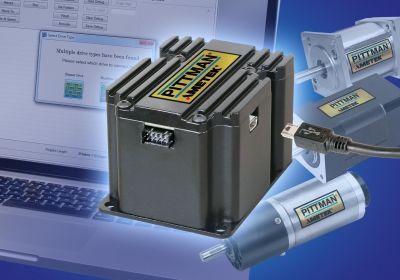
Pittman Motors PBL4850E Programmable Three-Phase Brushless Motor Drive Added to IDEA Drive Line
Pittman Motors has announced the latest addition to its IDEA drive line of motor controllers: the PBL4850E programmable three-phase brushless motor drive. With the PBL 4850E, Pittman motor users can create distributed stand-alone complex motion profiles intuitively and quickly, eliminating the need for additional motion control components such as programmable logic controllers or field communication buses.
Among the graphical user interface’s features is automatic population of motion profile parameters based on the entry of a few motor characteristics. Complex motor parameter calculations or in-depth knowledge of the motor specifications are not required for proper operation. Furthermore, Pittman IDEA software allows the user to program motors through the use of on-screen buttons instead of command sets or programming languages.
The PBL4850E is a four-quadrant brushless controller that utilizes sinusoidal commutation to produce smooth motion. The torque produced by sinusoidal commutation minimizes torque ripple. The drive further refines motion by incorporating two motion profiles: trapezoidal and s-curve. The latter may be used to eliminate jerk due to rapid changes in velocity rates during motion.
The drive offers programmable current control of up to 5.6A peak with an optional current boost during ramping of up to 6.5A peak. With an input voltage of 12-48VDC, the drive can accommodate a wide range of brushless motors. Hall cell signals are used for phase initialization and an encoder provides positional feedback.
Other features include eight opto-isolated general purpose inputs and outputs. Each input is rated for 5 to 24 VDC, 8 mA maximum per input. The outputs are open collector, 5 to 24 VDC, 200 mA maximum per output. The PBL4850E IDEA drive communicates via a USB to mini USB.
The IDEA software is configurable with numerous programming units to provide versatility in creating programs with the PBL4850E drive. Selecting units of revolutions creates a platform for users to generate complex velocity motion profiles geared towards rotary-based applications. Selecting units of inches or millimeters simplifies programming within a linear-based setup by allowing users to program with native units within the system to generate motion profiles.






 Power Transmission Engineering is THE magazine of mechanical components. PTE is written for engineers and maintenance pros who specify, purchase and use gears, gear drives, bearings, motors, couplings, clutches, lubrication, seals and all other types of mechanical power transmission and motion control components.