


Past Is Prologue
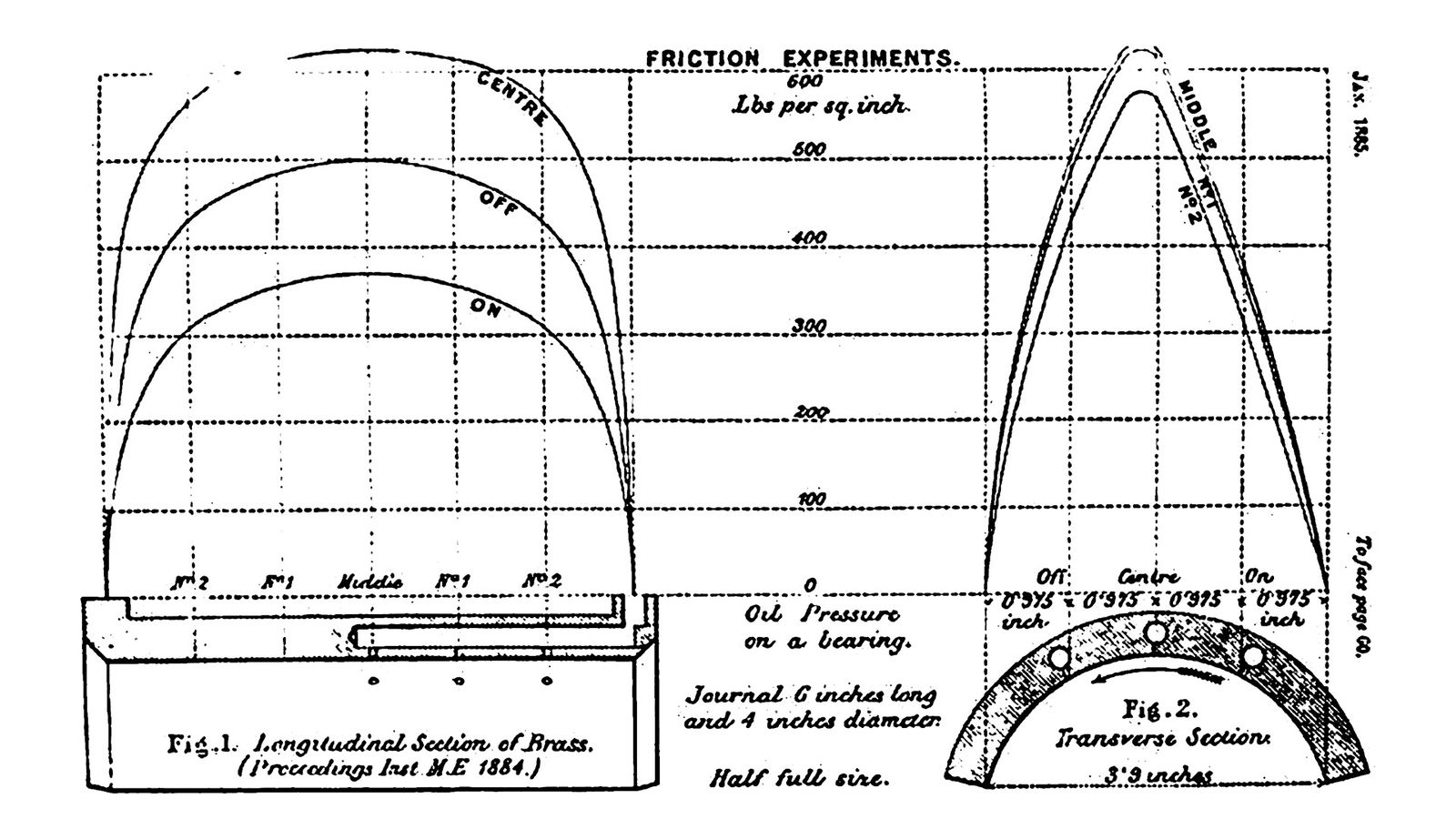
Beauchamp Tower’s 1885 measurements of oil pressure along and around a 4-inch railway journal, reaching nearly 600 psi at the center, well beyond the 200 psi his first gauge recorded in 1883. Osborne Reynolds compared his theory against these curves. (Image: Proceedings of the Institution of Mechanical Engineers, 1885)
Fluids have had a big year in the math pages. In August, Quanta Magazine’s “Theory of Fluids Enters the 21st Century” described physicists deriving the Navier-Stokes equations from symmetry and noting that the equations ignore a fluid’s molecules. In September, OpenAI announced that AI agents had found a blowup in the 3D Navier-Stokes equations driven by an external force, a point where an idealized fluid’s velocity runs to infinity. If it holds up, it would settle one of the Clay Mathematics Institute’s $1 million Millennium Prize problems. Nobody expects either result to change how a gearbox is lubricated. Engineers have been getting by on approximations of their own for a long time.
In 1883, Beauchamp Tower, testing railway axle bearings for the Institution of Mechanical Engineers, ran a journal in a bath of oil and measured friction coefficients as low as one part in a thousand. Late in the work, he drilled a hole in the bearing for an oil feed, and when the shaft turned, oil welled up through it. He stopped the hole with a wooden plug, and the oil pushed the plug out. A pressure gauge read more than 200 pounds per square inch. The shaft was riding on a wedge of oil that its own rotation had dragged in and pressurized, which is why the friction was so low.
Osborne Reynolds explained Tower’s results in 1886. He started from the Navier-Stokes equations and discarded the terms that become negligible when a film is far thinner than it is long, leaving an equation for the pressure in the oil. Even his rough solution matched Tower’s measurements. The Reynolds equation is still the basis of bearing and gear lubrication design.
Gears gave the theory an honest test. In 1916, H.M. Martin applied Reynolds’ equation to meshing teeth, treating the steel as rigid and the oil’s viscosity as fixed. His films came out a few hundredths of a micron thick, far thinner than the roughness of the tooth surfaces. By his numbers, the teeth should have been grinding metal on metal, yet gearboxes ran for years. The answer came from A.M. Ertel and A.N. Grubin in Moscow in the 1940s and from Duncan Dowson and Gordon Higginson at Leeds in 1959. Under load, the teeth flatten elastically, and the oil between them, at 1 to 2 GPa, roughly 10 to 20 times the pressure at the bottom of the Mariana Trench, becomes so viscous it behaves almost like a soft solid. With both effects included, the film comes out at a few 10ths of a micron or more, enough to keep the teeth apart. The field is called elastohydrodynamic lubrication, and its film formulas are built into the standards used to rate gears for micropitting and wear.
The improved theory has a limit. The Navier-Stokes equations assume oil behaves like a simple liquid, one whose resistance is proportional to its shear rate. Oil at 1 GPa does not. It thins as it is sheared, and past a certain point, it stops resisting harder and slips. Friction in the mesh depends on that behavior. Tribologists have measured it on test rigs for decades and fitted models to the results, which is why any new lubricant still must be tested. Those models describe what the oil does better than they explain why.
The physicists in the August Quanta story are working on the general form of that question, using symmetry to work out how a fluid must behave once the simple equations stop fitting. So far, their methods apply only to fluids close to equilibrium, and nobody knows whether they will reach oil at 1 GPa. If they do, they could explain what gear engineers have been observing all along. Practice has run ahead of theory before. Steam engines ran for about a century before Sadi Carnot explained them in 1824, and Kepler described how the planets move about 70 years before Newton showed that gravity was the reason.