
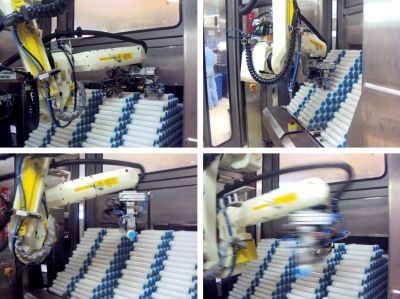
Keyence Robot Installed on Fresenius Medical Care's Dialyser Production Line
Fresenius Medical Care SMAD recently equipped its dialyser production line at its plant at L'Arbresle, France with a robot.
“In 2009, we decided to automate our dialyser handling unit, which is located between a conveyor system and a processing unit,” said Mouloud Ifri of Fresenius Medical Care SMAD's manufacturing department. “Automating the unit was an obvious solution. The main challenge was that the dialysers are stacked unevenly and their positions vary along three dimensions. We had to find a system that could recognise their positions.”
Fresenius automated its line for two reasons: it is installed in a controlled environment – problematic for human intervention – and it operated at high speed 24 hours a day, seven days a week.
The feed system consists of two conveyors, each with two rows of dialysers. The robot is equipped with a tool that allows it to pick up two dialysers per cycle. The tool is fitted with two Keyence LJ-G080 laser sensors, one per dialyser, so that the dialysers are correctly picked up one after the other.
The robot thus simultaneously removes dialysers from each stack on a conveyor. It takes dialysers from the two conveyors in turn. When a row (diagonal) is emptied, the conveyor moves forward until the stack reaches the unloading position.
The robot routinely ‘scans’ the theoretical positions depending on the type of product. It uses the Keyence sensors to detect products and correct its pickup position accordingly. If no products are detected, the robot moves to a different stack. It also uses the sensors to correct its X- and Z-axes. To compensate for dispersion along the robot's Y-axis, the robot's tool is fitted with a homing cylinder for each type of dialyser. The maximum height and slope of the stacks are always the same for the same type of product. However, these stacks may be uneven.






 Power Transmission Engineering is THE magazine of mechanical components. PTE is written for engineers and maintenance pros who specify, purchase and use gears, gear drives, bearings, motors, couplings, clutches, lubrication, seals and all other types of mechanical power transmission and motion control components.