AI Accelerates Adoption
The appeal of AI continues to increase because it eliminates the need for users to be experts in programming or software.
“Smaller machine shops are the backbone of manufacturing, and we empower them to use automation for the high-mix, low-volume applications that they constantly encounter,” said Simon Lapeyry, head of revenue at Intrinsic Innovation, an AI robotics group at Google. “As an example for machine tending, we combine AI with a camera to remove the need for fixturing and for robot reprogramming when introducing a new part. By removing these bottlenecks, AI enables your operators to focus on being CNC experts.”
CloudNC’s CAM Assist is an AI plug-in for existing CAM platforms (Autodesk, Mastercam, Siemens, etc.) that speeds up toolpath generation so that users can get to making chips faster. It uses physics-based AI to determine the cut depth, width, feeds, and speeds, and flags potential issues to the programmer so they stay in control of the overall output.
“CAM Assist turns something that might take you two days to program into five minutes inside CAM Assist and 20 minutes to clean up on the back end. Now you can make 10 times more parts in the same day with the people and machines you already have,” said Dan French, head of sales, CloudNC.
Steve Blackwell, leader of AWS’ Product Engineering & Services Center of Excellence, said, “A year ago, we were talking to customers about the potential of agentic AI. This year at IMTS, we have seen that leading manufacturers are already deploying AI across their operations and are realizing immediate increases in efficiency, quality, and agility.”
“Smart manufacturers understand the urgent need to adopt digital technologies as a means to gain more productivity from existing capital equipment,” said Ryan Kelly, vice president of technology at AMT. “With the shortage of skilled labor – some 435,000 people in durable goods manufacturing – we need more solutions that act as force multipliers to shorten the development cycle and increase output per person.”
Creating Speed and Flexibility
Kelly cited the AMT Emerging Technology Center (ETC) as an example of how digital technologies collapse the development cycle. The ETC’s convergent manufacturing platform for drone production, led by the Manufacturing Demonstration Facility at Oak Ridge National Laboratory (ORNL), connected machine tools, automation (robots, cobots, and a pallet changer), metal and polymer AM, and other technologies. It demonstrated how to quickly surge production capacity using equipment on the IMTS show floor, as well as production flexibility by producing three different sizes of drone bodies.
Sandia National Laboratories and its partners used AI, advanced computing, and metal AM to accelerate the development of the Aires Tide flight-test vehicle by about seven times and reduce its cost by 15 times compared with traditional manufacturing.
The ETC also demonstrated the need for the MTConnect protocol to foster interoperability between controls, devices, and software applications. Because it delivers machine data in a way that AI can interpret and software can understand, Kelly predicts AI will accelerate MTConnect adoption.
Technology Brings the Manufacturing Community Together
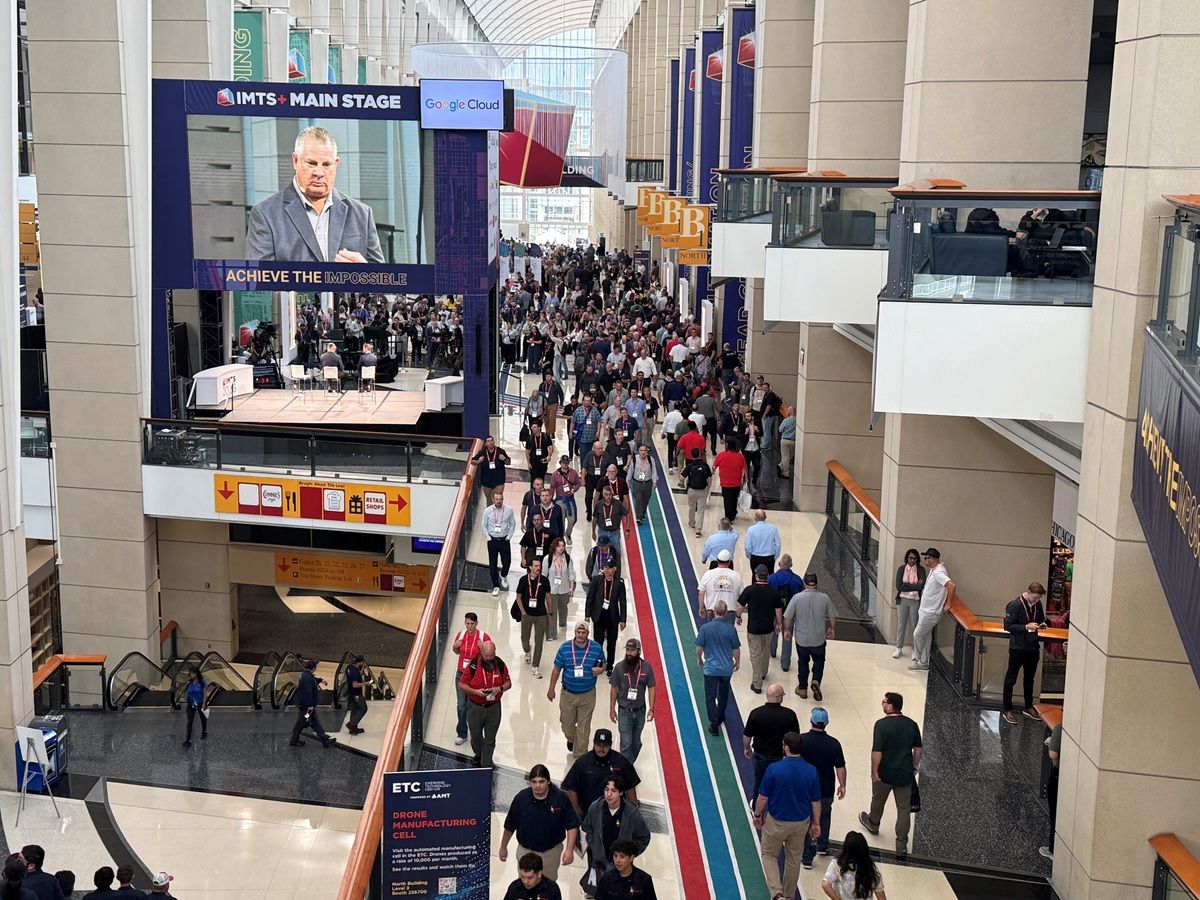
IMTS fosters people-to-people connections through hundreds of conference sessions, attractions, and industry-organized events designed for specific interest groups.
“No matter what you make or the role you play in manufacturing, you can find people who share your interests, challenges, and priorities. That’s why IMTS always feels like home,” said Michelle Edmonson, vice president – exhibitions at AMT. “The communities coming together at IMTS created an energy at McCormick Place that was incredible. We heard story after story of connections made here that will lead to new ideas, solutions, and opportunities long after the show ends.”
At IMTS, the manufacturing community came together in force. Groups such as SME, New American Industrial Alliance, Illinois Manufacturers Association, Women in Manufacturing, Defense Industrial Base Institute at Northeastern University, Centrepolis Accelerator at Lawrence Technological University, international associations, investor groups, and others held meetings and led show floor tours that turned IMTS into a hub for collaboration. Industry voices including Endeavor Business Media, Manufacturing Happy Hour, Practical Machinist, and MakingChips hosted live podcasts throughout the show, drawing fans, exhibitors, and attendees into conversations that extended the community beyond the aisles.
“IMTS and the LATAM Conference are premium events and very important to international market leaders like us. It's been essential for me to attend every IMTS,” said Aldo Rodriguez, director of Aalberts Surface Technologies in Monterey, Mexico. “All the presentations offered useful insights, but what really caught my attention was the international trade projections. They shared figures on the opportunities for Mexico and the U.S. to partner on exploiting future opportunities. Our company will be doing more research on international trade and taking advantage of that huge opportunity.”
“It’s really important for us to invest in the women in this industry because a lot of times there aren't women represented. At our company, we’re really making strides, especially in our engineering group,” said Liz Steffick, chief financial officer of Methods Machine Tools in Sudbury, Massachusetts. “We brought several members of the team to ELEVATE so they know they're valued and appreciated by the company.”
Roger Buccolo, plant manager at Teledyne Oil & Gas in Orlando, Florida, came to IMTS 2026 specifically for the inaugural Industrial AI Conference to learn how to bring artificial intelligence onto the manufacturing floor.
Volta Global is a permanent capital investment firm that specializes in private equity and real estate. Analyst Colin Weber said, “I attended the Investor Summit because we’re investing in precision manufacturing for the long term. I found the information about automation and the reshoring movement very interesting, and I met several business owners I’ll be following up with.”
Weber said he appreciated featured speakers from Nvidia and Google Cloud “who covered how manufacturers are using automation and vision systems to improve efficiency. With skilled labor this tight, that matters to every shop owner I talked to.”
Attracting the Next Generation
The Smartforce Student Summit attracted 14,447 students. Wendy Lawrence, a retired Navy captain and former NASA astronaut, spoke for the third time at IMTS, sharing these inspiring words:
“For the students who are here, definitely consider manufacturing as a future. What a fun job to have. At the end of the day, you get to walk away and look at everything that you manufactured. As somebody who got to ride the space shuttle four times, for all the people in manufacturing jobs, thank you very much. I never would have been able to go to space without your tremendous abilities. I appreciate all the hard work this country has put into the manufacturing sector.”
Companies such as Reader Precision Solutions sponsored the attendance of 153 students and educators at IMTS 2026 through its Operation Exploration initiative, giving participants the opportunity to explore advanced manufacturing technologies, meet industry professionals, and learn more about career pathways in modern manufacturing firsthand.
More Production Per Machine
Exhibitors focused on CNC systems that enable more operations in a single setup, expand unattended operation, increase output per employee, and automate repetitive tasks so operators can get machines into production faster.
Control highlights emphasized more intuitive operation, graphical programming, and AI-based assistance to reduce programming effort and help operators work more efficiently, and execute natural-language instructions.
“Our job is to bring technology to our customers in a usable way – to automate what we can and make the machinist’s day a little easier,” said Paul Gray, executive vice president of engineering at Hurco.
Smarter Robotics Move Toward Practical Adoption
Robot and cobot themes at IMTS 2026 centered on systems that are easier to deploy, safer to operate around people, and more adaptable to changing production needs. New collaborative robots emphasized integrated vision systems, advanced end effectors, and cleaner connectivity, reducing the complexity of installation and redeployment.
Safety-focused sensing technologies, including scanners and proximity detection, showed how cobots can slow or stop automatically as people or objects enter their work zones. AI-enabled automation demonstrated how handwritten instructions and natural-language commands can be translated into manufacturing tasks and robot programs.
“The real magic is how we make the user experience as powerful as possible,” said Will Healy, director of product and industry marketing, Universal Robots.
Tooling to Bridge the Gap
Exhibitors in the Tooling & Workholding Sector centered on new integrated software, sensors, and advanced geometries to improve tool life, productivity, quality, and visibility in toolroom operations. The skilled labor shortage and demand for higher productivity have driven solutions that promote faster and easier changeover for high-mix, low-volume operations.
“All industries are seeing skilled machinists and workers with manufacturing knowledge retire, so we need technology to help bridge that gap,” said Sean Cox, senior manager of operations at Collins Aerospace, which won the Zoller Toolroom of the Year award and sent a cross-functional team of six people to IMTS 2026. “We need advanced technologies to standardize processes, produce parts cost effectively, drive continuous improvement, and improve lead times as the aerospace industry ramps up.”
AM Integrated with Metal Removal
At IMTS 2026, the Additive Manufacturing Sector was located adjacent to the Metal Removal Sector to reflect how the two technologies are used together. To highlight demand for AM, consider that the U.S. Navy presenters on the IMTS+ Main Stage cited AM as a critical technology.
“Currently, the demand for our systems is off the charts,” said Glynn Fletcher, president of EOS North America, which launched its M4 ONYX metal 3D printer at IMTS 2026. “When we exhibited for the first time at IMTS 2010, there were hardly any metal AM machines in the U.S. With an installed base of several thousand machines and metal AM literally taking the Main Stage at IMTS, it’s clear metal AM occupies an essential role in the U.S. industrial base.”
imts.com








 Power Transmission Engineering is THE magazine of mechanical components. PTE is written for engineers and maintenance pros who specify, purchase and use gears, gear drives, bearings, motors, couplings, clutches, lubrication, seals and all other types of mechanical power transmission and motion control components.