


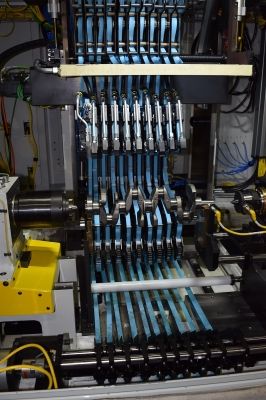
IMPCO Microfinishing Worldstar 1680 Offers Fully Flexible Microfinishing System for Automotive Applications
A new design CNC microfinishing system by IMPCO Microfinishing, polishes the critical cylindrical bearing journals of a range of different size crankshafts to micron tolerances consistently and automatically without the need to manually change and reposition the tooling, reducing changeover time from many hours to a few minutes.
The company says its Worldstar 1680 is the first fully flexible microfinishing system for the automotive industry and was built in response to the requirements of a European automaker for installation in Brazil.
Microfinishing is the process that removes the microscopic amorphous surface material left from the grinding of a dimensionally finished part, such as a crankshaft, camshaft or pump shaft, to permit a highly precise fit to a mating part. IMPCO microfinishing is used to generate the final functional surface texture required for friction reduction, higher performance, and greater reliability of the precision shafts. Microfinishing tolerances are unattainable with grinding.
"In today's automotive engines, the surface texture on these functional key features on the internal engine components are microfinished to very fine tolerances that enable combustion engines to operate more efficiently and to meet emissions, horsepower and fuel economy goals," said Mark Hendel, IMPCO global sales director.
In the IMPCO microfinishing machine, abrasive film is fed through a pair of opposed arms, each holding tooling that is shaped to fit over the part's cylindrical bearing journals. During the process, the arms close around the journals, holding the film against the rotating part for a specified time to achieve the desired surface texture.
The part may undergo several increasingly fine levels of finishing to produce the final finish. The IMPCO machine processes a 4-cylinder crankshaft through three levels of microfinishing plus thrust face finishing. In the automotive industry, surface finish parameters used to evaluate the surfaces of the crankshafts include Ra, Rk, Rpk, and Rvk.