


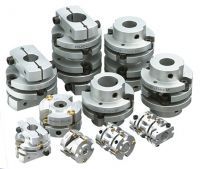
Huco Examines Flexible Coupling Selection
Flexible shaft couplings connect two shafts, end to end. They transmit rotation from one to the other and accommodate the slight, unintentional misalignment that is always present when two independently mounted shafts are presented for connection. There are many kinds of flexible couplings and while they all fulfil their primary purpose, each has certain characteristics that make it more effective in one application than another.
Misalignment compensation and axial motion
The choice of couplings available to today’s engineers can be daunting but one of the first factors that must be considered in determining the best for the job is whether the type concerned can provide adequate misalignment protection. The particular mechanism used – bellows, membrane, flexible beam or sliding disc – determines the performance characteristic of the coupling including its tolerance of misalignment or axial motion.
For instance, sliding disc and universal/lateral couplings can tolerate large misalignments but at the cost of having their backlash-free life reduced. Bellows-type couplings can absorb a high degree of axial motion with a possible reduction in misalignment capacity. Membrane couplings, however, can be damaged beyond repair if axial motion exceeds the coupling’s specification. That said, they can withstand large misalignments with little or no reduction in life expectancy.
Where misalignment is incidental, in other words, caused simply by manufacturing tolerances, a more realistic measure is the effective radial error. This is the radial distance between the shafts’ axes measured midway along the length of the coupling. Sometimes called the composite error, this can be crucial when determining a value for the maximum permissible misalignment.
Axial motion is often created as a result of axial clearances in the shaft bearings, or through thermal expansion. While it is usual to absorb this with a suitable coupling, it may, in some cases, be more beneficial to resist the motion, particularly if it has a positioning function. Couplings such as the universal/lateral type can be useful in such circumstances.






 Power Transmission Engineering is THE magazine of mechanical components. PTE is written for engineers and maintenance pros who specify, purchase and use gears, gear drives, bearings, motors, couplings, clutches, lubrication, seals and all other types of mechanical power transmission and motion control components.