
High-Strength Sinter Parts for Decoupling Units in E-Axles
The following article on high-strength sinter parts appears courtesy of CTI Symposium USA.
Powder metal technology is well known for products used in the automotive industry. With the shift to electric powertrains, key requirements such as component strength had to be adapted. This has been successfully achieved by developing and implementing new innovative processes to withstand the loads required in electric axles. Powder metal parts such as planetary gears or disconnect systems can even combine these properties with a significantly lower product carbon footprint compared to conventional steel.
The disconnect system
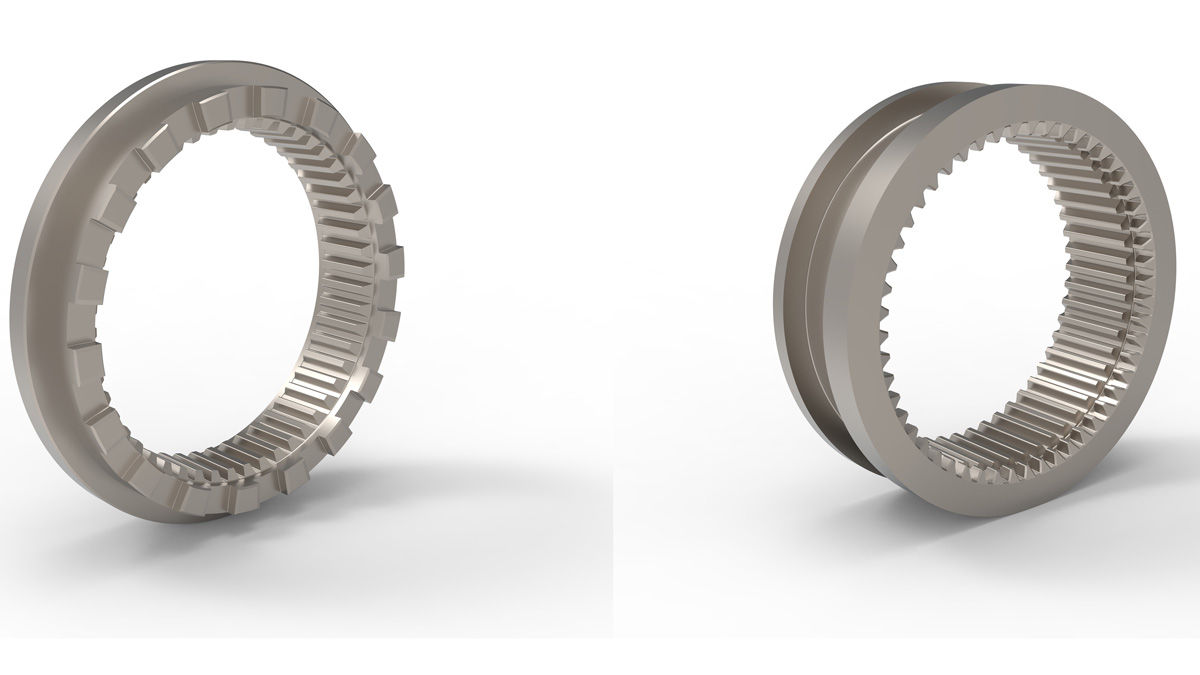
The primary function of an e-axle disconnecting system is to improve the efficiency and performance of battery electric vehicles by automatically decoupling the transmission shaft from the wheels when no power is required from the electric motor. As soon as power is required, the connection is closed again. Various concepts for disconnect units are available on the market, utilizing shifting components such as dog clutches or sliding sleeves to achieve the mechanical disconnecting function.
The key functions of a disconnecting system are:
Energy Efficiency: By disconnecting the e-axle when it is not needed (e.g., during highway cruising when only one axle is sufficient), the system reduces power consumption, which in turn can extend the vehicle’s range.






 Power Transmission Engineering is THE magazine of mechanical components. PTE is written for engineers and maintenance pros who specify, purchase and use gears, gear drives, bearings, motors, couplings, clutches, lubrication, seals and all other types of mechanical power transmission and motion control components.