

Harnessing Noether’s Theorem for Gear Optimization
In gear design, efficiency often comes down to a battle with vibration. High-speed gears in transmissions, turbines, and robotics inevitably bleed energy through friction, heat, and unwanted oscillations. These losses may look like background noise, but they add up to reduced performance, accelerated wear, and shortened service life. What if the key to reducing those losses came from a century-old breakthrough in theoretical physics?
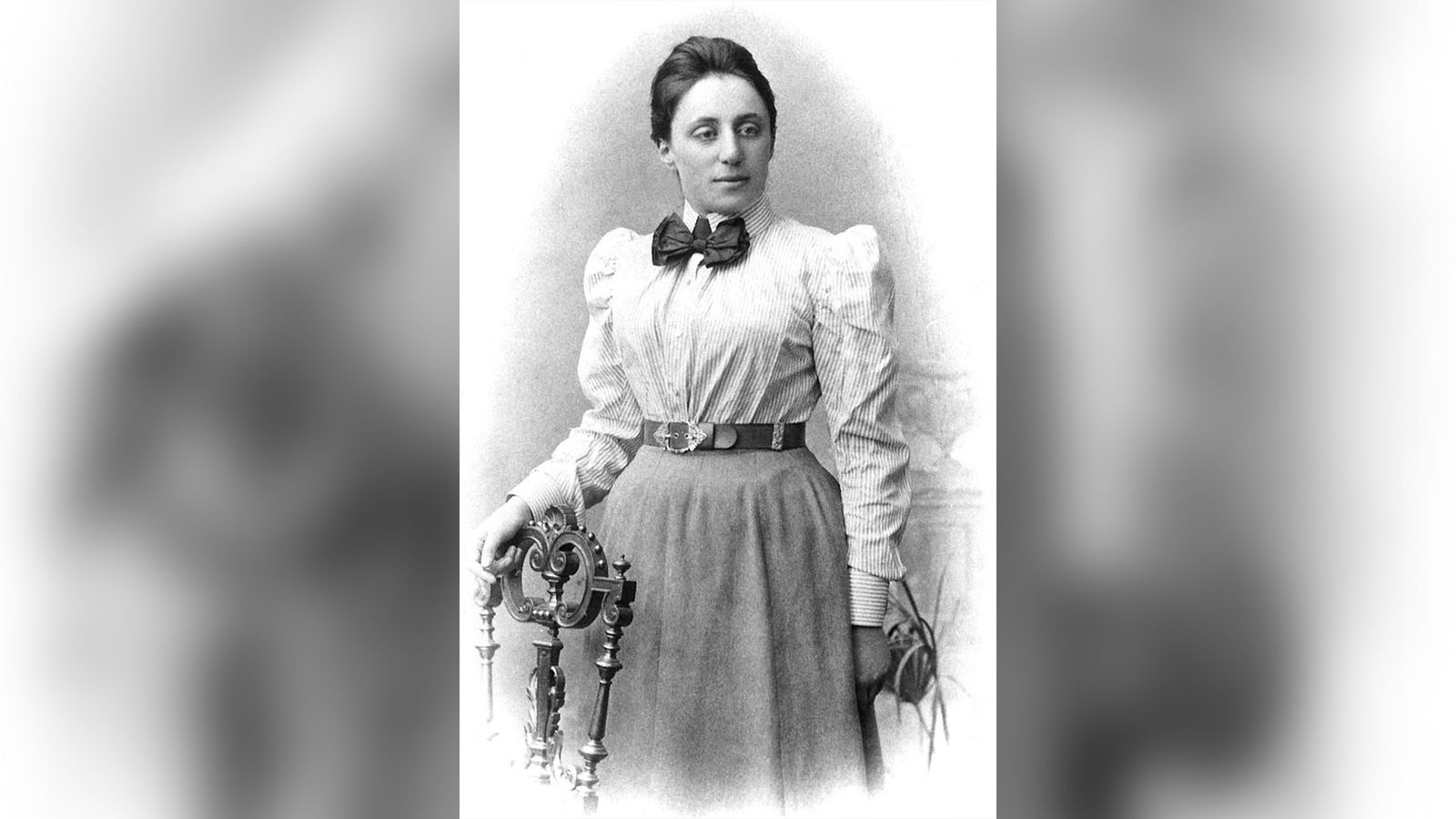
In 1918, mathematician Emmy Noether proved a deceptively simple principle: whenever a system has a symmetry, something is conserved. Time symmetry means energy is conserved. Rotational symmetry means angular momentum is conserved. Physicists regard this theorem as foundational to everything from particle physics to relativity, but its relevance doesn’t end there. For gear engineers, it offers a surprisingly practical lens for thinking about energy conservation and vibration control.
In an ideal gear system, energy would slosh cleanly back and forth between kinetic rotation and elastic tooth deflection, without any net loss. But in the real world, gears are never perfectly symmetrical. Materials flex, lubricants shear, surfaces rub, and losses creep in. Each small asymmetry breaks the neat conservation that Noether described. The result is energy leaking away in the form of noise, heat, or premature wear.
The real power of Noether’s perspective is in its diagnostic potential. If energy is to be conserved in a perfectly symmetric, time-invariant system, then any observed energy loss becomes a signal. It tells the designer exactly where the symmetry has been broken, in tooth geometry, material properties, lubrication, or resonance behavior. In other words, vibration is not just a nuisance; it’s a map of where efficiency is being stolen.
Modern simulation tools make this practical. Finite element analysis (FEA) doesn’t just show stresses and deflections; it tracks how energy moves through a system. By plotting kinetic and potential energy over time, engineers can see how quickly energy decays and pinpoint where losses are doing the most damage. If the plot reveals energy vanishing too quickly, it’s a clue to stiffen a tooth, adjust the geometry, refine lubrication, or switch to a material with better characteristics.
Take a spur gear subjected to sinusoidal loading, simulations will often show energy declining steadily as vibrations die out. By adjusting tooth stiffness or geometry, that rate of decay can be slowed, meaning less energy wasted. The gear runs smoother, quieter, and with lower wear. What began as an abstract theorem about symmetry becomes a very concrete design tool for optimization.







 Power Transmission Engineering is THE magazine of mechanical components. PTE is written for engineers and maintenance pros who specify, purchase and use gears, gear drives, bearings, motors, couplings, clutches, lubrication, seals and all other types of mechanical power transmission and motion control components.