How a World War II solution continues to shape maintenance strategies today
Maintenance strategies created by the RAF during World War II are still relevant in 2026.
Tom Knauer, business strategy manager at Balluff Inc., took a deep dive into the origins of proactive/optimized maintenance practices as he became more involved in Balluff’s condition monitoring program. While the industry typically focused on recent practices, and optimized maintenance strategies, Knauer came across Stephen Budiansky’s Blackett’s War, a history of Great Britain’s World War II effort to counter U-boat attacks by applying math, analytics and probability theory. This research became a blueprint for the data-driven maintenance approach needed on the modern shop floor.
“One topic of interest was the analysis and improvement of maintenance processes to increase Royal Air Force (RAF) aircraft availability/OEE, which has a direct connection to today’s maintenance practice goals,” Knauer said. “The concept was that in certain cases less maintenance is better. Maintaining items that do not or rarely fail wastes time, people and parts; and occasionally (when done incorrectly) maintenance can lead to more, rather than fewer, failures.”
The RAF learned that it may be best to apply different maintenance approaches to different components of an asset. Some parts may be served with a “run to fail” approach, some by preventative maintenance or a proactive approach—the data and a “criticality analysis” can help figure out the best approach for each component on a case-by-case basis.
The success of condition monitoring and predictive maintenance technology in the future—AI agents, smart automation, hybrid models and smart sensors—will greatly depend on the quality and availability of data, workforce trust in AI-generated recommendations and solving potential cybersecurity concerns. Yet lessons the RAF learned during World War II still shape the evolution of sensor technology and condition monitoring tools 84 years later.
Lessons Learned in World War II
According to Britain’s Air Ministry, the RAF flew thousands of anti-submarine and maritime reconnaissance sorties against German U-boats. When Churchill questioned aircraft serviceability rates in the early 1940s, Coastal Command investigated why available planes were flying so few sorties. The cause was maintenance—not pilot endurance or sortie restrictions.
The key insight was that the RAF was measuring the wrong thing. Commanders were judged on serviceability, meaning the share of aircraft ready to fly at any moment. That rewarded keeping planes on the ground in reserve rather than flying them. Analysts proposed linking maintenance schedules directly to the number of sorties the planes were expected to fly and ordering squadrons to ignore the serviceability target rate.
The trials showed something counterintuitive: while serviceability rates dropped, monthly flying hours went up. Planes spent less time idle, so fewer were sitting ready at any moment, but far more patrol work was done.
The method was to treat maintenance like a factory production line, matching servicing capacity to a planned flying program instead of reacting to whatever came in. Flying hours increased, airfield capacity grew and the RAF achieved large manpower savings without reducing total effort. Coastal Command aircraft received periodic “minor” and “major” inspections based on flying hours.
In other words, the maintenance service itself was introducing faults through disturbed components, reassembly errors and early failures of new parts. This finding challenged the assumption that more frequent maintenance is always safer. Decades later, the same idea became a pillar of reliability-centered maintenance used in the 1970s for airlines.
During Knauer’s presentation on the subject at Automate 2026 in Chicago, he examined which parts of the RAF’s maintenance process are applicable today. This included using actual production data to address bottlenecks, optimizing personnel/resource scheduling, analyzing failure data to implement condition monitoring/predictive maintenance and applying longer maintenance intervals when justified by the data.
The Condition Monitoring Playbook Today
The approach Balluff takes with customers today starts with an assessment of the most critical assets in the plant. “How often could a failure potentially occur? What’s the cost to fix that failure in terms of people’s time, in terms of the components? What’s the cost of lost production? We’re then carefully going over the data to find the best possible solution for the customer,” Knauer said.
The main challenge in MRO today is that each application and manufacturer has a different risk profile in terms of costs, safety and frequency. Components featured regularly in this magazine, including motors, pumps, fans, conveyor drives and gearboxes, benefit from a maintenance strategy that includes a variety of sensor technologies. However, every application and industry is different and brings their own unique challenges to production.
In a perfect world, condition monitoring and predictive maintenance would prevent every failure and catastrophe from ever taking place. More times than not, it is the breakdown of a part that gives the educational insight the company needs moving forward.
“Unfortunately, in our business, we occasionally provide the best solution for a component that has already failed. We had one case study at an automotive manufacturing facility, for example, where the motor and gearbox went down and not only destroyed the conveyor line but the materials on it,” Knauer said. “By studying the failure, we were able to provide a comprehensive maintenance plan to prevent future shutdowns.”
For a different application, Balluff was asked to provide a system to map the complex processes in a woodworking machine, suitable for both stationary integration and mobile applications. Balluff offered the BCM condition monitoring sensor in combination with the CMTK condition monitoring toolkit to solve the diverse requirements. This system enabled simple monitoring and visualization of vibration, temperature and other environmental conditions.
“The consensus seems to be that while temperature and vibration can be very simple and easy to apply on a variety of applications—especially for motion applications—these sensors shouldn’t be the only technologies to consider,” Knauer said. “Bearing technology, for example, might include accelerometers to capture high-frequency resonances or acoustic emission and ultrasonic sensors to pick up stress waves from metal-to-metal contact.”
[advertisement]
Today, monitoring is also moving toward bearings with integrated sensing built into the unit itself, sending the necessary data to a laptop, smartphone or tablet.
Depending on the course of action, a manufacturer might need to weigh the cost benefits between purchasing new equipment altogether or retrofitting older machines to provide the necessary maintenance strategies that work best.
Retrofitting offers a wide range of options, including condition monitoring as a service. Service providers supply sensors, help customers figure out where to install them, integrate hardware and software and provide ongoing support. Balluff and other traditional sensor suppliers offer customers greater ownership of the sensor technology with this method.
“The customer owns the data; they own the hardware and could potentially even write code. Then they can take that data and do whatever they want with it. They can take it up into the cloud or take it up to their CMMS system. There’s flexibility there and room to build out other systems,” Knauer added. “For example, you may already be checking the speed of a motor or the power of a motor, right? That may already be a capability you have on your drive or motor system and that data can provide basic information for a condition-based or predictive system.”
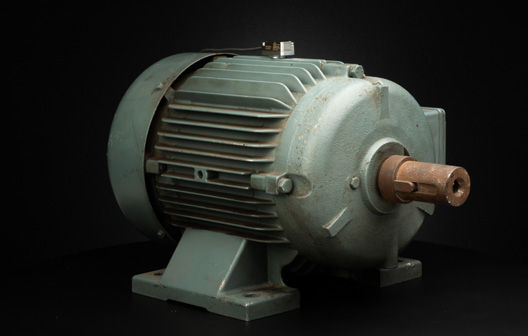
Motor with sensor (Image: Balluff)
The Next Strategic Step
Prescriptive maintenance predicts when equipment is likely to fail and recommends specific actions that will prevent or reduce this failure.
“Prescriptive maintenance is adding features and capabilities to your condition-based or predictive system and builds an additional layer on top of the more proactive approaches,” Knauer said. “You have the necessary information built up in a database as well as the steps needed to solve the issue, and you can present this to the maintenance team or write a work order.”
Knauer pointed to a familiar scene: a 30-year manufacturing veteran walks by a machine and stops at once because something doesn’t sound right. “They know exactly what needs to be done to fix it just because it sounds different. This invaluable knowledge is disappearing. We have a new generation coming up with a separate set of technological tools. How can we as suppliers and manufacturers provide tools that can be as valuable to this generation as the machinist on the shop floor for 30-plus years that knows by sound alone when equipment is failing?”
Traditionally, Knauer said, manufacturers and end users have been the most interested in condition monitoring and predictive maintenance strategies. But he sees a future where OEMs build much larger condition-based monitoring, predictive and prescriptive maintenance programs.
“This is a value-added service that many of these OEMs are not taking advantage of today, so I could see a subscription-based maintenance package where companies have the flexibility and technology to stay ahead of component failures or unplanned downtime.”
Knauer spoke with an Italian OEM that builds large CNC machines for aerospace customers in Asia. Its biggest bottleneck was the cost of sending MRO teams to remote sites to fix the equipment. If all the data were available at once, the company might not need to send a crew all the way from Italy to do the work.
“Maybe they can hire somebody on site to look over the data and work with the maintenance team remotely,” Knauer said. “Or if they have no choice but to send maintenance personnel, at least they have a better idea of what’s going wrong with the machine and what spare parts and tools they’ll need to complete the work. Anyone involved in repair knows some of the work is standing around and waiting for the parts and tools to arrive.”
Where AI Fits In
Artificial intelligence is poised to accelerate every step of MRO. Condition monitoring generates more data than most maintenance teams can review, everything from temperature, vibration and motor currents to runtime counts around the clock. Machine learning models can quickly determine what “running normal” looks like for gearboxes, motors and bearings and provide the information when something goes wrong long before a field technician might notice the problem.
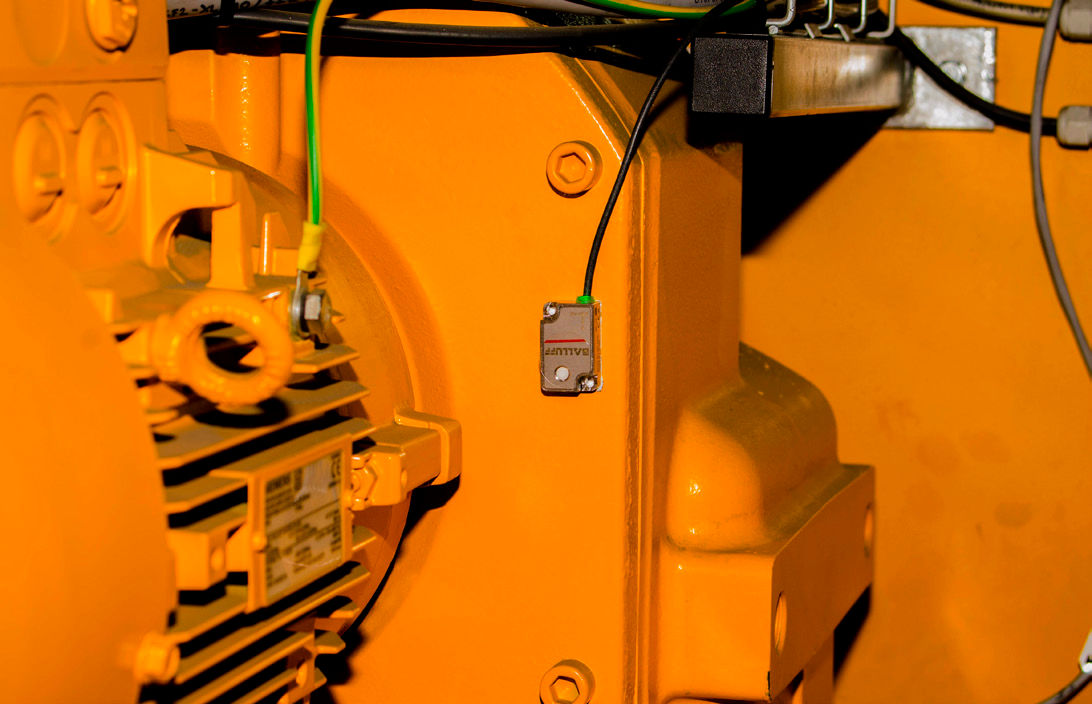
Gearbox with dedicated sensor for maintenance (Image: Balluff)
Then there’s the generative AI piece of the puzzle. A field technician can simply ask AI why a pump keeps tripping and receive an answer built on the machine’s own historic data. Instead of digging through records and work orders, the tech has the information immediately and the steps and parts needed for the job. Knauer sees a future where the knowledge that once lived with the 30-year maintenance worker can be captured via sensor data and made available to whomever is on the shop floor when a failure occurs.
The RAF’s lessons apply here, too. An AI system that flags every minor anomaly can recreate the over-maintenance problem Coastal Command uncovered during the war, sending crews to service equipment that was running fine and introducing new faults in the process. Much of AI’s value lies in helping teams decide where not to intervene, and that depends on the same foundations mentioned at the outset: clean, consistent data, a clear ranking of which assets are most critical, secure connections between the plant floor and the cloud, and maintenance staff who trust the recommendations enough to act on them.
Despite apprehension and doubt about the use of AI in manufacturing, Knauer said MRO is an area where AI can easily exceed the hype.
“Middle school, high school and college kids today will gladly accept any tool or resource that is going to make their day-to-day job easier, right? This is what they’ve grown up with. They have an extremely high comfort level with accepting AI-based prescriptive maintenance tools. It feels very much like it’s going to be a career enhancer rather than a career destroyer for the next generation of manufacturers and maintenance personnel.”
AI can sharpen a maintenance strategy, but it can’t replace one. The plants likely to see the biggest return are those that have already done the groundwork. Balluff walks customers through identifying critical assets, putting the right sensors in the right places and building a reliable data stream before asking an algorithm to make sense of it. The first step in this process is the most valuable for future success.
Knauer said the key is to start small and scale up. Take the time to perform a criticality analysis of all your equipment. What assets are most important for your operation today? You should address these challenges before continuing your condition monitoring and predictive maintenance journey. Knauer credits former Balluff employee Will Healy with a perfect quote on the subject:
“You can either plan the downtime on your machine by using a proactive maintenance approach or your machine is going to plan it for you.”