Two-Target Pareto Front Optimization simultaneously optimizes for multiple competing objectives, for example noise and durability. In reality, engineering decisions are always trade-offs - improving one metric often at the expense of another. Previously optimization targeted a single goal, and engineers had to iterate manually to explore trade-offs. With MASTA 16 engineers can generate a range of Pareto optimal solutions, not just one. They can visualize the full trade-off space and select the best design based on application needs. This suddenly helps engineers move from finding the best solution to a single challenge, to choosing the most suitable compromise for best overall performance.
System Deflection Surrogate Model
The System Deflection Surrogate Model within MASTA 16’s ML Optimizer uses machine learning to automatically replicate part of the system-level analysis within the context of micro geometry optimization, removing the need to run calculations every time. Previously, high-fidelity micro geometry optimization required re-running system level deflection analyses for every change in micro geometry. Not only were these analyses computationally expensive, they were a major driver of runtime. With the new system deflection surrogate model, MASTA 16 ML Micro Geometry Optimizer significantly reduces optimization time. In practice optimization loops can be 2–3x faster, with the greatest speed-ups expected in larger MASTA models.
More Accurate Data & High-Fidelity Analyses
As powertrain systems become lighter and faster, the margin for error in simulation continues to reduce. MASTA 16 enables engineers to model powertrain systems more realistically - capturing the effects that matter most and giving greater confidence in simulation-led design decisions. Even the smallest assumptions impact behavior, influence durability outcomes and are leading to discrepancies between simulation and test. MASTA 16 includes the highest levels of fidelity by improving how physical behavior is represented in simulations, reducing simplifying assumptions and enabling higher-fidelity modelling within practical workflows. The result is not just more detailed analysis in MASTA 16, but greater confidence in using simulations to make decisions earlier in development.
Flexible Gear Blank Advanced LTCA - High-Fidelity Gear Analysis
MASTA already includes a state-of-the-art Loaded Tooth Contact Analysis (LTCA) with advanced LTCA calculation as standard. However, with thin-rimmed or lightweight gears, tighter coupling between the tooth contact analysis and system model is necessary for the most accurate simulations. With MASTA 16, a single finite element (FE) model is used for both the gear blank and gear teeth, together with a Hertzian representation for local contact, removing these previous limitations. The result is higher accuracy for gear stresses and transmission error, which are key design targets for engineers. This will be particularly valuable for high-performance applications, lightweight designs and EV powertrains.
FE Centrifugal Effects
FE Centrifugal Effects allow deformation caused by high rotational speed to be directly accounted for within finite element-based analyses. In high-speed systems, components expand and deform under rotation, impacting alignment, load sharing and contact - this is particularly common for lightweight high-speed applications. Often creating a disconnect between modeled behavior and real operating conditions. MASTA 16 now includes more realistic representations of operating conditions for much improved predictions of misalignments, contact conditions and overall system response. FE Centrifugal Effects reduces the risk of unexpected behavior during testing and fewer redesign cycles.
Meshed Bearing Rings
Meshed Bearing Rings in MASTA 16 brings detailed bearing behavior into everyday workflows. Previously, bearing ring meshes had to be created externally and then reworked when geometry changed, making high fidelity modeling time consuming and not ideal for iterative design. FE meshes are now generated directly within the workflow and geometry changes can be handled without restarting the process. Meshes can be updated simply with design changes and bearing behavior is represented with much greater practical realism. MASTA 16 allows engineers to setup models faster, reduce manual effort and increase consistency between models.
Bearing Rings - Continuous Flexible Interpolation
MASTA 16 includes a more advanced method for representing bearing ring deformation, including non-uniform and out-of-round behavior. In practice real bearing behavior is not perfectly circular and influenced by system loads and deformation over time. Traditional methods only approximate this behavior at discrete points which does not allow for component rotations to be properly captured. With MASTA 16 engineers can see more accurate representation of deformation and load distribution, giving much improved modelling of large systems and flexible structures – essential for those applications where structural flexibility drives behavior.
Updated SKF & NSK Bearing Catalogs
As standard in each release of MASTA, MASTA 16 comes with direct access to the latest manufacturer data. Accurate simulations depend on accurate component data. These updated bearings catalogs ensure continued alignment with real-world products and the reduced need for manual data input. Having access to the latest manufacturing data from within MASTA allows engineers to enjoy faster model creation, greater confidence in results and removes the risk of relying on outdated assumptions. While less visible than some of the enhancements in MASTA 16, this underpins accuracy across all analyses.
Expanding Electric Machine Capabilities
The challenge is no longer just modelling electric machines, it’s integrating them effectively into the wider system and enabling engineers to work faster, with greater confidence. MASTA 16 adds capability to explore the design space for electric machines, improves realism in simulation, and expands the range of machines and scenarios that engineers can now model, enabling engineers to move faster and make better decisions earlier in development.
Parametric Study Tool (PST) for Electric Machines
The Parametric Study Tool (PST) for Electric Machines in MASTA 16 allows engineers to run design studies directly on electric machines from within MASTA, varying inputs and assessing their impact on performance. Previously, engineers often relied on custom scripting to run parameter studies, adding complexity and often requiring additional expertise. With MASTA 16 results are automatically visualized with charts and outputs and engineers can quickly explore how changes in geometry, materials and operating conditions affect torque, efficiency and performance. They can iterate designs without writing code and make faster, more informed decisions. PST for electric machines removes the friction in the workflow and makes advanced studies accessible to more users.
Surface Permanent Magnet (SPM) Machine Modeling
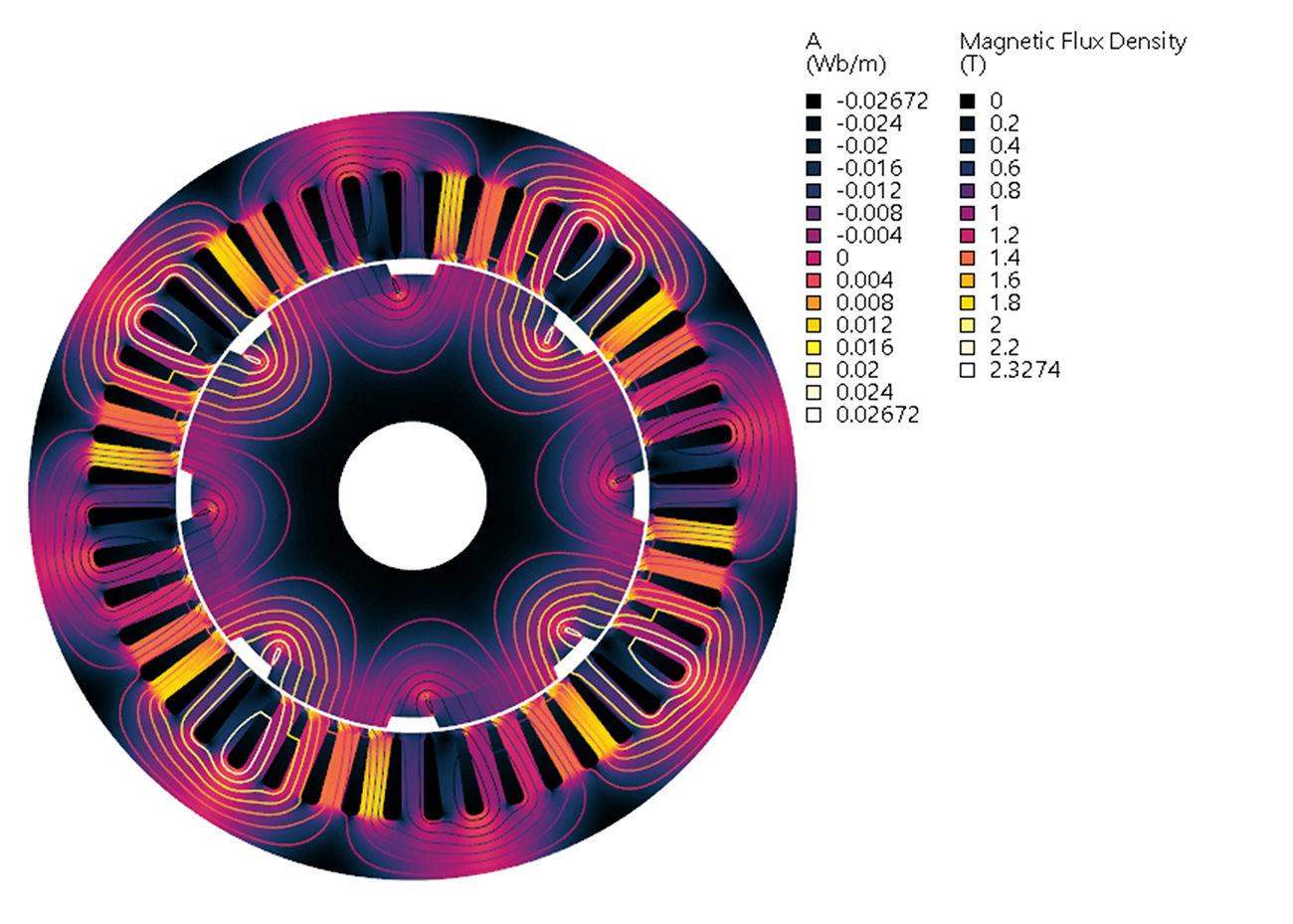
MASTA 16 now supports surface permanent magnet machine topologies where magnets are mounted on the rotor surface (pictured above). This expands the range of electric machines that can be analyzed in MASTA, supports applications beyond traditional automotive, including high-speed systems, robotics and aerospace. Engineers can now model and analyze more machine types within a single environment and avoid switching between tools for different machine architectures. This is a key step toward broader electric machine capability within MASTA and long-term platform expansion.
Demagnetization Analysis
Demagnetization Analysis allows engineers to quickly evaluate whether an electric machine design is at risk of losing magnetic strength under real operating conditions. In reality high temperatures or currents can weaken magnets over time, leading to reduced torque and underperformance. This risk is often not easily assessed. In MASTA 16 engineers can test operating points to ensure designs remain valid, avoiding designs that fail to meet performance targets in operation and avoiding costly redesigns when systems underperform. This shifts validation to much earlier in the design process, reducing downstream risk and improving confidence that a design will deliver expected torque.
General Current Input (Real-World Excitation)
MASTA 16 allows real measured/simulated current waveforms as well as idealized sine waves to drive electric machine simulations. We all know that in practice electric machines are not driven by perfect signals - real currents include distortion and ripples from inverter behavior. In MASTA 16 engineers can input real-world test data and create a more accurate representation of actual operating conditions. This gives a much better prediction of real-world performance, as well as noise and vibration characteristics when coupled with MASTA’s harmonic analysis.
smartmt.com








 Power Transmission Engineering is THE magazine of mechanical components. PTE is written for engineers and maintenance pros who specify, purchase and use gears, gear drives, bearings, motors, couplings, clutches, lubrication, seals and all other types of mechanical power transmission and motion control components.